Drill Organizer

The organization bonanza continues. My workbench has been the collector of all things used, but without a proper place to call home. In my last shop I had a place to store my dewalt drills in a hanging organizer above the toolbox. Bits were stored in a little shelf setup nearby. Neither of those made it through the move.

My previous drill hanger was a piece of plywood with some rough cutouts that hung, via zip ties, from wire shelving. It worked pretty well, so I will make a nicer version of that. I measured the drills and tried to make a careful slot for each.

The hammer drill (far right) was a little wider in spots than I thought, so it took a little freehand work to get right. The rest fit beautifully the first time. Everything got a chamfer inlet and a router roundover top and bottom. The back edge is cut at a 5 degree angle to tilt the whole board upward. It makes them want to slide to the front of the slot a little. No vibration or jostling will cause them to fall.

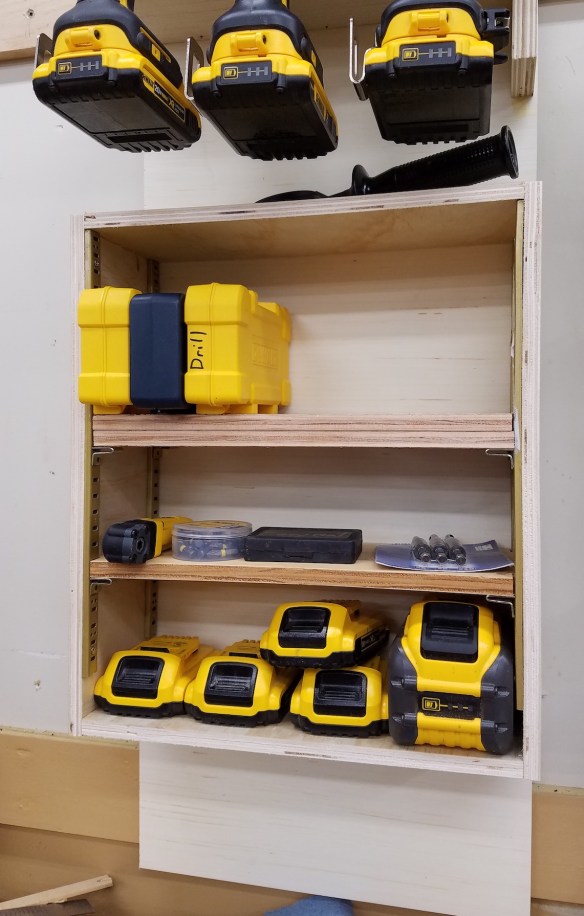
Everything hangs from the french cleat system I already had going. The drill holder was supported with some blocks underneath cut to the similar 5 degree upward angle. Underneath it all I put a box with pilaster rails. They accept shelf clips and are really easy to work with. I have used them in other shop applications like my hardware rack. 1/2 plywood serves as shelves for batteries, and drill accessories.

Instead of routing a groove for the pilaster rails I left them proud. This was easier to manage in the 1/2 plywood sides, and it meant cutting a notch in the shelves would lock them into place, front to back, between the pilaster rails. Everything fits with room to spare and adjustability to accommodate.

Dust Collector Upgrade

I picked up my current harbor freight dust collector probably some time in 2010. For the price it is an awesome deal, but after these years it is time for an upgrade. The motor (lower left in left picture) pulls in dust and blows it into the upright section. Everything swirls around so big dust falls to the clear bag while finer dust gets filtered in the white upper section.

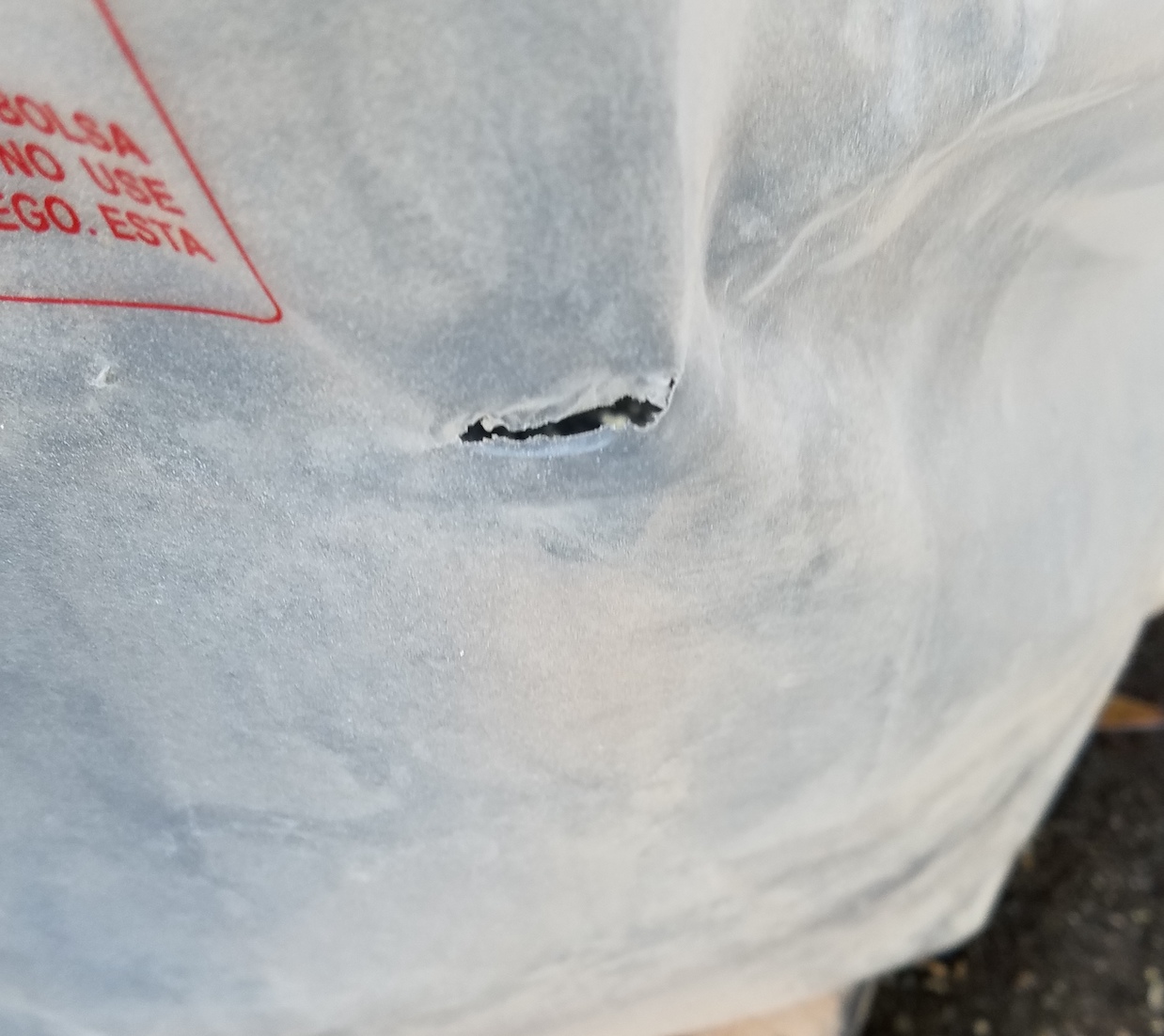
It is an ok principle, but has issues. The upper bag filters down to 5 micron, but no further. A very fine dust will land on everything in the shop when using this for a while. Those finer particles are bad for your lungs. The bag is a pain in the butt to replace and often gets rips in it from sucked up chunks of wood.

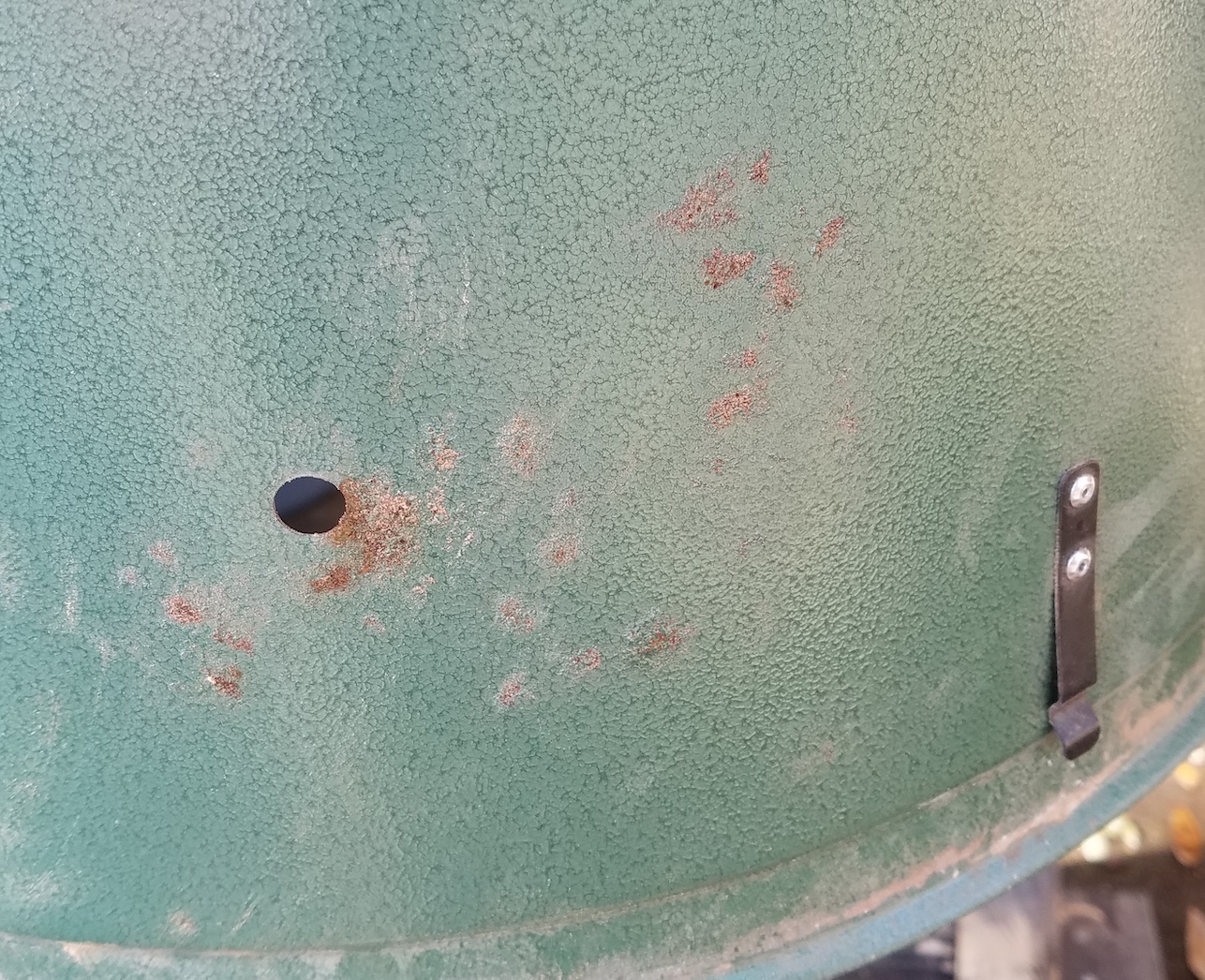
I spent about $350 on this upgrade. Over half of that was the filter. Considering a new harbor freight dust collector can be had for about $180, that is ludicrous. A new tool with good filtering and easier disposal is in the $1,500 neighborhood. We have had a ton of house expenses, so maybe a diy upgrade isn’t so ludicrous after all. I want to keep my lungs clear, so let’s get started. With a dust mask on, I ground off some rust spots and repainted with whatever green I had lying around.

I had thought about doing a lesser version of this many years ago, but never got around to it. I spent a lot of time thinking about how to do one upgrade and make it count. I will show where we are going, then explain the journey in steps.

The motor has been turned sideways from where it originally was. Below it is a pre-separator (red). It pulls out most of the junk before it gets to the filter area. As everything swirls in the upright the leftovers fall into my new bag replacement (blue), and finally out through a new hepa filter (green). Everything gets attached to a mobile base. Let’s start there.


Dropping Some Base

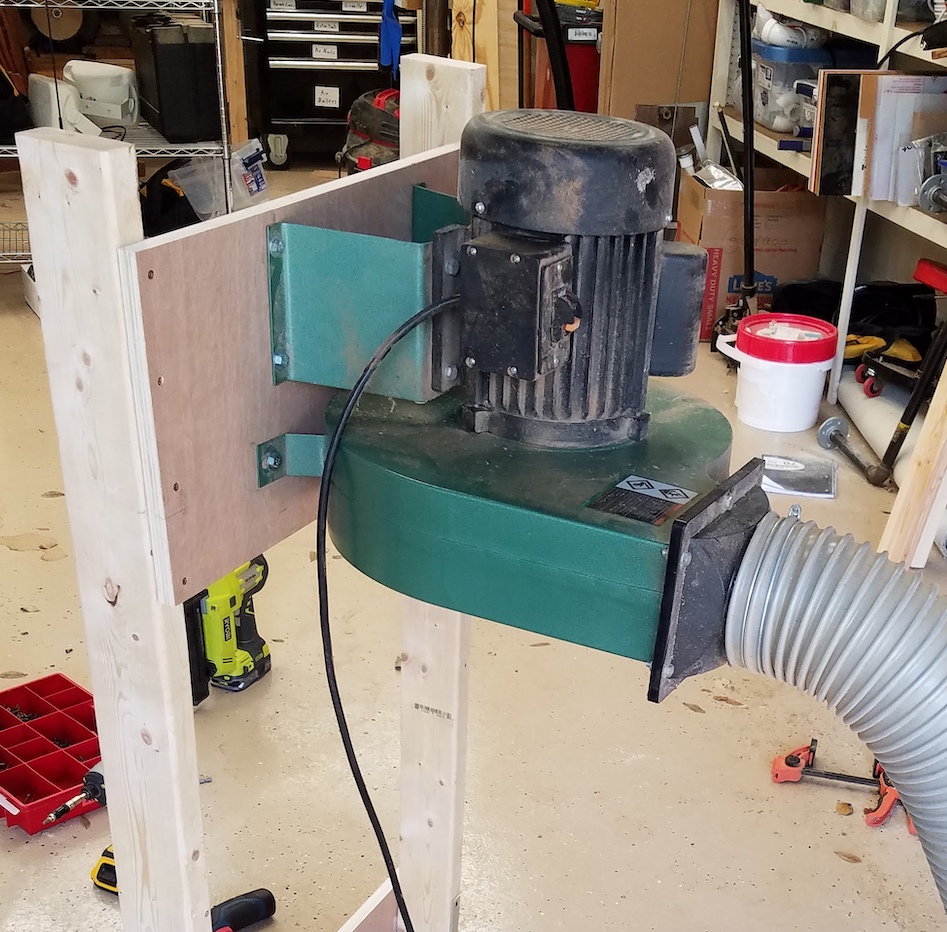
I was going to need more space for the pre-separator and wanted nicer casters than the original assembly, so I started with a cut bit of 3/4″ plywood. A set of 2×4 uprights with plywood and angle brackets support the motor in its new configuration.

The motor is really heavy and caused the base to flex a lot. I added a rib along the right side and eventually a 2×4 underneath to further stiffen the bottom. With that I had a good mobile base for my new dust collector.

I reused the circulator and upright rods to attach that section to the base.


Pre-Separator

Before hitting the motor or clogging up the filter most dust will be caught in the pre-separator. The design is called a Thien Baffle. The exact dimensions seem to be debated, so I just made it up as I went along. Basically everything comes in through a right angle port so it swirls around and gets flung to the edges. Gravity takes over for the particles and the air goes up through the center.

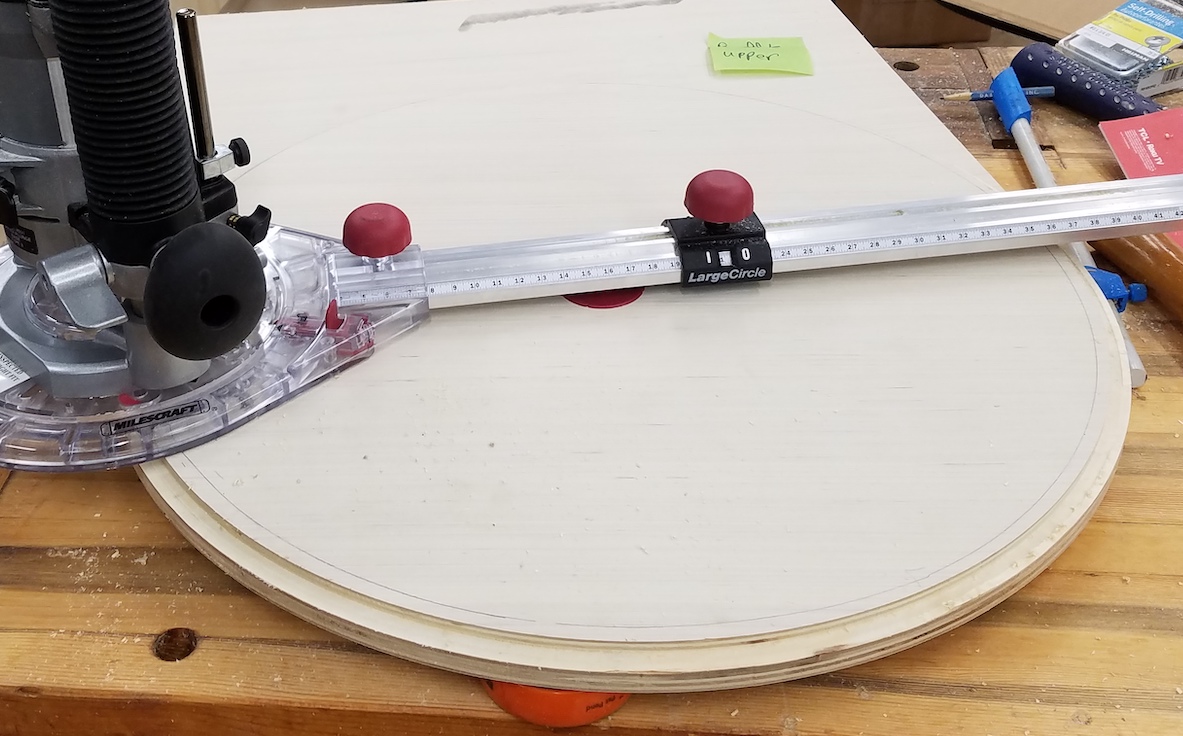
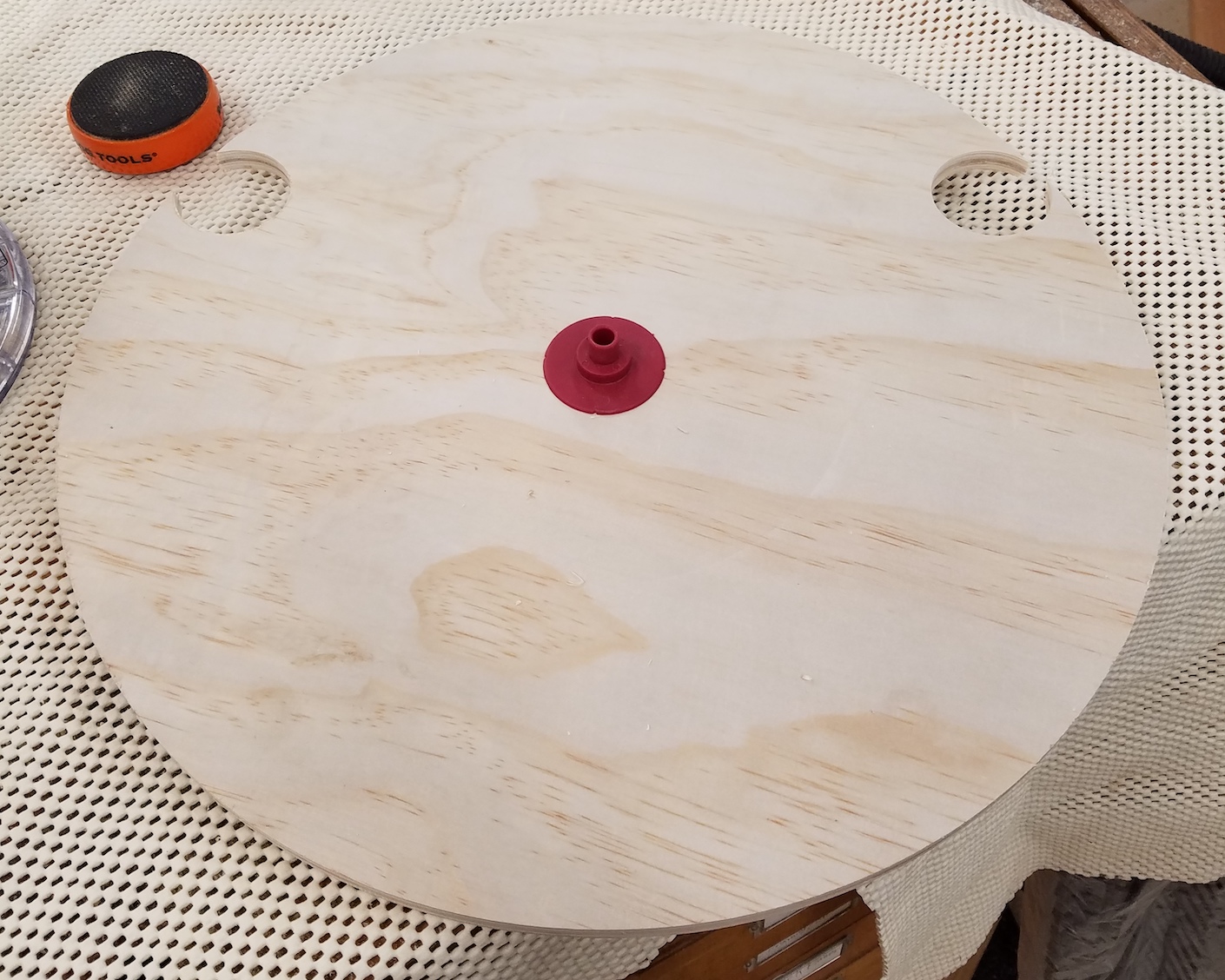
My circle cutting jig came back in full force with a lot of inside and outside cuts. I love this thing! I cut out a top for the separator and added a groove for the weather seal that would go up against the trash can top (left). Next I cut the baffle that keeps dust in the bin from getting pulled back up (right).

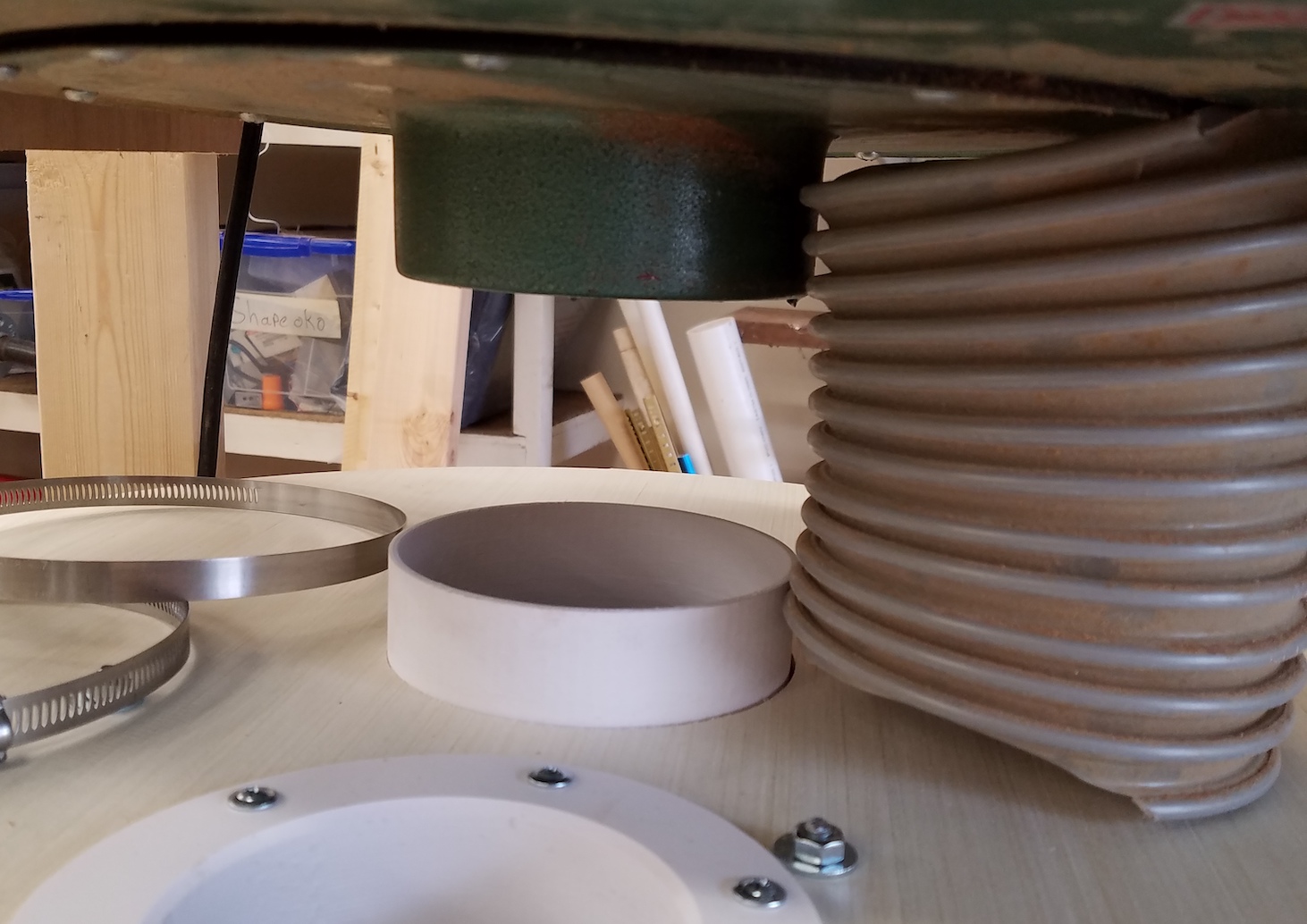
I clamped the two together and match drilled the 1/4″ threaded rods that hold the two sections together. I used the circle jig to drill out the 4″ inlet and 5″ exhaust ports. The inlet port is sized to allow a 4″ right angle dust fitting to slip into the top. The bottom goes onto a 4″ tight PVC drain elbow. I custom printed this to work with the parts I had around. I used silicone calking to seal it and screws to hold it in place. The center is larger and will accept 5″ hose to go between the separator and motor. Same method of silicone calking and screws to seal and hold.

I bolted the bottom baffle on and fitted it all to the metal trash can. This section is before the motor, so it will be under vacuum. I think the metal can will do better than a plastic one in preventing collapse.

I added weather stripping to the lid where it interacts with the trash can overlapping the interface to help form a better seal. With everything underneath I just needed a short segment of 5″ hose to attach the two.

Here is the pre-separator fully assembled and in place.


Bag Replacement

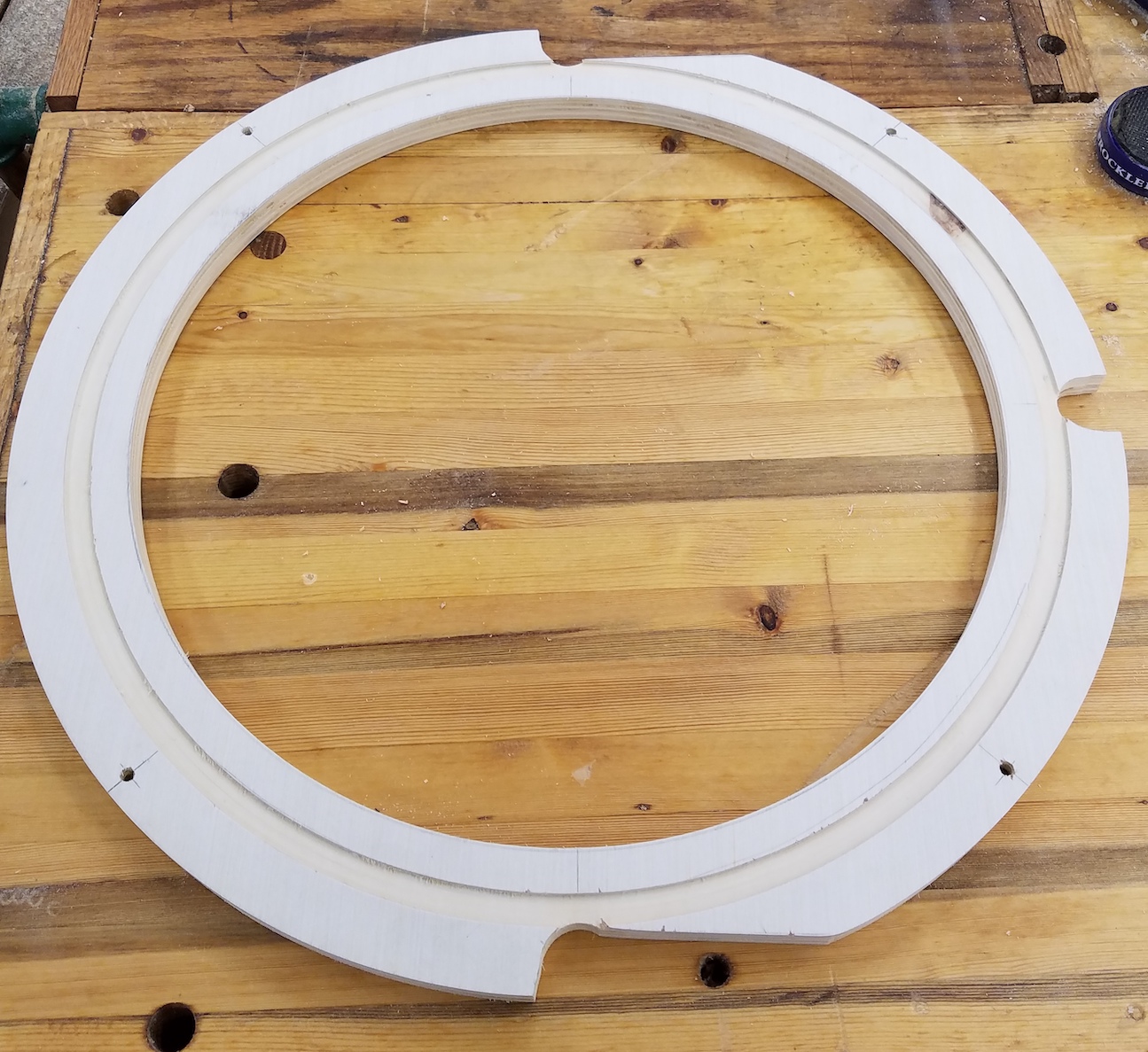
Ideally, most of the dust is already out by the time it passes the motor. Some will still exist and it will need a place to go. Instead of a thin plastic bag that rips and is difficult to install, I wanted another rigid bin. A 20 gallon rubbermade can was just about the right size. I temporary attached two pieces of 3/4″ plywood and match cut the interior and exterior diameters, the cutouts for clearing the metal upright bars, and holes for screwing the two halves together.

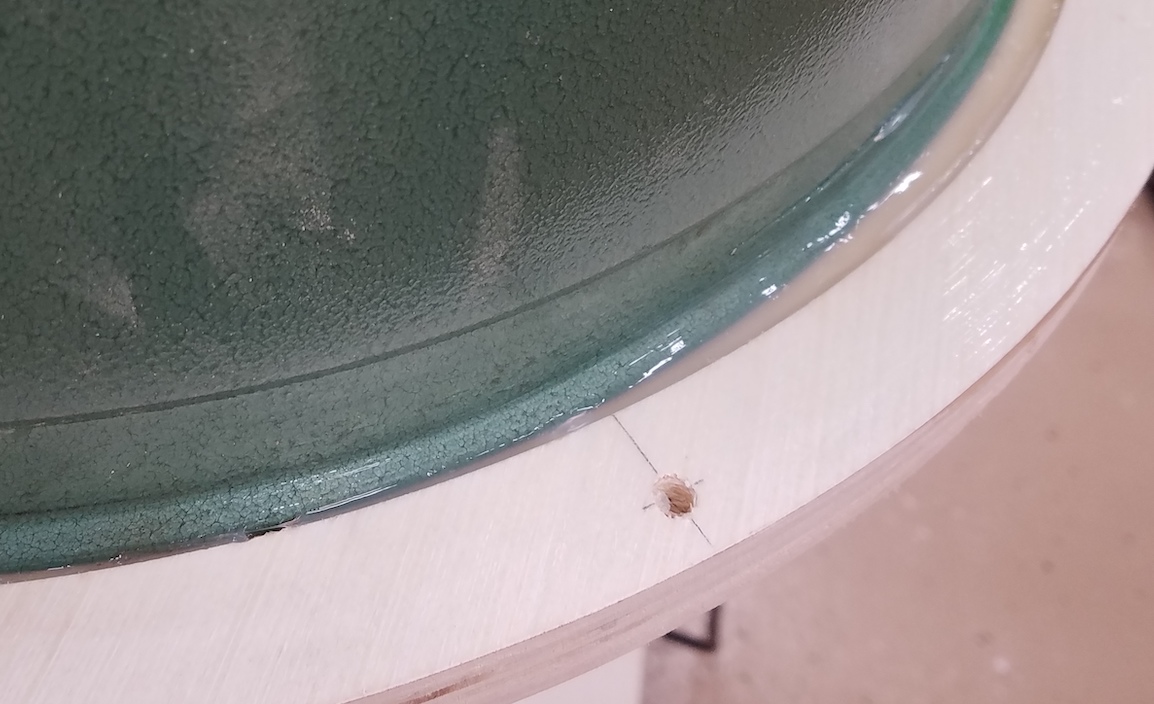
The upper section had a groove in it to lay a generous bead of silicone calking to help it seal with the metal ring of the circulator. It turns out that ring isn’t very circular, so the gap in that groove varies wildly.

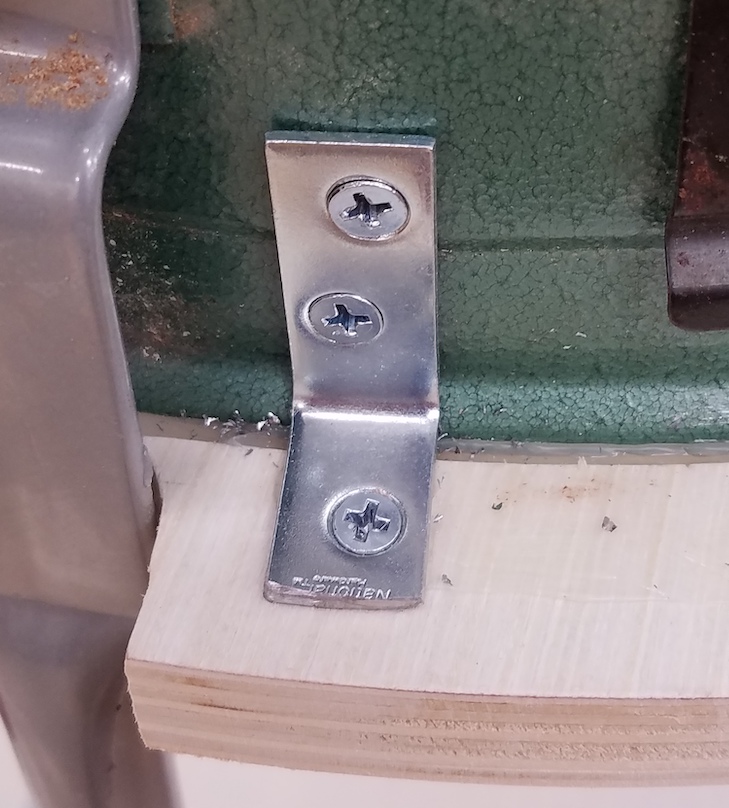
I didn’t trust the calking alone, so I cut down some right angle brackets and drilled/screwed them into place to help support this mating ring.

The bottom half of the mating ring will attach to the 20 gallon trash can. I installed 1/4-20 T-nuts so a bolt can come in from the top to draw the can up and seal it. I put another thick bead of silicon calking on the ring and screwed the can down through the lip. The combo of screws and silicon made for another slid connection.

It is pretty important that you don’t let this section get too full. Otherwise the circulation of dust might get up to the filter and damage it. I cut a thin section of clear plastic and added a viewing port to the can.


Last but not least is the filter. Made in America from Wynn Environmental, the filter is a majority of the cost of the project. The new filter gets down to 0.3 micron instead of 5 micron. That doesn’t hamper flow though, instead of the 30-something square feet of filter the bag had, this one has over 200. The kit comes with little cleats that look like modified hose clamps to strap everything down from the inside.

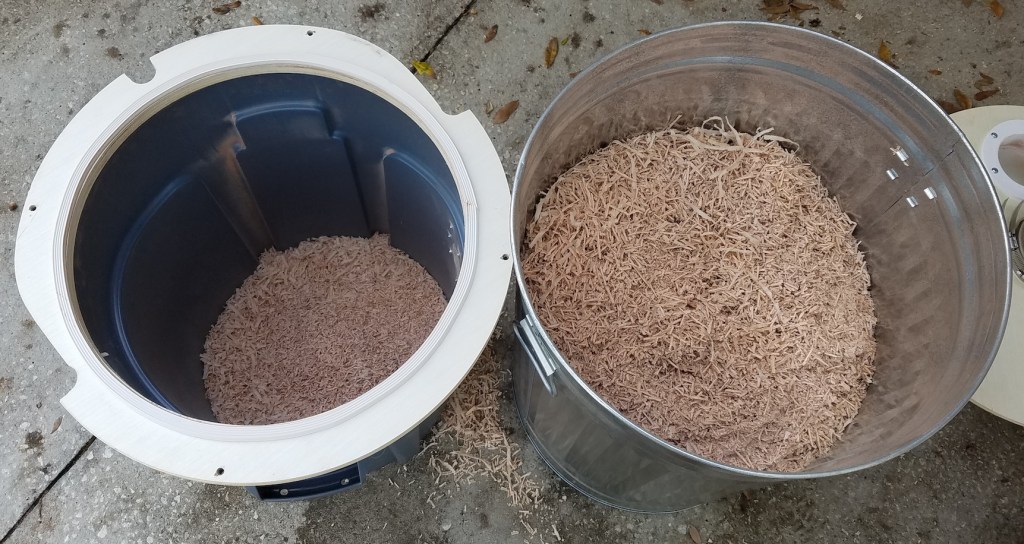
To test out my new vacuum rig I had 20 board feet of 4/4 maple to plane. I got through all the boards and looked into the grey plastic bin. I was horrified to see a pile of shavings in it. I thought the pre-separator had failed to… well separate.

Turns out the pre-separator was past full and the shavings had gotten up past the baffle into the final stage. Good thing emptying both sections is easy and only takes a minute. The newly revamped dust collection rig works well and the pleated filter on top makes it breathe even better than before the pre-separator was added. Very happy with this upgrade.

Vacuum Cart

I am trying to make a commitment to do better dust collection in the new shop. I want to prevent the thick layer of sawdust the was on everything in my last shop, and I want to keep my lungs healthy for another half century or so. I have a few projects coming up that are aimed at those goals. The first being a shop vacuum cart.

I have used a small shop vac for specific applications, but never had a general one to use at different places around the shop. My portable sanders, router, miter saw, and other dust generating tools often went un-vacuumed.

I picked out a decent sized vacuum that had good specs but wasn’t the highest end you could get. It seems like for another 100 bucks you got a few features and a marginal increase in performance. The next level above that would go to the pro-sumer version at 5x the price. Not gonna happen on my current budget. I took some of the old counter top material left over from the previous owner and routed a nice radius on the front.

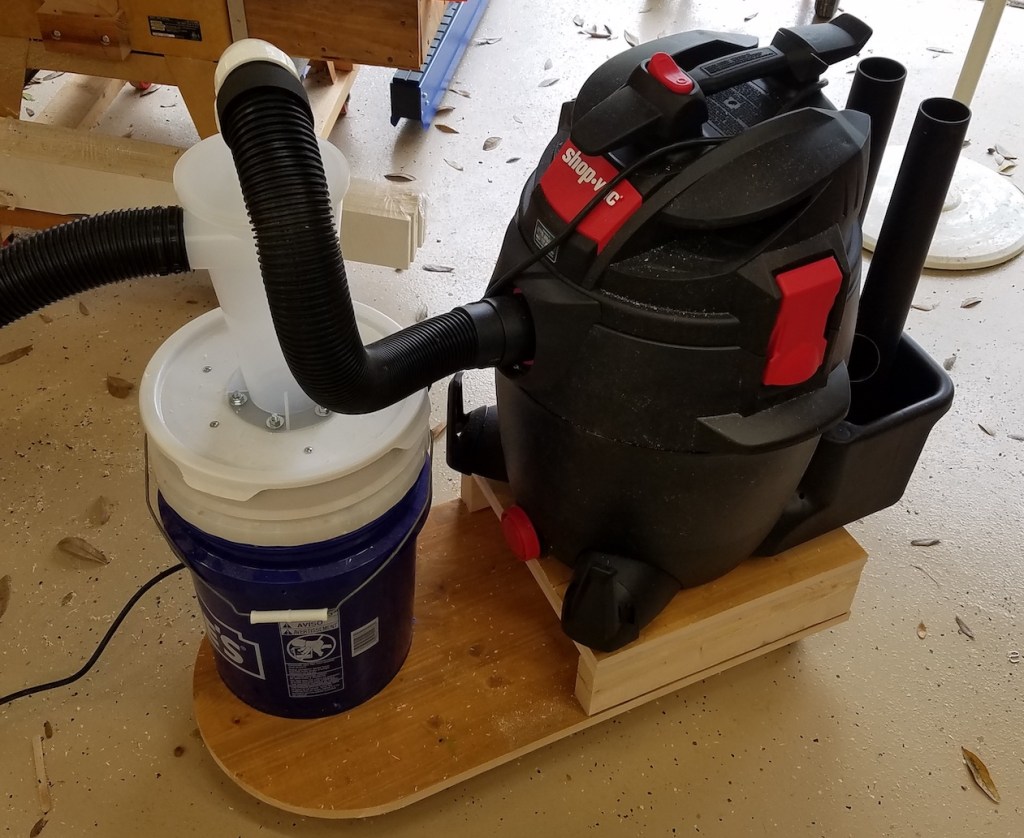
I picked up the milescraft circle cutting jig for an upcoming project, but decided to give it a test run here. What a great jig! Well worth 40 bucks. There is going to be a 5 gallon bucket pre-separator before the main vacuum. I screwed a bucket to the base to hold the separator bucket and built up a platform to get the shop vac higher.

I did a lot of positioning and found that moving the bucket to the right side and rotating the vacuum to the left let the inlet hose clear more easily. I screwed the shop vac down through the base into the platform. Hopefully these screws don’t rip out. If they do I will lose a lot of vacuum pressure.

I got a dust deputy brand cyclone separator. It is supposed to spin the dust out to remove most of it before it gets to your filter. The hose port situation is a little awkward. The port up top goes to the shop vac. Even with elevating the vacuum it is an odd stretch. The hose wants to kink in on itself.

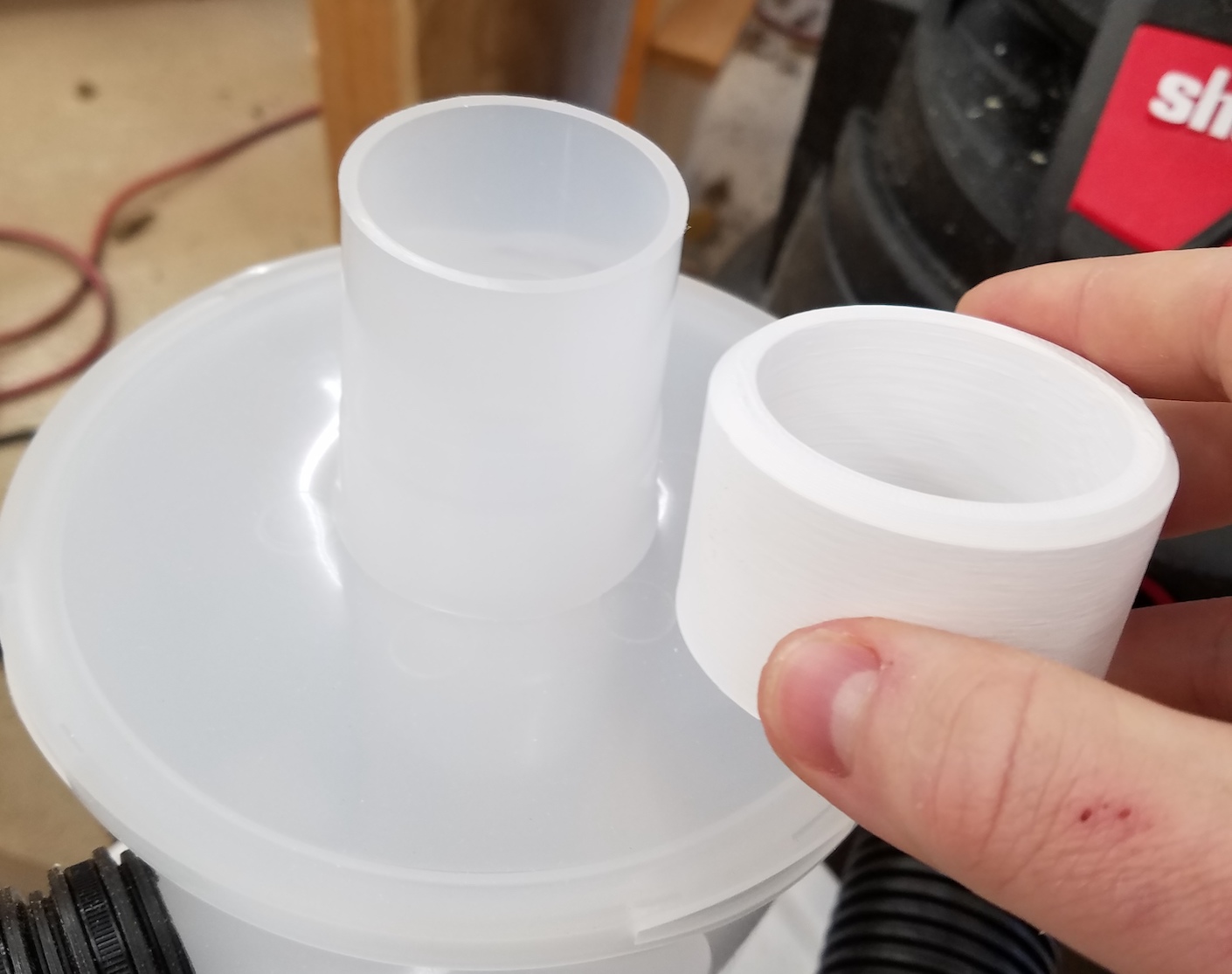
I took kind of a step back and had a think. This calls for some 3D printing. The top of the dust deputy has a tapered shape to it. I printed a matching ring that fits into a 2″ PVC elbow. The printed part got epoxied into the elbow and fits on the top of the dust deputy. The friction fit holds it well and makes a good seal, but lets it be removable.

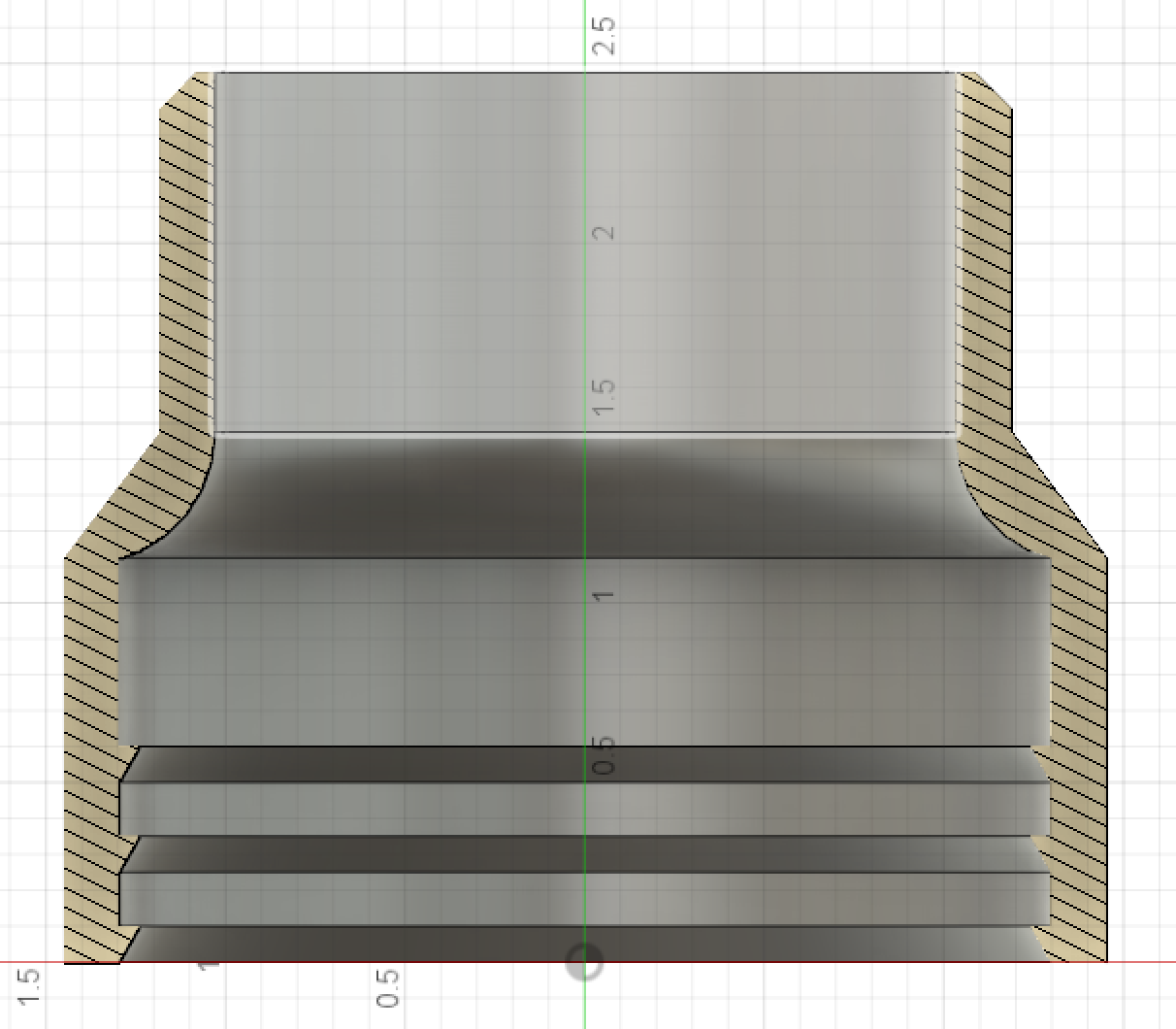
With the elbow taken care of I created another fitting to push onto the end of the corrugated vacuum hose. This one works a bit like the fitting that comes with the vacuum. It slips over the outside and locks into the ridges. They are a 1/4″ pitch. I made a fitting with ramped one way rings inside. It pushes on easily, but is tough to remove. That should form a decent seal as well.

I might bond this part in eventually, but for now, the hose can be removed, and so can the elbow. It makes taking the bucket lid off and dumping the dust easier.

All assembled, I wanted to perform a test. I dumped out the main vacuum body and the removable bucket. I then went around and vacuumed a section of the shop floor around my miter saw and where I had been working on this project. I came up with a few cups of dust, a bunch of leaves and some chunks of stuff. The vacuum chamber was basically empty.

This is great news. Now I can easily empty the smaller bucket instead of the big vacuum. Instead of running a standard pleated filter I can use a bag. The bags get disposed of, but have a finer filtration level. With 99% of the junk getting caught in the vortex, the bags will last a long time. Plus, anything that might puncture a bag will get filtered out.

I have been using this a lot with my router for a really big dust job and everything has been working wonderfully. If you are thinking about adding a dust deputy to your shop vac, do it!

Table Saw Bearing Replacement

A few months back I noticed my table saw was sounding a little ill. It was louder than usual. It had trouble getting through boards that normally didn’t give it pause, and the blade would come to a stop a short few seconds after turning off the power. I had a bearing problem somewhere.

I pulled the belt off between the motor and the shaft that runs the blade (called the arbor shaft). Turning the motor on, it spins freely and takes a while to slow down. Trying to turn the arbor shaft by hand is quite difficult. Well that was a fairly easy diagnosis. Now how to fix it. Matthew Cremona made a short video demonstrating his journey of replacing the bearings in this saw. (Ridgid R5411 Table Saw purchased in September 2009) He does a good job of showing what everything looks like, but some of the technique could be improved.

Step one is to remove the table top. Remove the blade and lower the arbor all the way down (sad story about that later). There are 4 bolts around the perimeter that hold the granite beast down. Remove them and walk the table top off onto a surface of similar height. This will expose the arbor shaft. There are two big bearings (6004zz) located here (under each red arrow), one of them is likely the culprit.

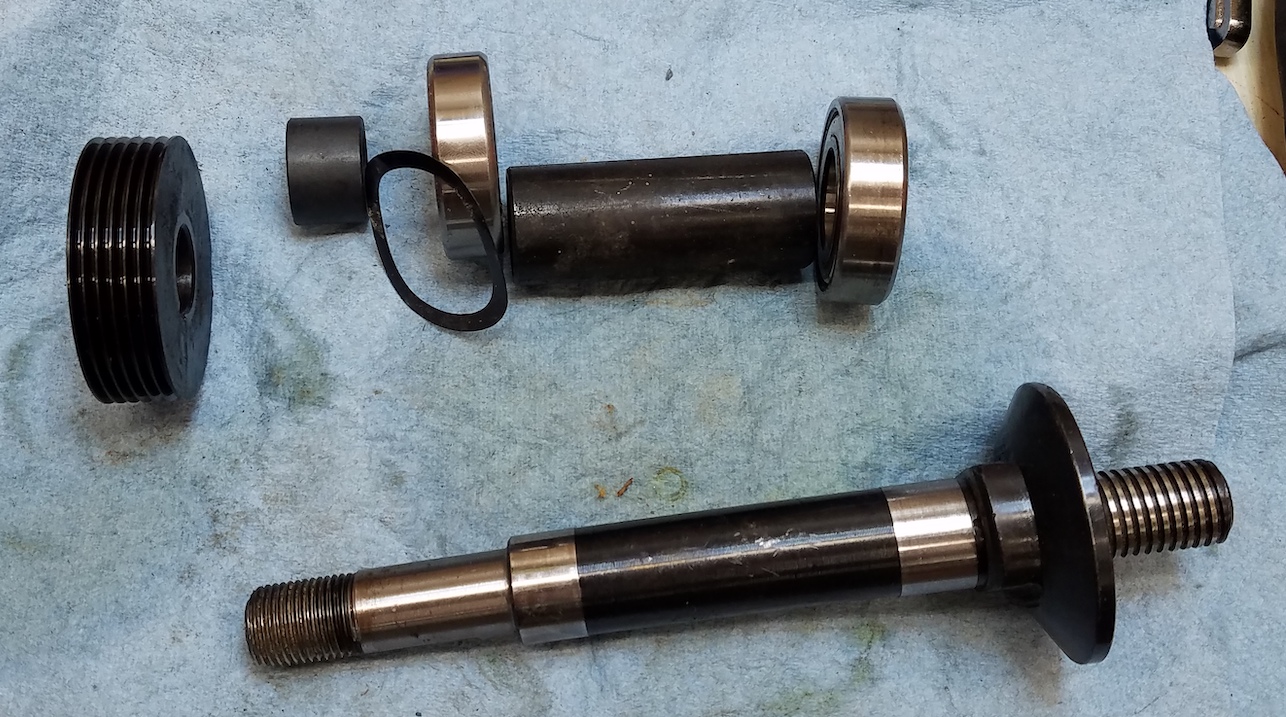
Now that everything is open I would suggest some lubrication. PB blaster is pretty well rated and available at a lot of auto parts stores. Spray everything that will need to slide and come back in a day or two. That stuff can creep into places for days. Raise the arbor back to the top, remove the pulley and use a block to push out the shaft like Matthew shows. I used a really big dowel to hammer out the bearing that gets left over (left side in above picture). What I ended up with was this below.

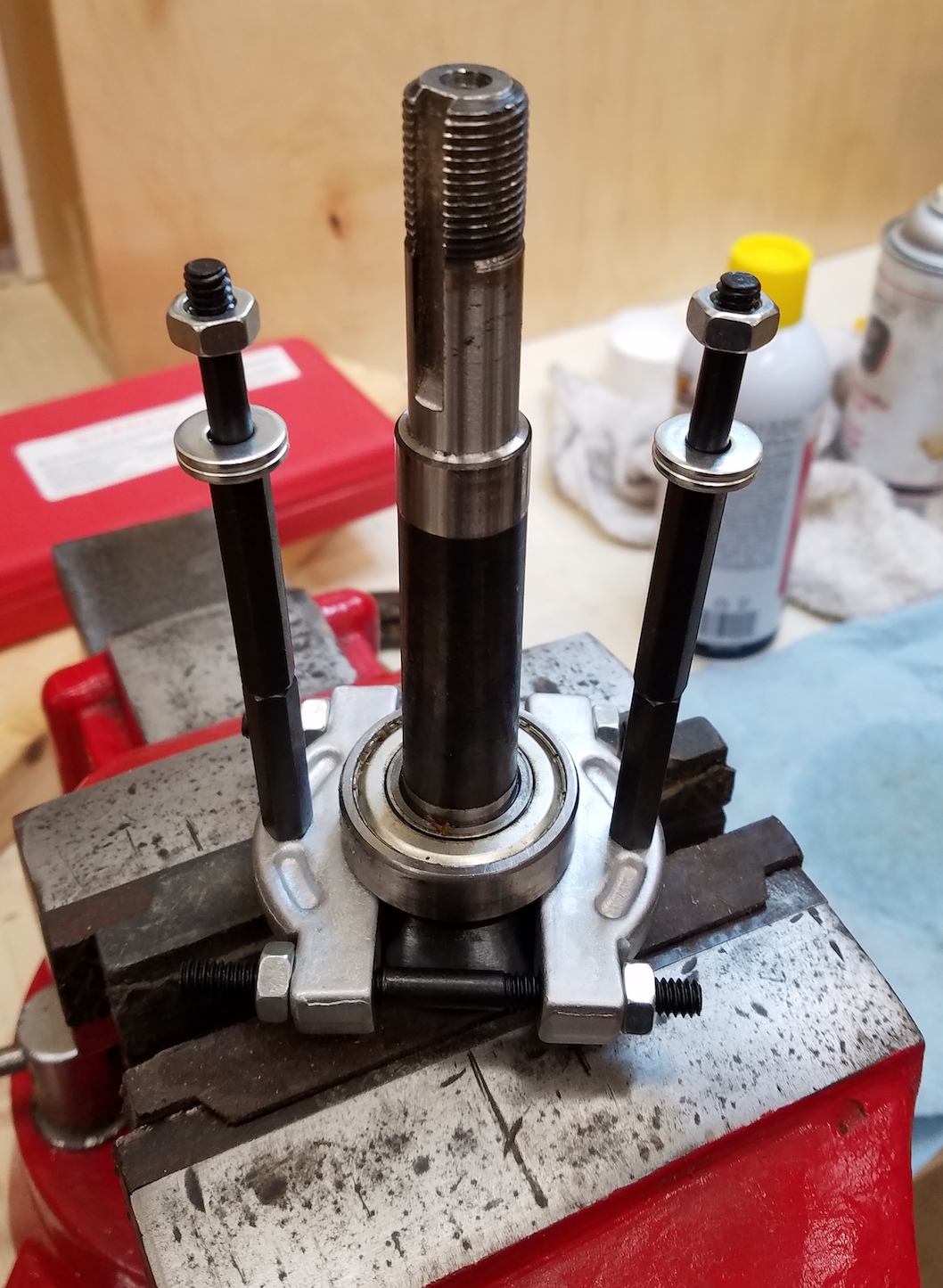
That right most bearing is tricky. It has to slide off of its resting surface, and the one for the left most bearing. Lube helps a lot, and so does the right tool. I picked up a cheap bearing splitter kit and am glad I did. There isn’t much room between the bearing and that flange that goes against the blade. The splitter wedged itself between the two and started the bearing moving towards freedom.

The big red vise from a few weeks ago is going to come in handy now! Next I installed the rest of the hardware to start pulling up on the bearing. The extensions were not long enough. Thankfully they were 1/4″-20 threads. I cut up some threaded rod I had around and got to work.

With two adequate threaded rods installed a double fork thing hooks in and has its own threaded center to push on the shaft. A socket wrench helps provide some umph.

Careful application of force was all it took to take everything completely apart. Here is what it looks like with all the bits fully disassembled. The right most bearing was very much seized.

I broke out my new bearings (6004zz) and was a little disgusted. They had surface rust on the outside races. Both sets were individually sealed, but still had rust.

They were all I had and a little fine scotch bright pad took it right off. I used light sanding to make a lead in chamfer on all the bearing surfaces to help with initial seating. I hammered the right bearing back into place using a piece of 3/4″ PVC pipe. Most 3/4″ pipes should do, always apply load to the race you are seating. Inner in this case. The left bearing went back in with a parallel clamp just like in Matt’s video.

Everything was going well until I paid closer attention to the pulley. I had a section that was really dinged up. I had the blade off, but the arbor was near the top when I walked the granite top off. The top sat and slid around on this pulley with its delicate grooves. OOPS! I still can’t quite figure out what this is exactly called, or where to get a replacement. Careful use of needle files and a dremel got the rolled edges out of the way. I have used it a while and so far, no shredded belts.

With the drive system back together I dropped the arbor, waked the top back on and proceeded to re-align the saw. The miter slots should be square with the side of the blade. The only method of “fine” tuning available is to loosen the screws, bang it with a mallet and check again. Tedious, but I got there eventually.

I attached my dial indicator to a sled to make it all go faster. Once aligned I was back in business. Good thing too, I have done a lot of plywood cutting since this repair and have more to do.

In summary, the video linked at the beginning is a good general guide. Additionally, get a basic bearing splitter set to help ease things along. Use good penetrating oil to help in removal. Clean up everything and apply oil for re-assembly.

Corner Chamfer Router Template

I have gotten some good use out of my router radius templates. I saw an interchangeable jig system that did a similar job and included chamfers in addition to the radii. First a reminder of how they work. You sit the template on top of the wood and use a special router bit that is a cutter with a matched diameter bearing on top. The bearing follows the template and removes any wood that protrudes beyond it. Ideally you cut off as much waste as you can on the bandsaw or elsewhere. Routers don’t remove a lot of material well.

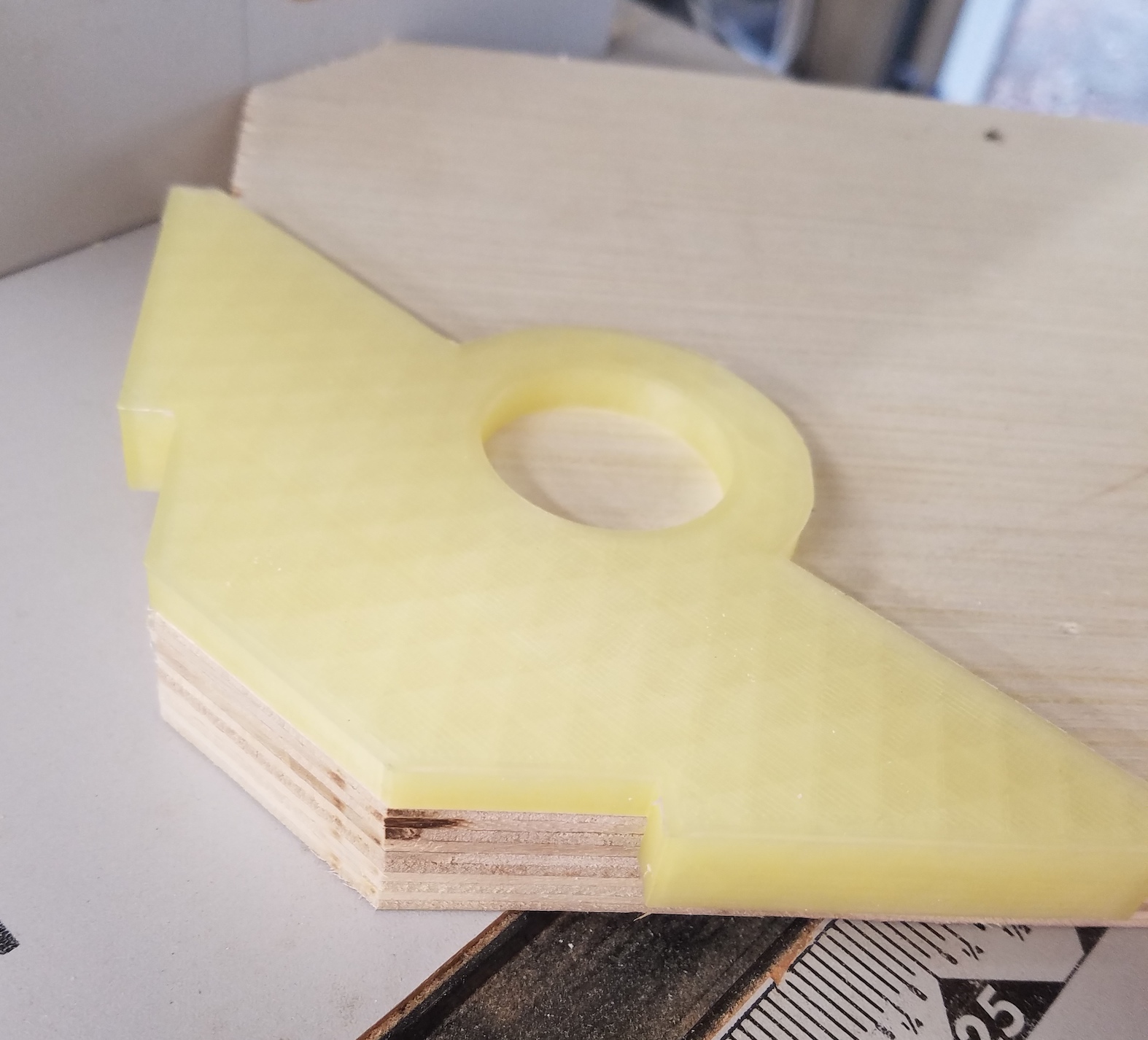
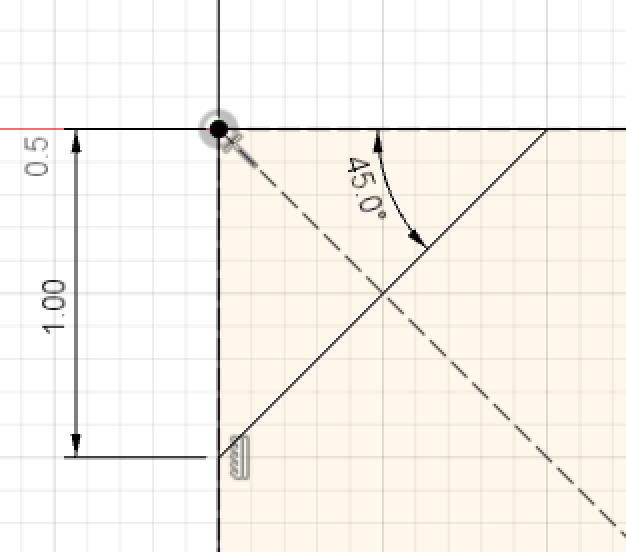
I modeled a variety of them from 0.5″ to 1.25″. The length given is a leg of the isosceles triangle that will get removed, not the hypotenuse. See the diagram below.

I printed a stack of them in case the need arises, and uploaded the design to thingiverse. If they look odd compared to my normal prints, it is because I used some cheap translucent filament I had lying around. I figure they will get torn up eventually, so no need to use the good stuff.

Heavy Work Bench

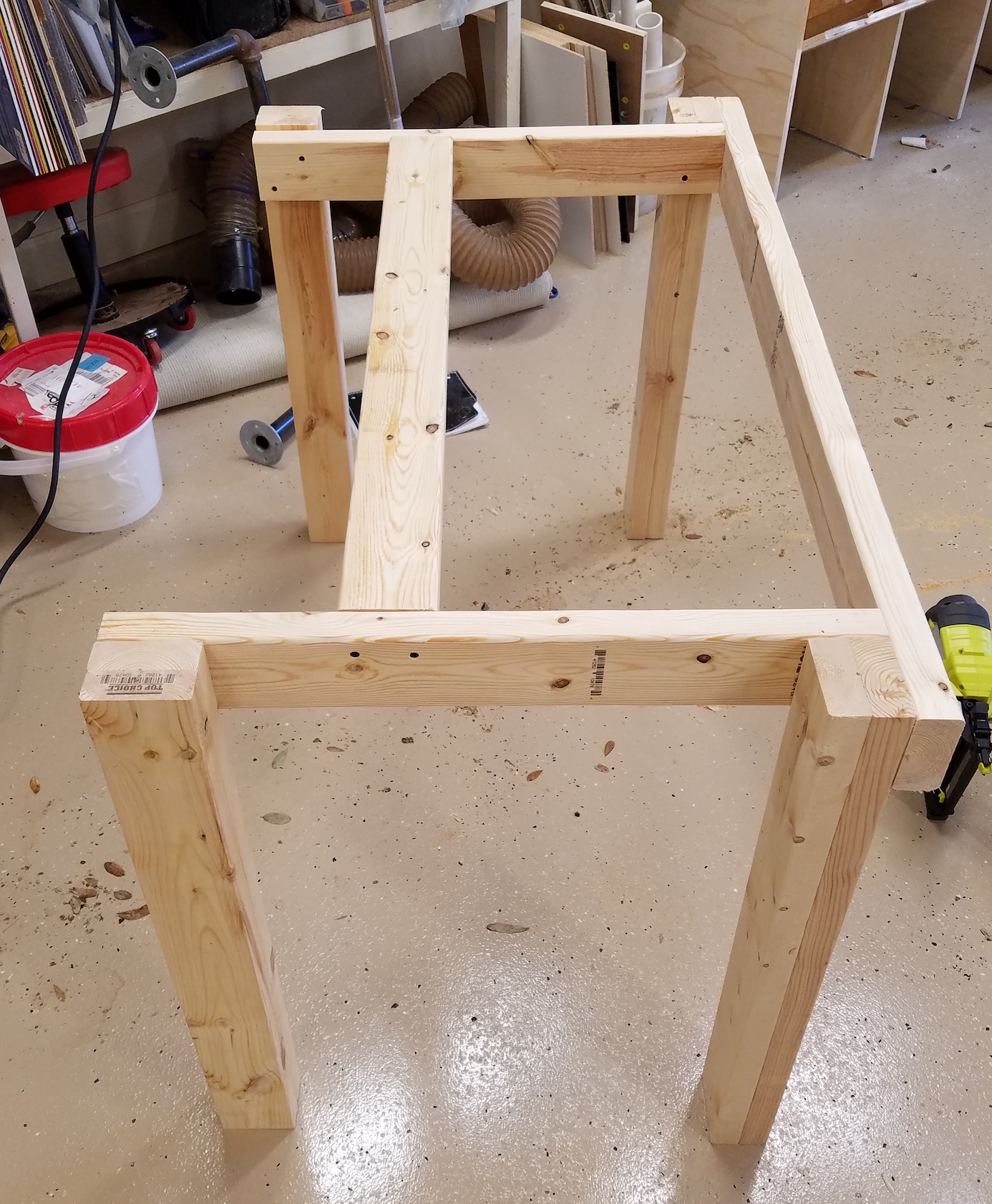
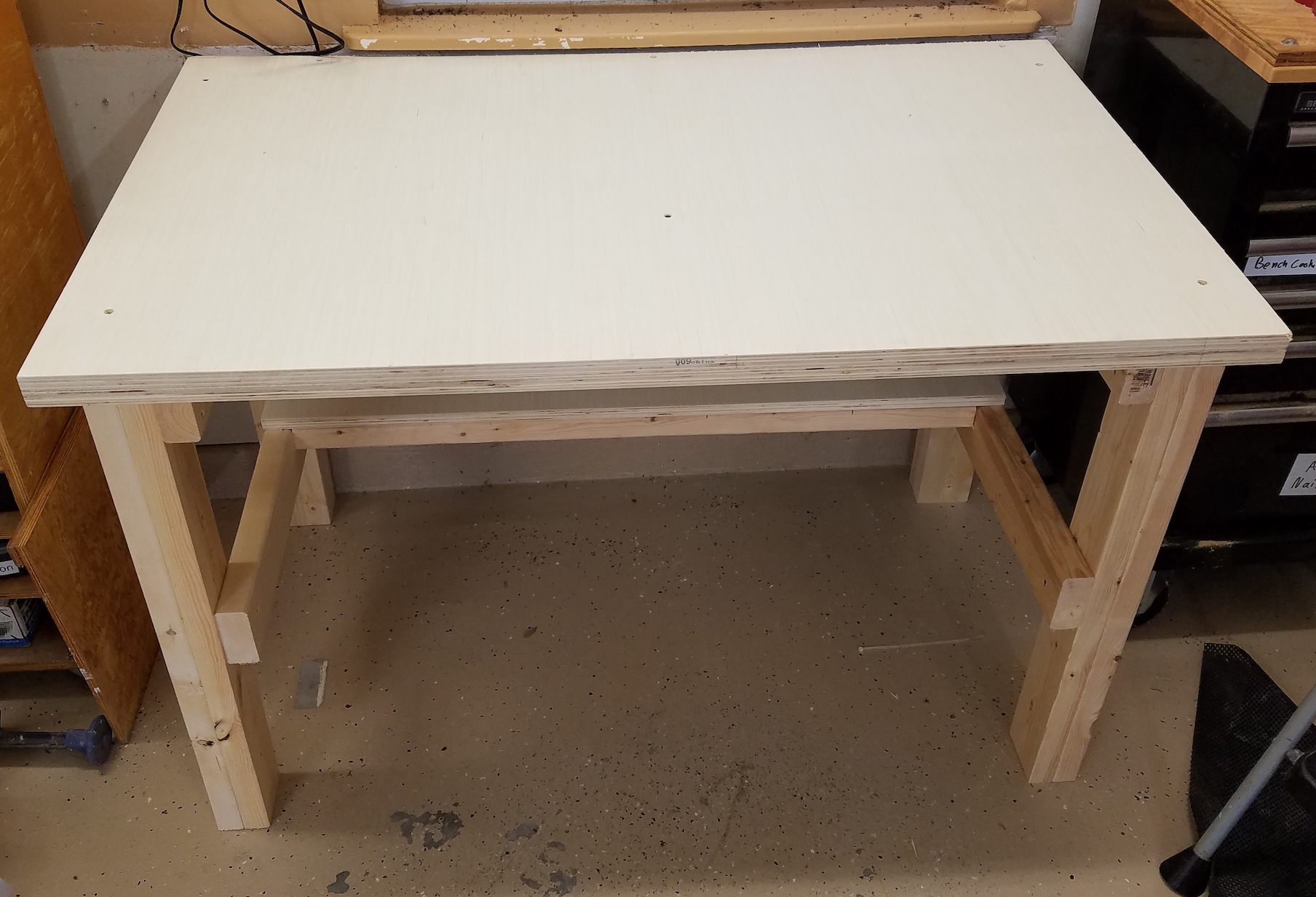
Shop work is still mostly getting usurped by home improvement projects. In moving stuff around the shop it occurred to me that there was some space for a work bench. I want something very sturdy to attach bench tools to (vise, bench grinder, anvil, etc), but also a place I could sit and do repairs. I worked out a design that requires most of a sheet of 3/4″ plywood and a hand full of 2x4s. I started by planing 2x4s square and gluing them together for extra thick legs.

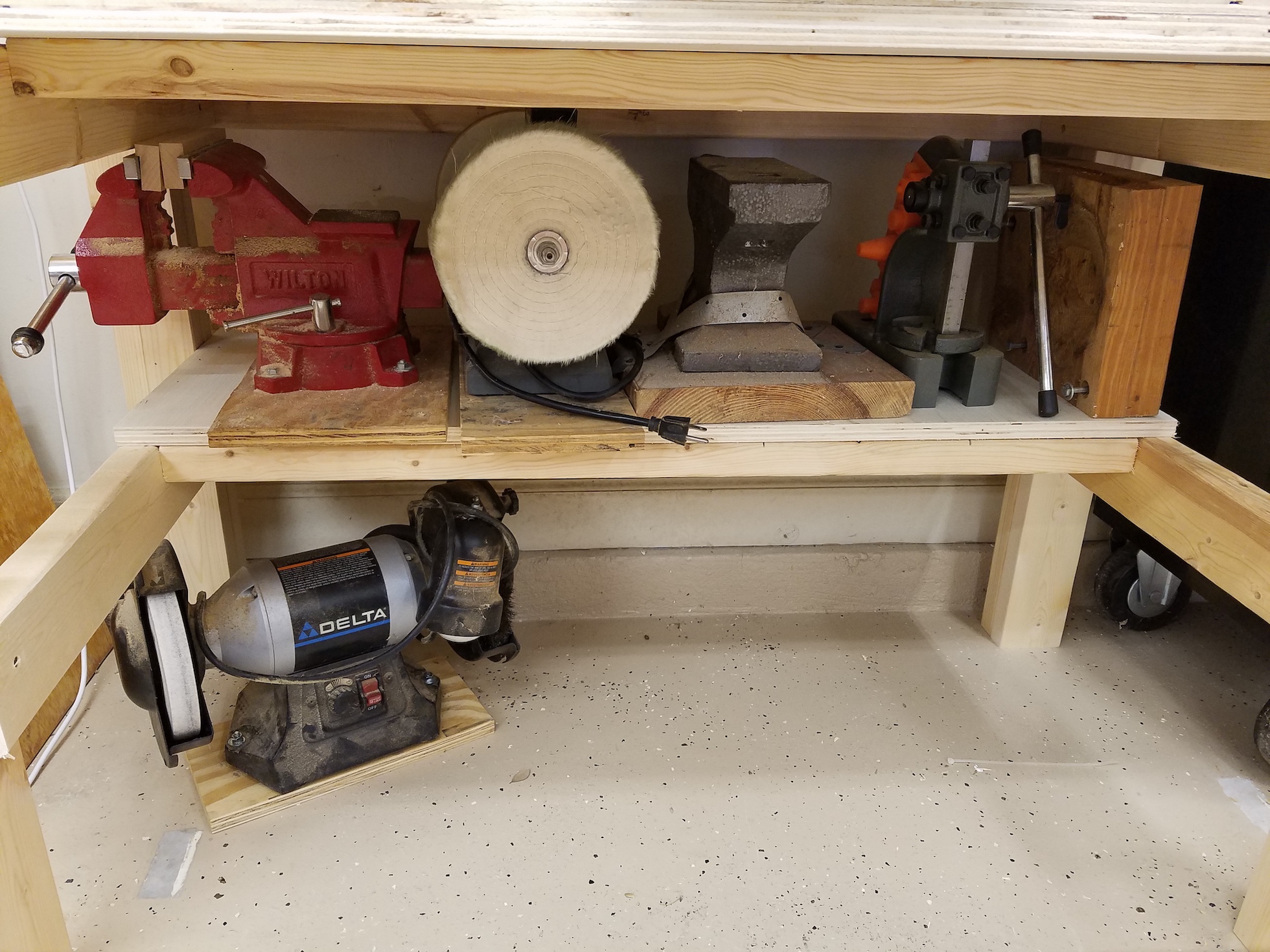
The frame is 4ft wide which goes well with a 4×8 sheet of plywood, and 8ft 2x4s. The recessed bottom shelf gives some space for storing bench equipment when not in use. It would store more and be more accessible if it was full depth, but I wanted leg room so I could sit comfortably at the bench.

I screwed together two sheets to make the top. I was going to glue them, but screwing was good enough and I can replace the top piece if it becomes damaged. This is a very stout table.

Bare, and in its final resting place it looks pretty good. Time to load it up with junk! From left to right, my big red vise from my dad, old bench grinder turned buffer, anvil, arbor press, carved depression used to hammer bowl shapes in wood, and bench grinder on the bottom.

Most everything is attached to thick pieces of wood. This lets me put the tool wherever I need it and clamp them down. I made sure the table top protruded from the legs far enough so I could clamp anything across the entire width. I kept thinking of fancy dovetail sliders, or bolt patterns, or bench dogs that would let me install a wide variety of tools. In the end a thick top and some C-clamps is simple and effective.


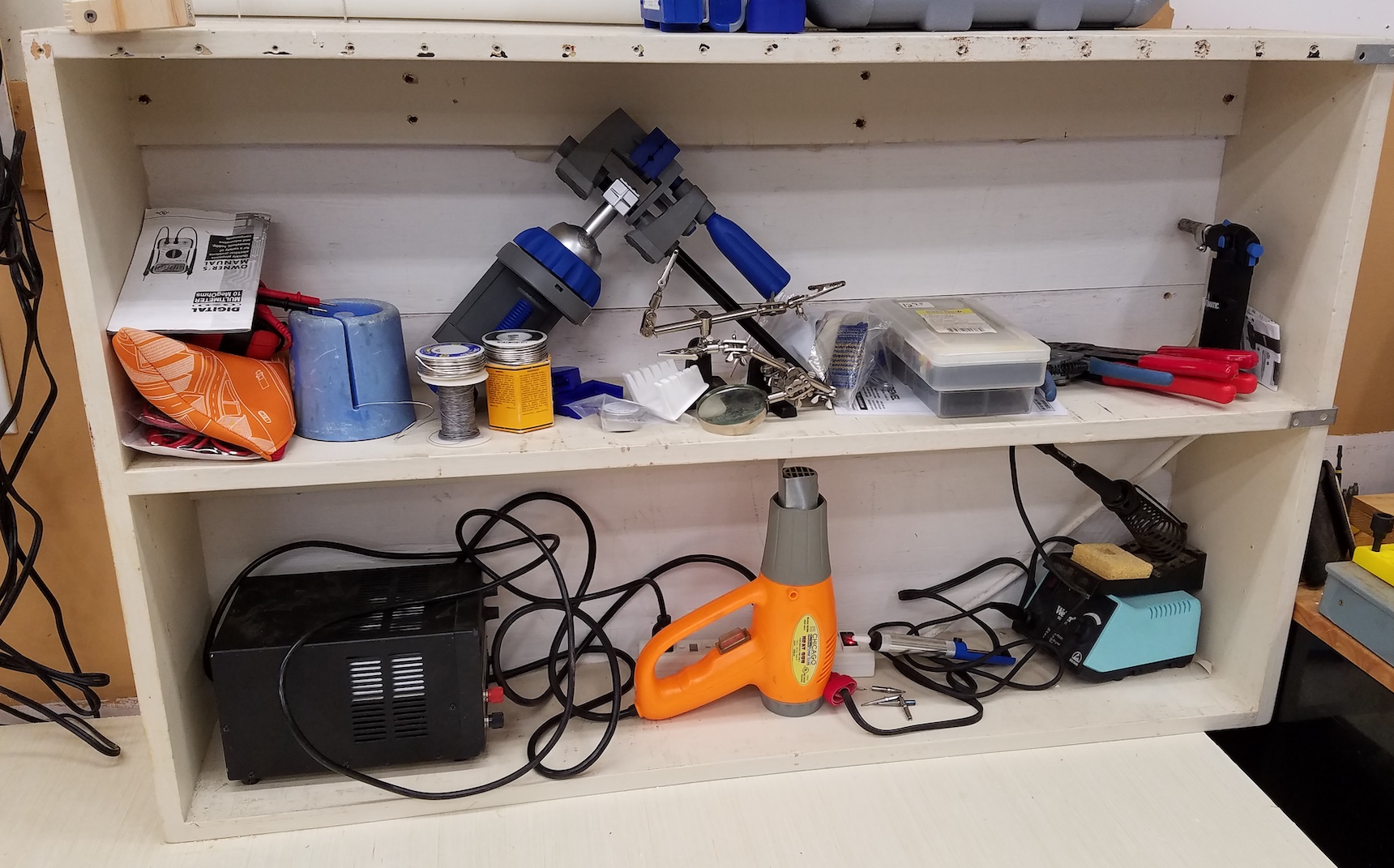
While I was dismantling parts of the garage to make space for this bench I pulled off these shallow shelves. It was kind of perfect for what I wanted to add to the bench. These shelves can be used to store my electrical/electronics stuff. That jives with my idea of this serving as a part time repair bench. The shelves were up against the wall and didn’t have a back. I added one to keep stuff from falling out the back.

The lower shelf has a power strip and commonly used equipment. It probably needs more organization in the top shelf. For now I am going to live with it and see what gets used often, and what can live elsewhere.

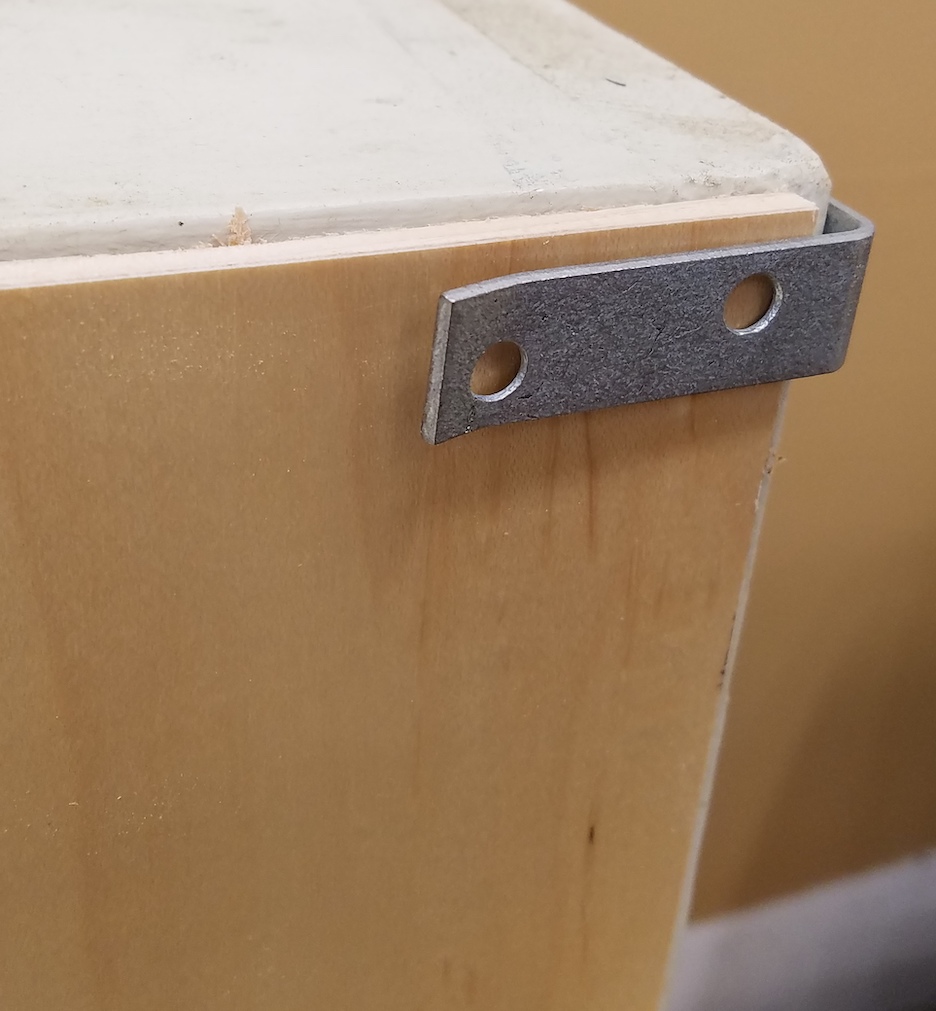
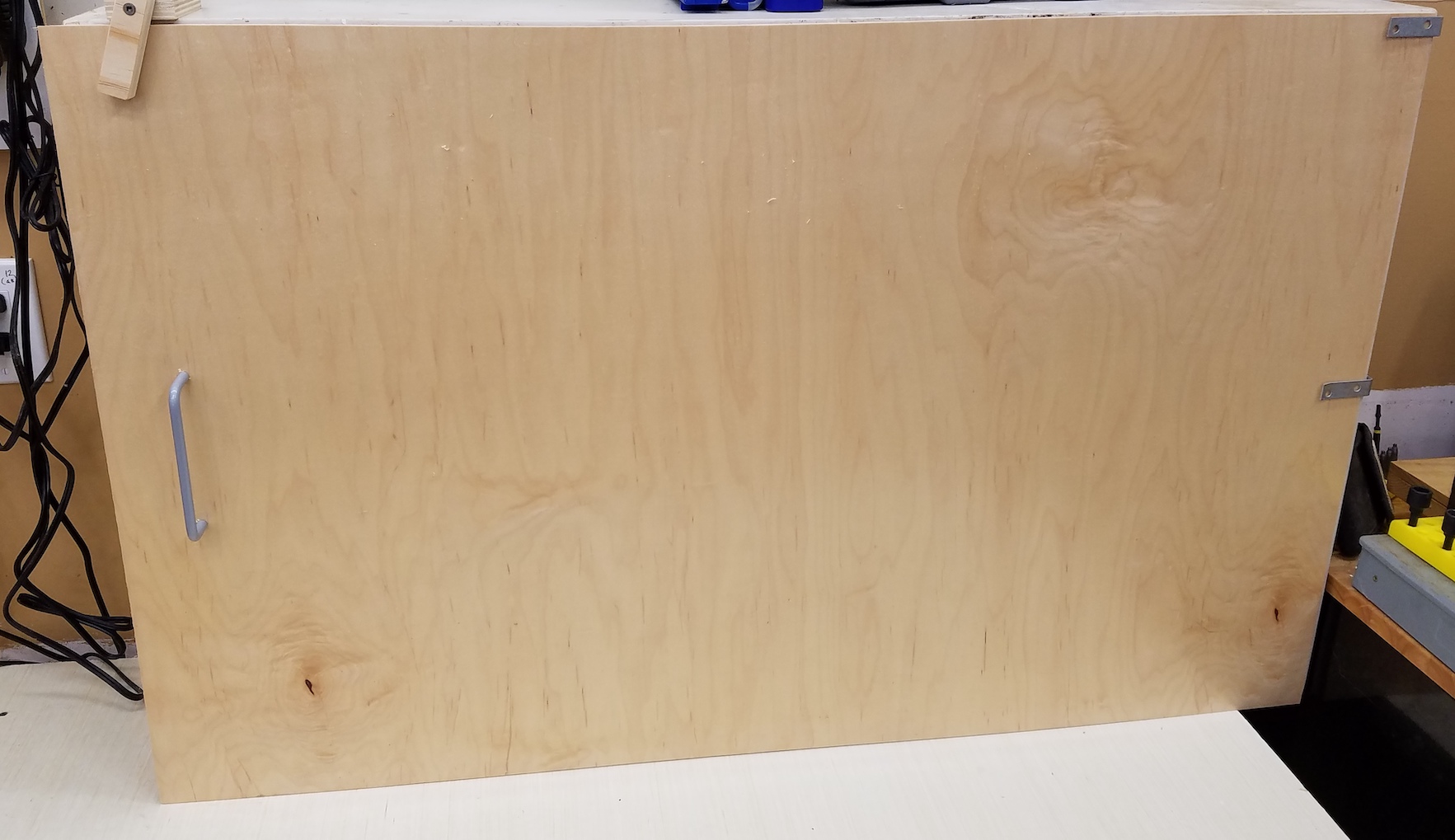
A front cover helps keep the dust out and things from falling off the shelf when banging on the table. Two bent brackets catch the front door on the right hand side, and a swiveled part holds it at the top. To remove you just swivel the one catch and slide the door left a few inches. That way it can be removed or installed even when the table is covered in junk.

I have had it this way for a week or two now and already I christened the table top with grinding detritus and grime from the next project. We all knew that pristine surface wasn’t going to last long.

Mobile Clamp Rack

The next set of loose junk around my garage to organize are my clamps.  In the previous shop, these filled every nook and cranny along one wall.  Those dowel holders are a very efficient way to pack as many clamps in as possible horizontally.  The professional metal brackets don’t pack quite as tight, but look nice and make the clamps easier to access.  I had bought a number of them in the past, but didn’t use very many for lack of space.  Thank goodness I never throw anything away!

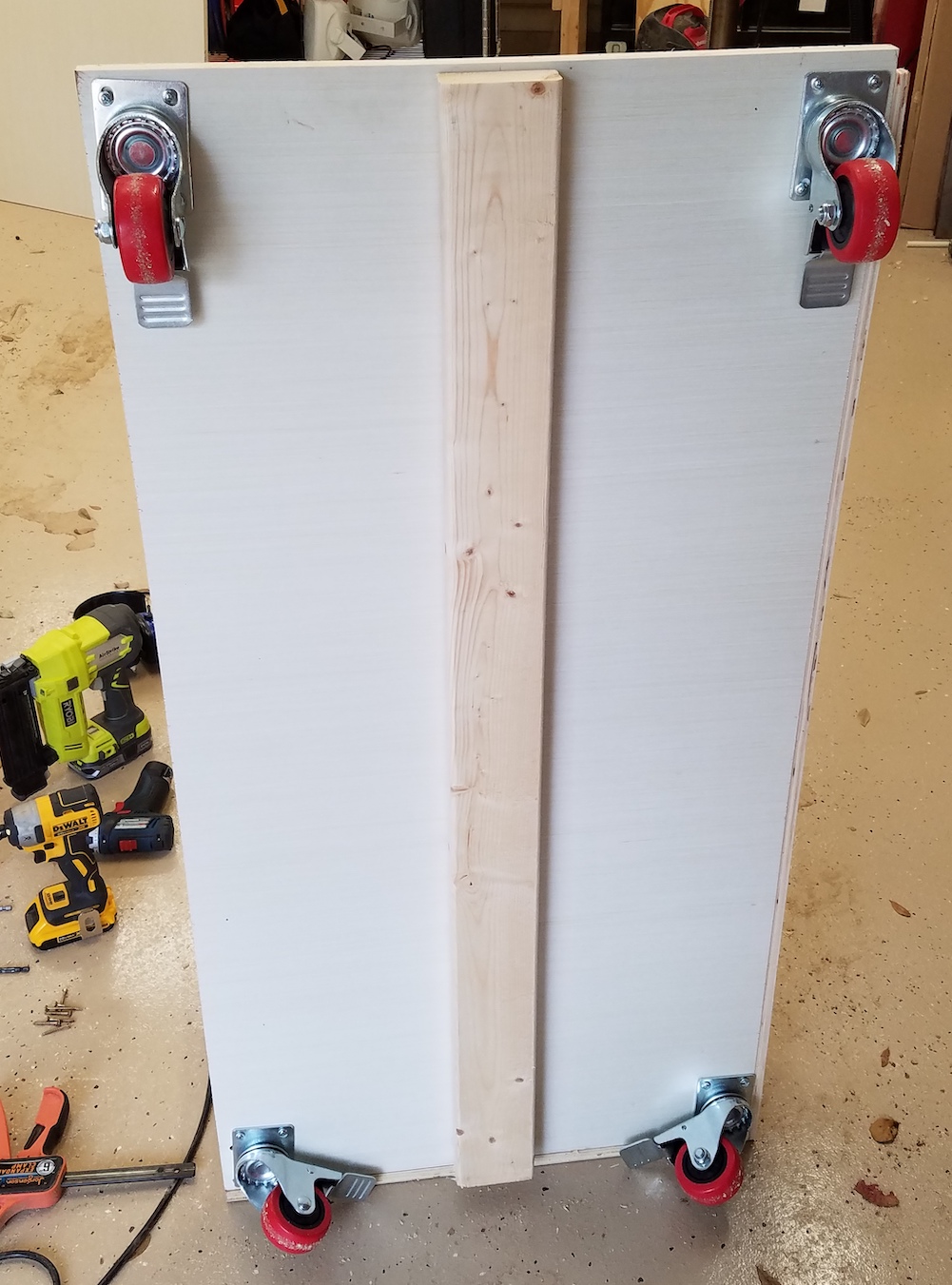
My new shop has a lot of space, but not as much wall as you would think.  Windows, doors, and a lot of plumbing stuff take up much of the available wall surface.  To remedy this, I need a new wall.  A wall on wheels.  I cut down two 1/2″ sheets of plywood and screwing them down to a 2×4 frame.

The wall stands on a set of 2x4s with casters and is short enough to get under my garage door.  I can roll this anywhere in the shop now.  The frame took 4 boards, and the legs with braces another 2 for a total of 6 2x4s.  I had the casters already, but went for nicer grade plywood and ended up spending about 100 dollars to build this.

I used a few of my previous clamp holders, but ditched most of the hodge podge for the nicer looking store bought metal brackets I already had.  Everything got directly screwed to the plywood face.  This big of a blank canvas supports all sorts of solutions and lets me pack in clamps efficiently.  I even managed to get my saw/router guides and cawls onboard.  I may eventually re-organize so they are grouped more by length than type of clamp, but with everything so open it is really easy to see what is available.


Lumber and Cutoff Storage

As things slowly settle inside the house I am turning my attention to the shop.  The garage is kind of a messy puzzle.  You have to put something away so you can make space to put more things away.  I was going to make some sort of vertical wood storage, but wasn’t sure how I wanted to do it.  Instead I found a good space that would support traditional horizontal storage.

I found Lowe’s has a line of Blue Hawk (store brand) brackets and shelving that was pretty affordable, came with a weight rating, and was thinner vertically than the Closetmaid option.  I cleaned out a corner of the shop and found a set of studs I could sink the brackets into.  This will mostly cover up the window, but it has dark tint and blinds so it wasn’t being used for light anyways.

20181021_130342

I started filling up the rack and was pretty happy with my new setup.  This handles boards from 30 inches to 10 feet pretty well.  Shorter pieces don’t stack well and offer a different challenge.  I decided to build something extra for below the main rack.  I have traditionally put shorter cut off pieces into 5 gallon buckets, and let them pile up under foot.  I came up with something that makes good use of the dead space under the wall rack.


This was done with a single sheet of 3/4″ plywood, but you could make two out of a sheet of 3/4 and a sheet of 1/2″ and get the price down a little.  The uprights are 23×23″, the shelves are 15″ wide and 30″ long installed at 35 degrees, and the back that runs across the storage unit is a full 48″ wide and 12″ tall. The diagram below shows how I cut it out of a 4×8 sheet.Screen Shot 2018-10-28 at 6.29.29 PM.png

There is a little bit of scrap left over, but not a ton.  Depending on your available space, you could adjust the angles and make it hold more or less materials.  This design lets me store a stack 10″ tall before it interferes with the lowest horizontal rack.  It accommodates anything up to about 34 inches, but at that length, it should go on the big rack.

I cut everything out and assembled one side to the back to start with.  I then went ahead and put pocket holes in all the “shelves”.  That let me screw them in horizontally to the uprights from underneath.

I worked from left to right installing one shelf, then another upright on and on.  The shelves got a little higher with each one, the first is 35 degrees, the last is probably more like 40.  I should have stuck a layout line on each upright to keep things on track.  Still, the assembly is very sturdy and fits where I need it to.  I added plastic furniture gliders to the bottom so the plywood doesn’t sit in direct contact with the floor and I can slide it out easily.

I had thrown out a lot of scrap before moving and threw out more stuff that wasn’t worth keeping before filling this up.  PVC and other non-wood related items go in a bucket, but everything else gets a cubby.  Most have a left and right divide of wood species.  I might work out some moving divider later on.

The horizontal racks are mostly organized by wood species.  This is way cleaner and more efficient than what I had at the last garage.  My previous home made brackets were much taller and didn’t allow as much storage space.  I need another space for sheet goods, but this should cover the rest.  Hopefully I can stay disciplined in my buying and keep my collection to within the confines of this rack area.


New Garage

We have been moved in about a week, but have spent all of that week cleaning up our old house to get it on the market.  Almost all the renovations that happened on the new house occurred at such a break neck pace that I didn’t document much of anything aside from a choice disaster.

That having been said, I wanted to say goodbye to my beloved garage.  9 years ago I moved in without owning a power tool bigger than a compact miter saw, and with less than a year of woodworking experience.  I added electrical outlets, lights, and a lot of sawdust to that place.  Many mistakes were made and lessons learned.

This slideshow requires JavaScript.

It was a packed mess, but I knew where everything was (mostly).  The new space is over twice the size.  You couldn’t tell in these shots because I had a temporary work bench setup for house renovations, tools everywhere, and the movers were pushing things in off the truck.  It is a tough place to navigate.  There is some built in shelving that helps for now, but might need to come out.  Also the previous owner had an office setup along the one wall.  Probably not going to stay in the long run.  Going to need to get the old house cleaned up and unpacked inside before moving onto the shop.

This slideshow requires JavaScript.

Little Bushy South

This project was completed in July at the old house, but I had to keep it under wraps so it could be a surprise to someone.  My wife’s grandmother was a British war bride.  She met her American husband at Bushey Park outside of London where he taught air sea survival for the 8th Army Air Force.  When the war was over they moved to Michigan (his home) and eventually had a farm called “Little Bushey”, after the place they met.  We had talked about calling our new place “Little Bushey South” as a tribute to that.  I thought a sign was in order, and no wood could be better than the family wood.

These walnut beams were picked up by my mother’s parents when she was very young.  They spent a lot of time around boats and they were used as ballast by someone.  No clue how old they were then, but our family has had them for 50+ years.

One of the beams had been cut down a few times, so I cross cut it to about 42″, and then re-sawed it to make a 1 inch thick slab.  I left some of the worm eaten edging because it is so good looking.  A little work with my jack plane had it smooth and revealed a gorgeous piece of walnut.


In order to make the text for this project I am using my plunge router and custom printed 3D letter templates.  I wrote up all the text, then broke each segment up into a size that could be printed.  They are keyed to fit together to keep alignment and kerning proper.  Letters like “e” and “B” have to be done in multiple segments.  The “B” below shows how I tackled this.

The plunge routing went reasonably well, but something shifted part of the way through.  My cuts were shallower when I went back and redid certain segments.  Not sure what happened, but next time I will make everything double tight.  I went back with a chisel and cleaned up the issue areas.  The bottoms are still not smooth, but aren’t as uneven as before.  That left me with a few accidental chipout segments.  See near the top of the “O”.  Also, the “h” was in part of a knot.  My colorant will want to bleed into those cavities, so I have to fill them.

I used some dark woodworking epoxy to fill these problem areas.  First I went carefully with painters tape and dammed up all the problem areas.  Next I mixed the epoxy and used a syringe to put just the right amount into the voids.  A little light buffing and the epoxy filled the voids but is really hard to see.

DSC_1396

dsc_1400.jpg

I was going to spray paint this, then just plane off the top layer to reveal colored letters.  The bottoms are still uneven, so I opted to try epoxy.  I bought a big batch of system three epoxy with white color resin.  It worked really well.  No progress pictures because you have very limited time once the mixing begins.

The places I blocked the chipouts didn’t bleed, and only a little snuck in under the knot around the lower case “h”.  A syringe helped me pipe it into each letter, and manipulate the results.  The epoxy clung up at the sides and dipped a little in the center.  The result is a really awesome shiny 3D lettering effect.  It looks quite good on our new mantle.  I don’t really understand fireplaces in Florida, but this one looks picturesque.

20180813_141454