Kilt Belt Loop Repair

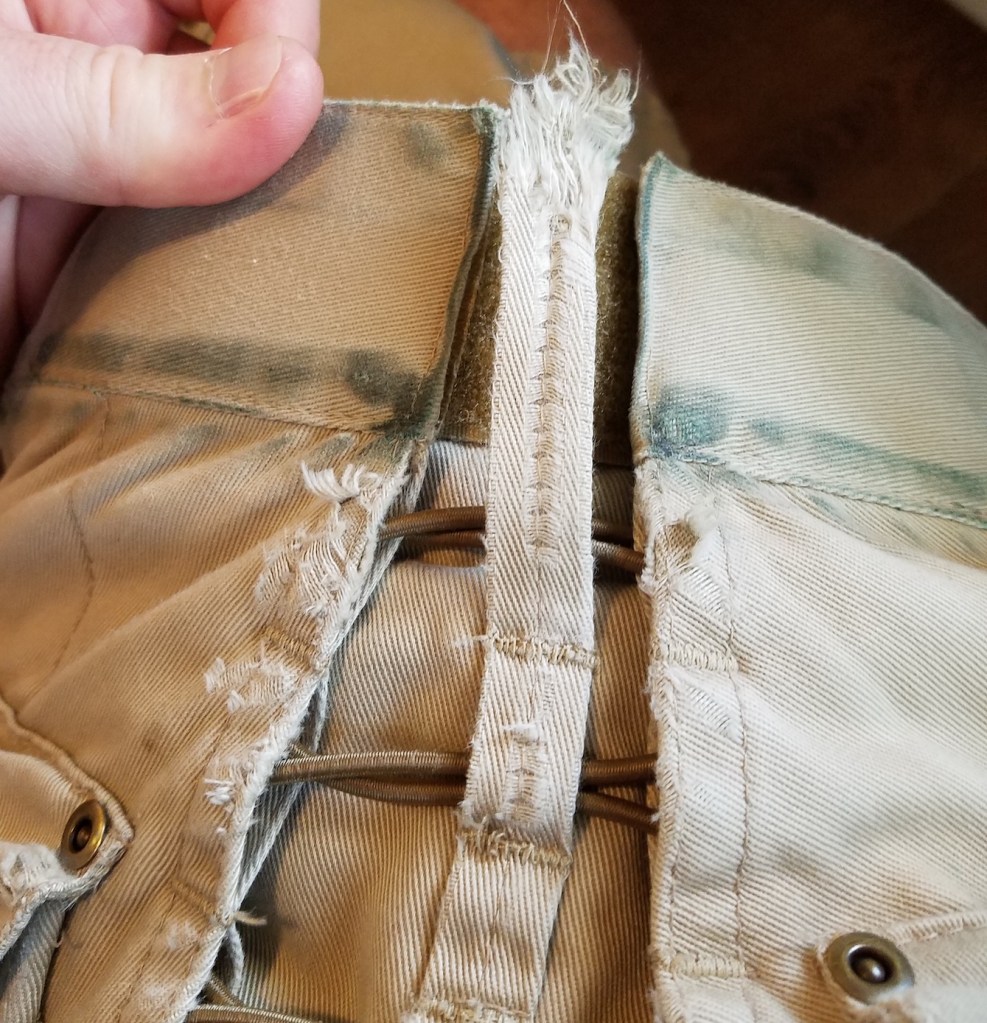
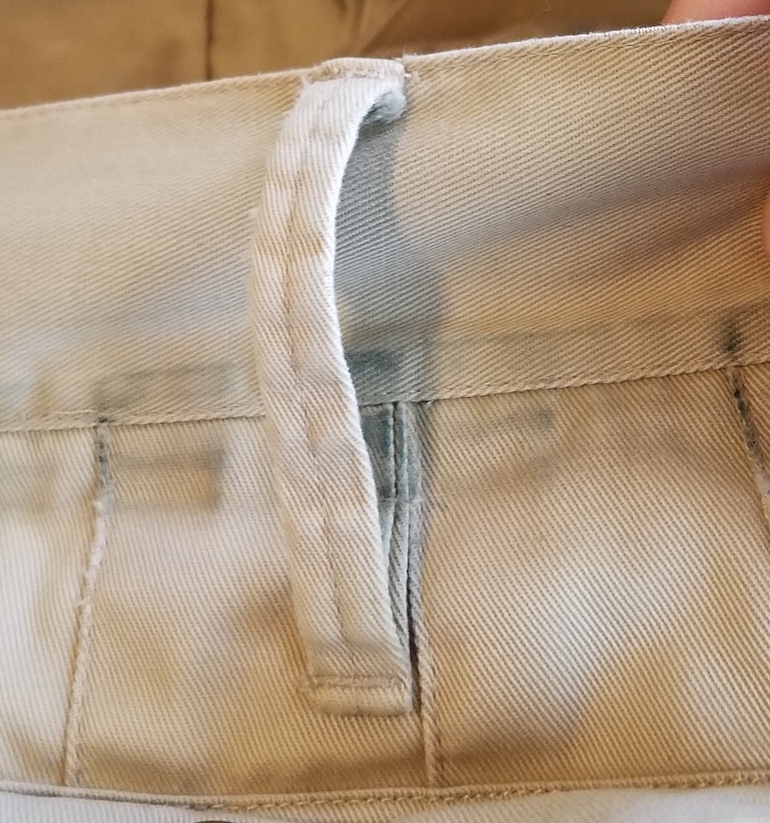
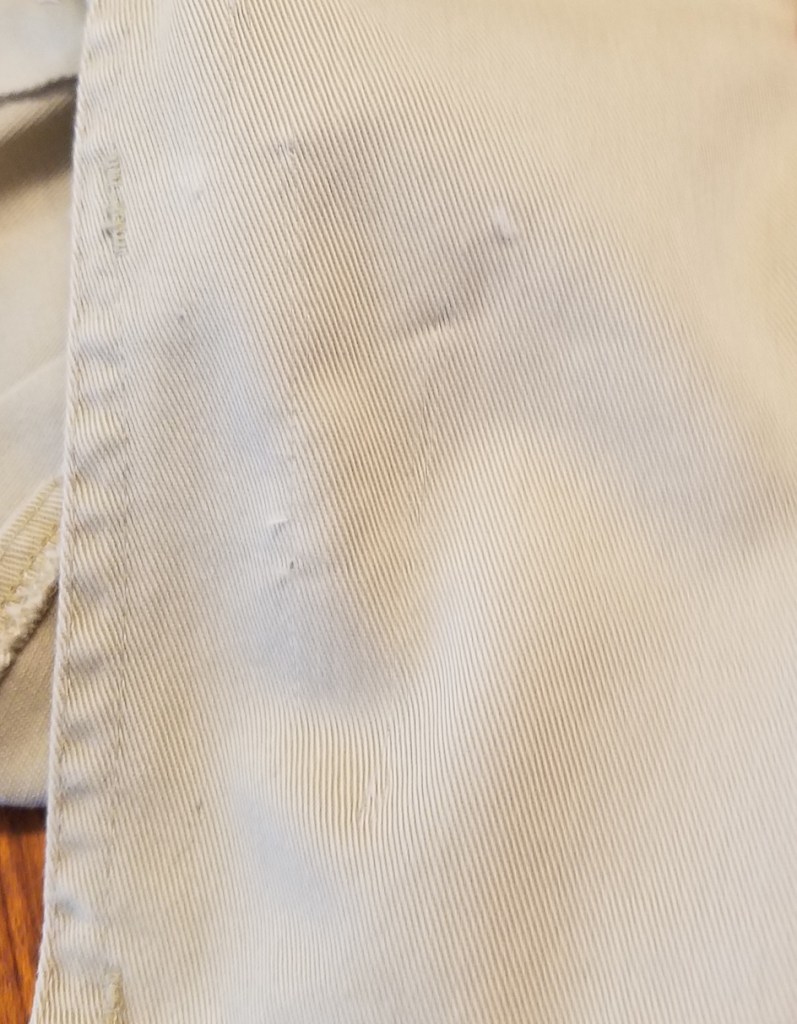
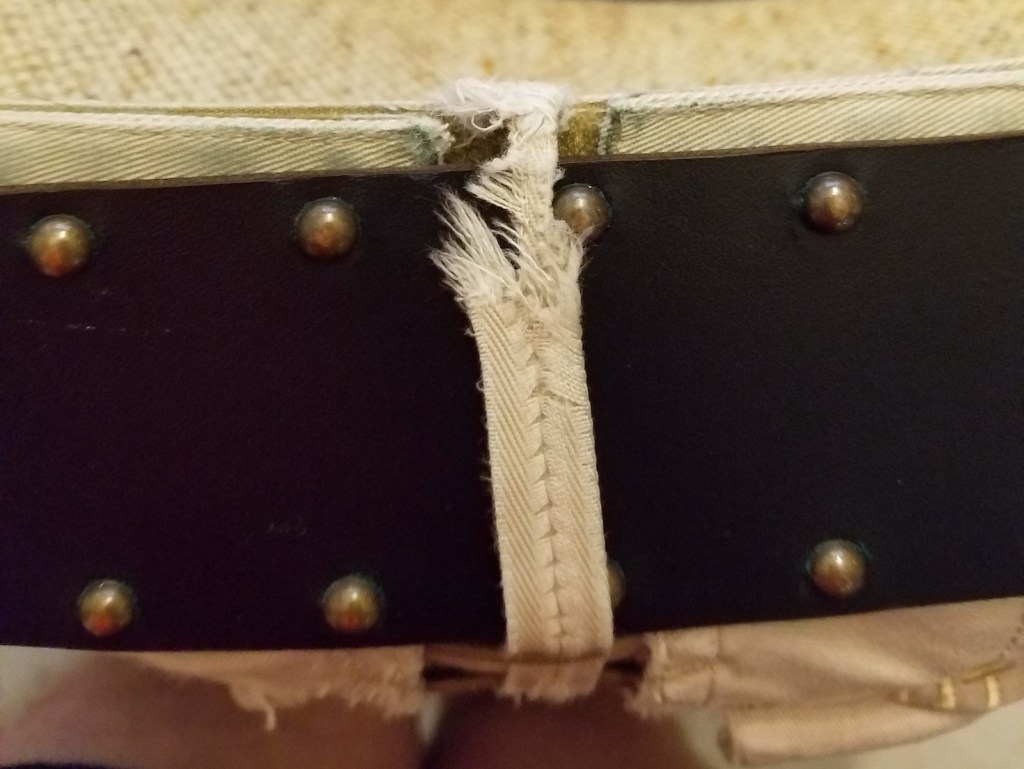
My latest kilt is going on 3 years old and has an issue with one of its belt loops. The center one in the very back is hanging on by a thread. This kilt is a few sizes smaller than my previous ones, and I have noticed that smaller pants/kilts tend to come with fewer belt loops. It may be the fewer loops, it may be the design changes utilikilt made, but for whatever reason, I need a new loop.

About 10 minutes after snapping the above picture I put the kilt on, sat down, and broke the last threads. Good thing I have an old kilt that I kept around. I figured I could cut some material out, sew it up into a belt loop, then sew that on. Turns out one of the loops on the old kilt was in really good shape.

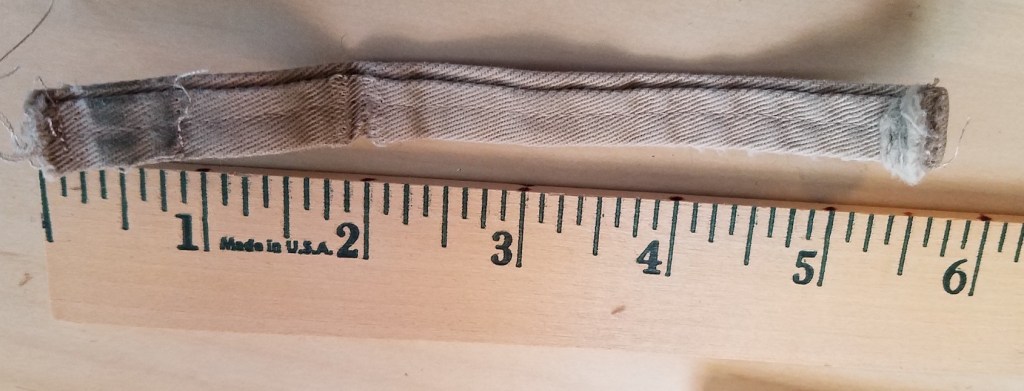
I went after the old kilt with a thread ripper and managed to free the loop. The way they fold it over and under there ended up being a lot of material to work with. Good thing I am a hopeless hoarder!

I bought a basic sewing machine not long after college. I used it to make a few things early on, but never really picked it up as a hobby. Every year or so I break it out to fix something and completely forget how it all works. I need to make a photo guide. To make things worse I think it needs oiling.

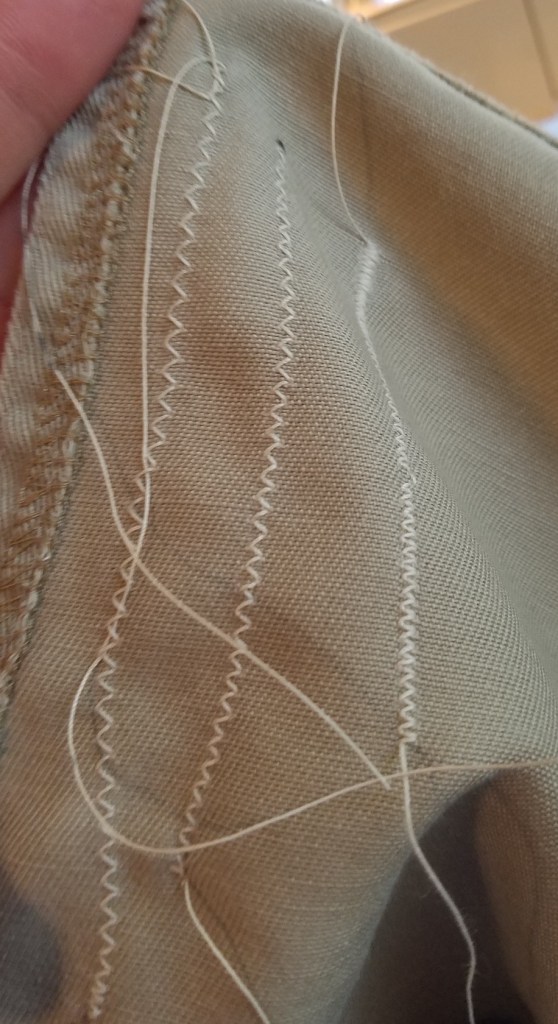
I picked up the old kilt and sewed a few straight lines to make sure I had the stitch settings the way I wanted. When I got done I realized my mad sewing was done in the kilt I was trying to repair, not the spare parts kilt. Oops. More time spent with the thread ripper. Thankfully it wasn’t in a highly visible spot and the final damage was minimal.

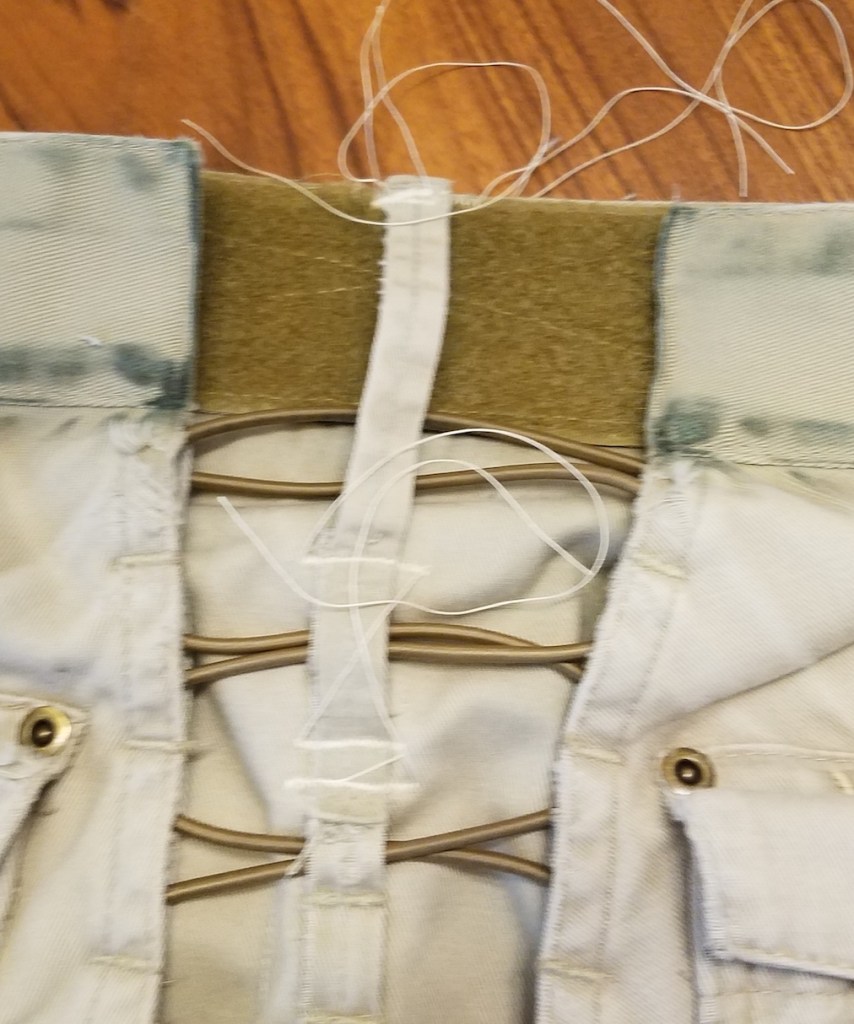
With the settings all worked out I went ahead and started tacking the repair loop down. The sewing machine had a lot of issues with the thickness and I ended up with a broken needle for my troubles. I switched out the needle and was able to finish. It looks a little ugly, but feels sturdy. I went wild with the sewing and managed to sew down the tag. Oh well, no real harm done.

Once I trimmed up all the spare strings it looks nice. I need a little darker thread next time, but this will definitely keep my belt in place for another 6 months or year. I like to get 4 years out of a utilikilt if I can.

Socket Cabinet

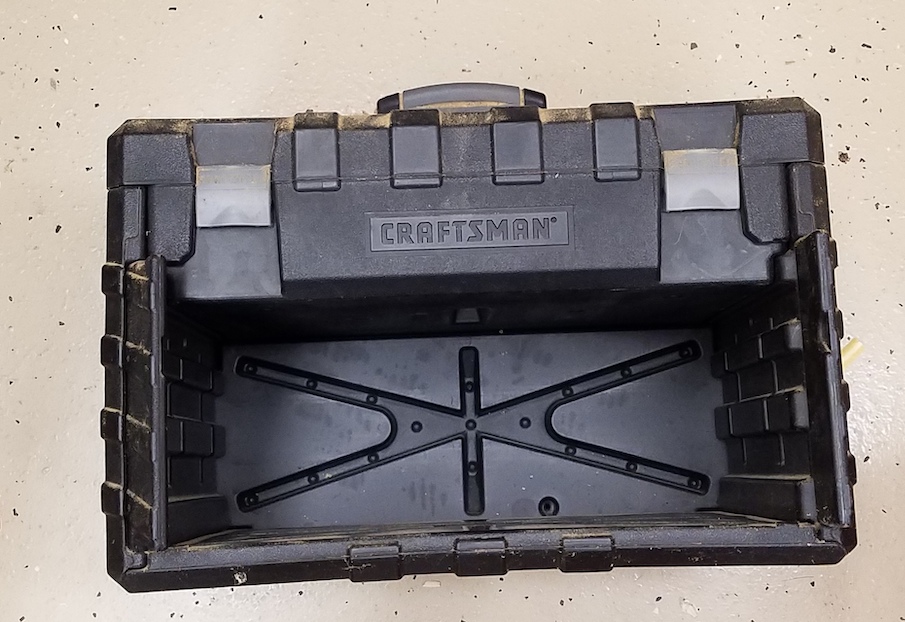
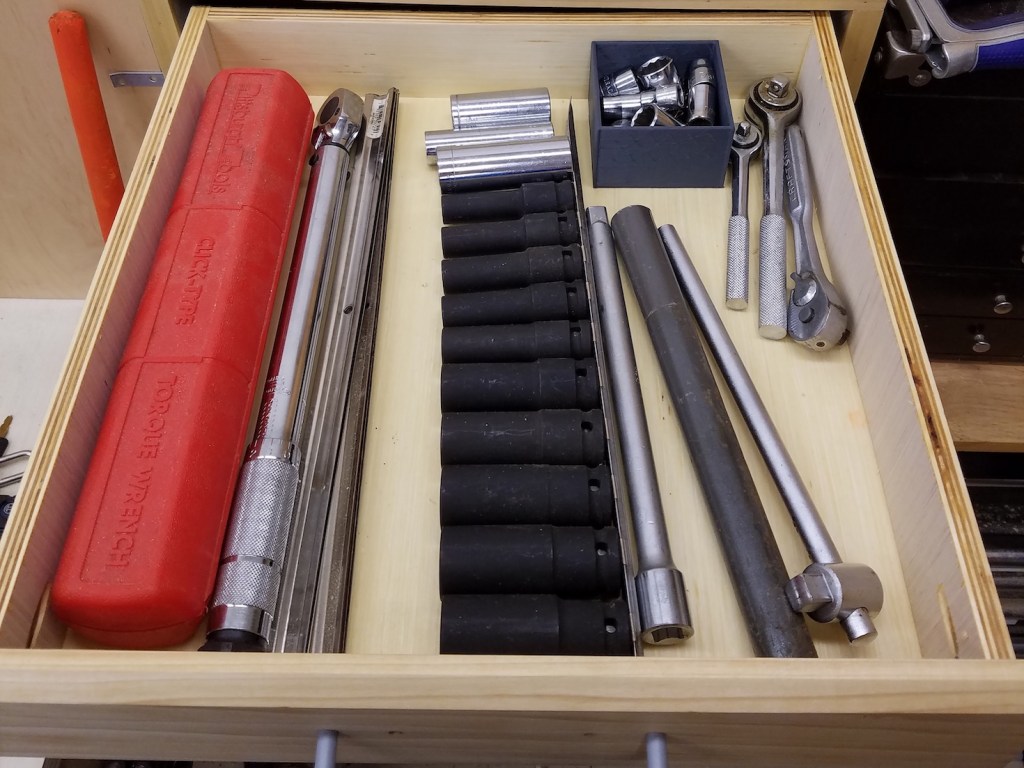
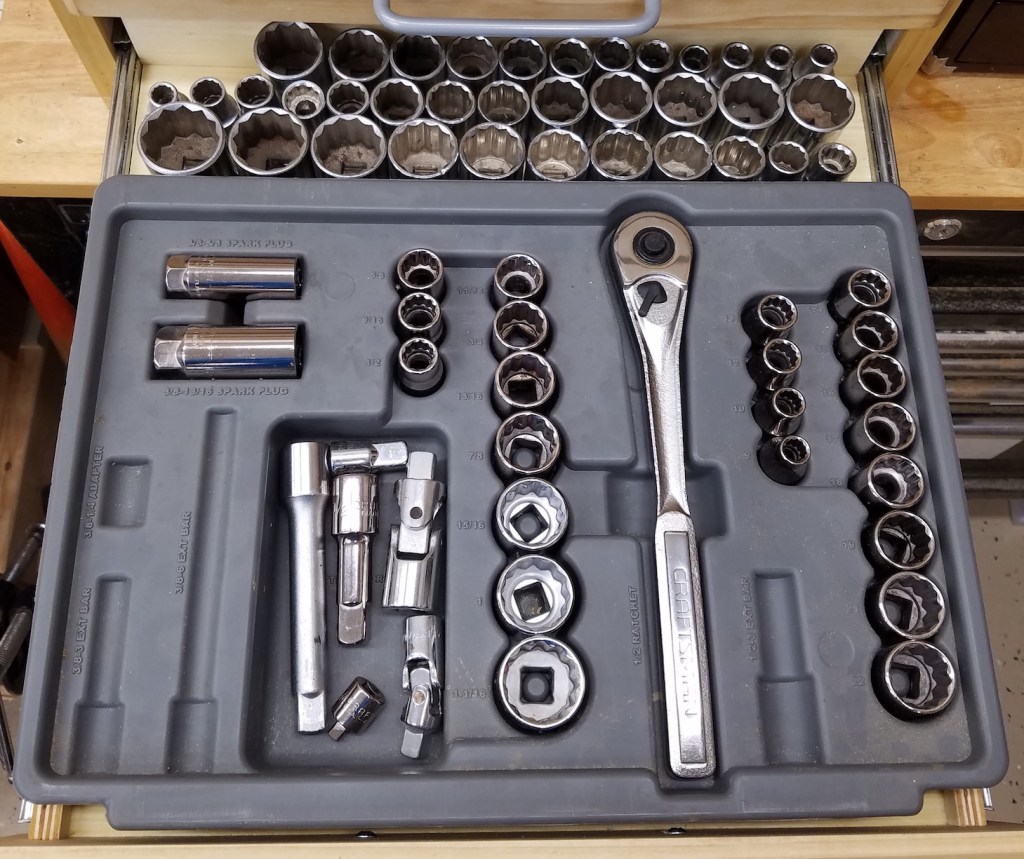
Not long after buying my first house I picked up a big set of socket wrenches from craftsman. Previously I had an odd assortment of hand me downs that were missing various sockets. The plastic trays the sockets came in were labeled and worked well. The case was always kind of shoddy. It tended to drop the drawers out and spill sockets everywhere. If you pulled the bottom drawer out the top drawers collapsed. I am finally ditching it and making my own cabinet.

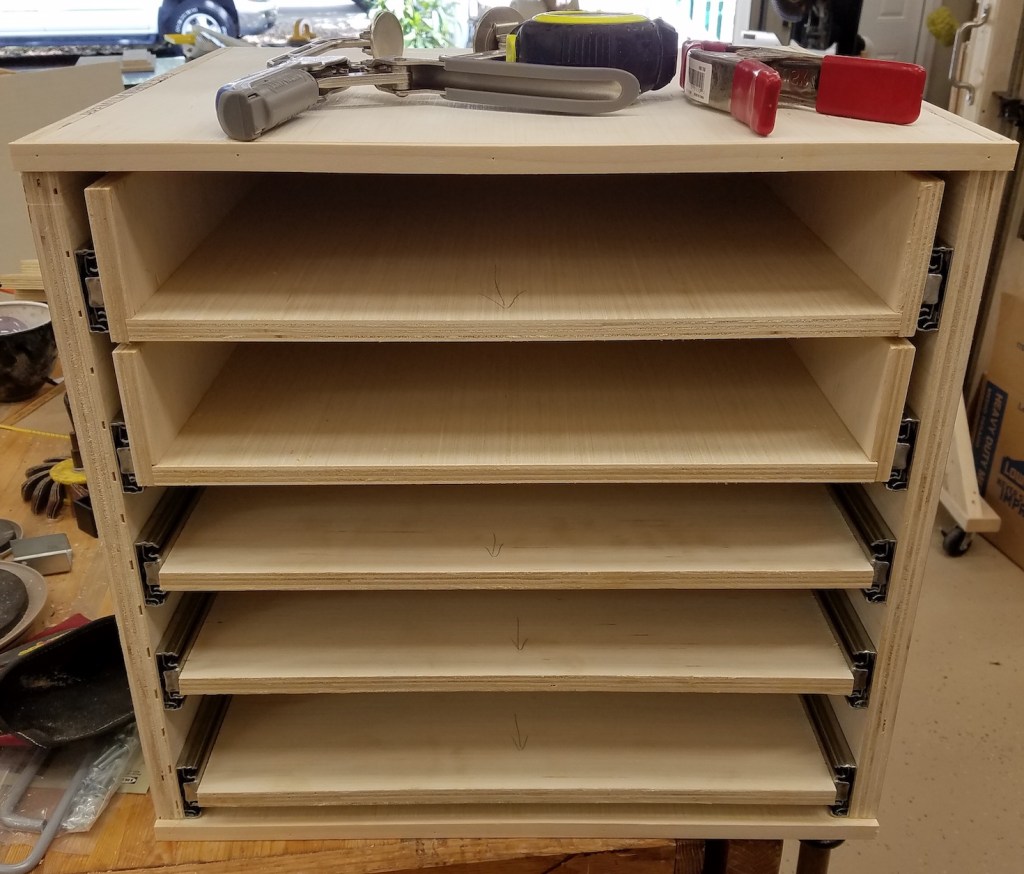
I started by making plywood drawers for each plastic tray (1/4″, 3/8″, and 1/2″ socket set), and two more full drawers for extras. This is the first project I have done where I made the drawers all first, then built a cabinet to hold them all. Kind of a neat way to work.

Once I got all the drawers assembled and installed into the cabinet I covered the face frame of the cabinet with 1/4″ poplar. I thinned more poplar down to 5/8″ and put a heavy chamfer on it to make drawer fronts. I thought pocket hole screws would be a great way to attach the fronts. They were, but I forgot to reset the depth of the drill bit to 1/2″ instead of my standard 3/4″, and drove the first screw through the drawer front. oops…

That won’t matter too much, and I am sure nobody will notice. Mostly because I accidentally drilled the first set of drawer pull holes at 3″ instead of 5″. Otherwise the cabinet looks great after a coat of boiled linseed oil.

Now to fill it all up. I used small strips of plywood to make stops so the plastic organizer trays sit still and don’t slide left to right when opening and closing the drawers.

Everything fits with room to accommodate future purchases. I don’t do a lot of mechanic work, so this set will probably cover me for the very far future. Lastly I did 3d print a few little organizers and helpers. I seem to have a lot of 3/8″ extensions, so I made a little slot holder for them. Also adapters to go from 1/4″ hex drive to various socket set sizes. The steady drum beat of garage organization marches on.

Kilt on a Hot Tin Roof

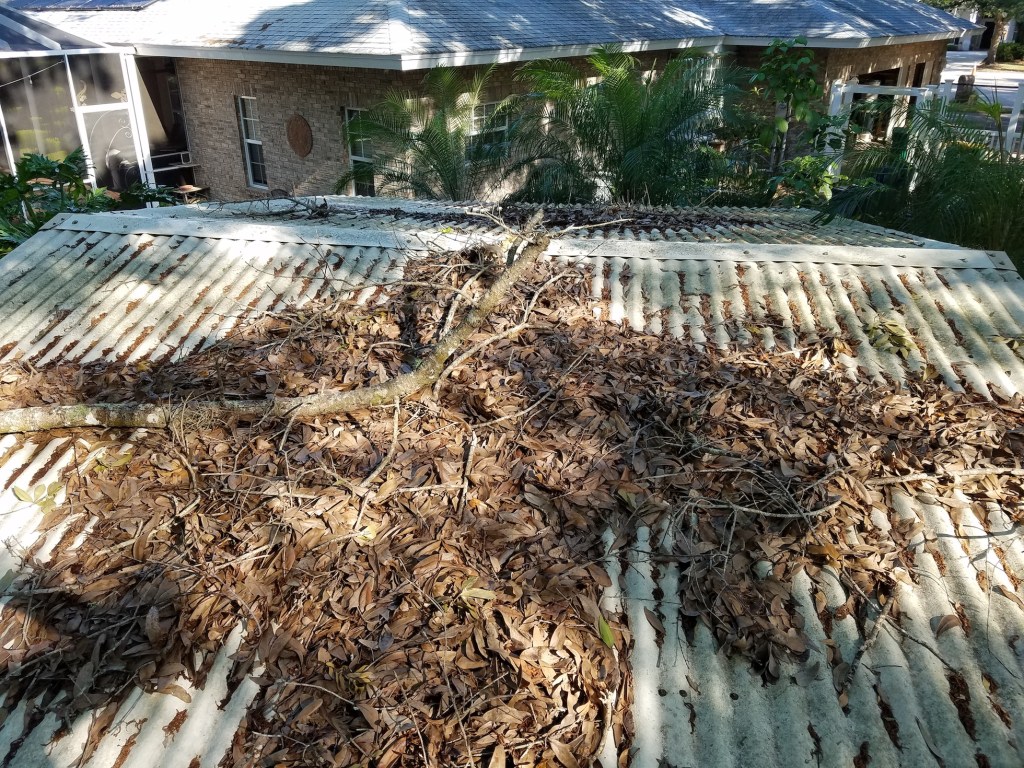
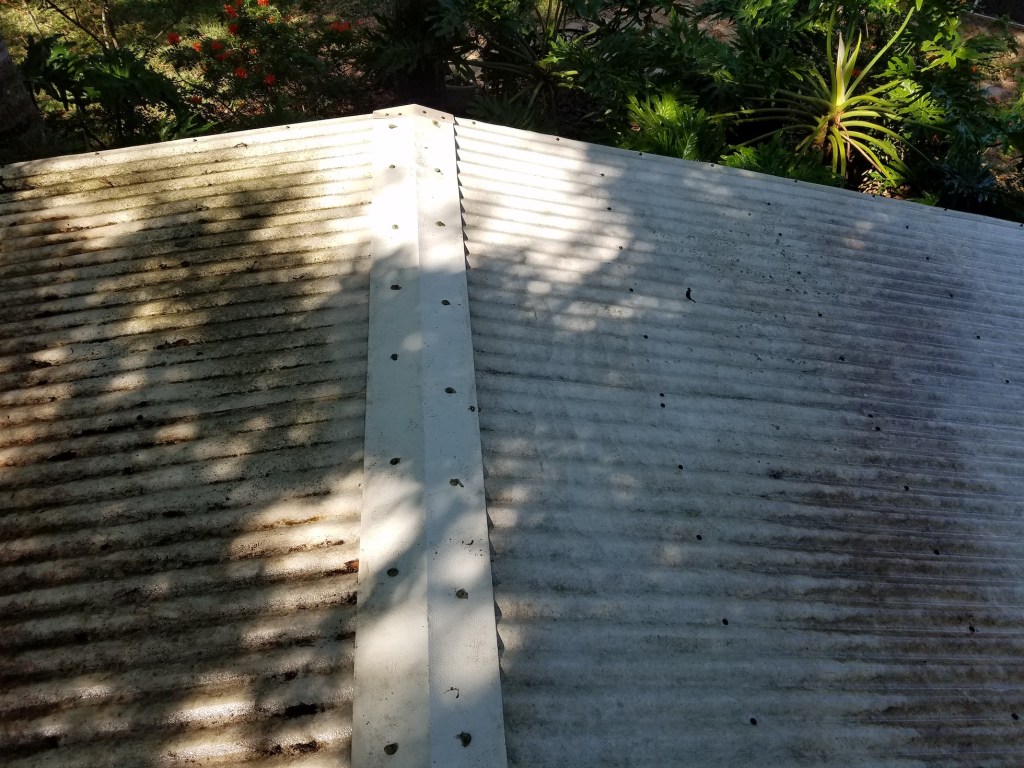
OK, so it is probably steel, but it still has a nice ring to it. The old shed at our new place could use a little love. It is 10 years old and the fasteners that hold the metal roof down appear to be in bad shape. The tops are all rusted and the rubber washer that keeps water out looks rotted. I pulled a few, and luckily none appeared to be rusted below the surface.

The shed seems to have a constant supply of leaves on top. In fact, I think that branch has been up there since before we moved in.

Some of the leaf piles had been there so long they had decomposed into a dirt/compost looking substance. The surface finish of the roof looks really rough in places.

I swept off all the leaves and debris, then gave the roof a pressure wash to clear the rest of the dirt and prep the surface for paint. Before painting I went through and replaced every screw on the roof with a new longer one.

Once all the screws were replaced I sealed everything in with two coats of a siliconized roofing compound. It looked a lot like super thick paint. Putting it on really heavily, a 5 gallon bucket gave me two coats with a little left over.

I spilled over the sides in a few places, but otherwise it all turned out well and looks nice. I hope this buys the roof another 10 years before I have to do anything. I know walking around up there was bending the sheet metal up, so I won’t make a habit. I do need to sweep off the leaves a few times a year though. That should be an easy job with a long broom and a ladder.

Miter Saw Dust Collection

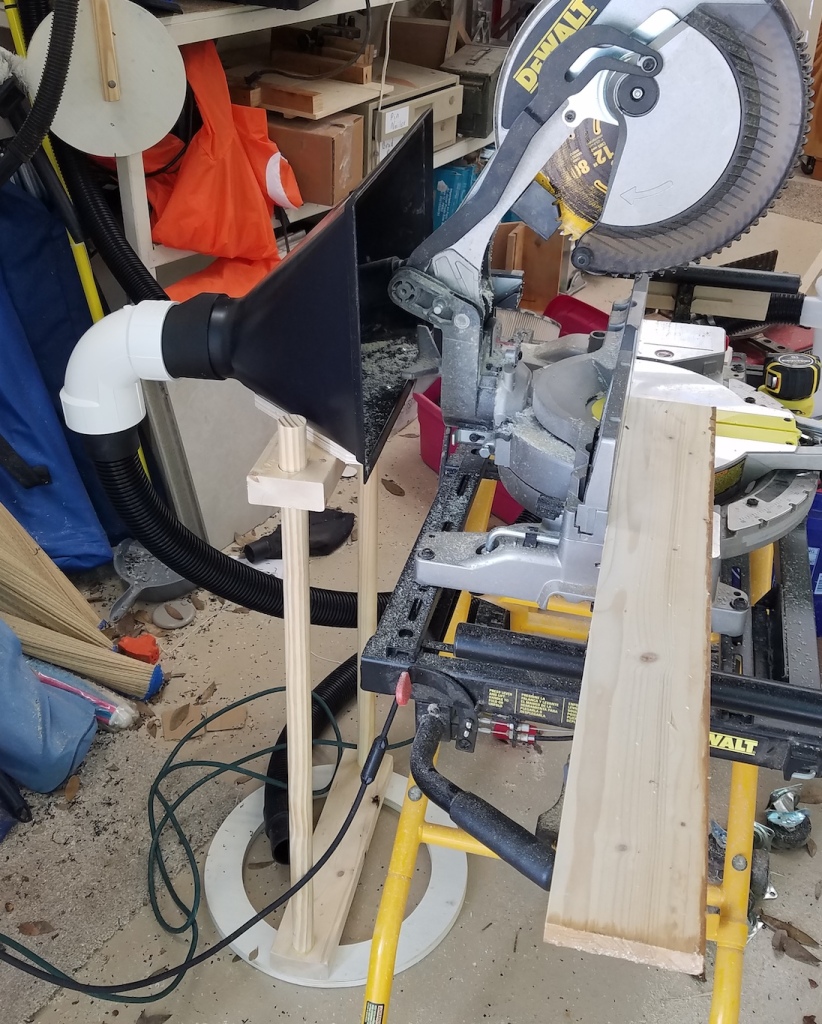
Miter saws are incredibly useful and one of the first power tools I bought that wasn’t a hand tool. As useful as they are, they produce a lot of bad dust. The high speed cutter makes a fine dust that gets kicked back and up out of the tool. The little catch bag that comes with them helps, but much of the dust still escapes and becomes airborne.

I tried attaching a vacuum to the dust port in the back, but that only catches about half the dust. The rest just blows right by. Instead a big funnel would guide all the high speed dust into a vacuum port. That was the thought at least. It works a little better than just using the saw’s dust port, but not much better.

I had some plywood rings left over from my dust collector upgrade and thought this one would make a nice base to start with. I attached a 2×4 with holes in it for dowels to elevate the dust catch.

The big gulp dust catcher attaches to a similar piece of 2×4 with some plywood in between to help spread out the load. The upper 2×4 had the holes reamed out so it would slide easily. A set of screws goes through the 2×4 into the dowels to keep everything at the right height. I didn’t know exactly what height would be ideal, so I made it adjustable.

To adapt from the big 4″ port to my mobile shop vac I printed some adapters with a 3″ PVC elbow. Once again, 3D printer to the rescue when it comes to adapting dust collection fittings.

I am still getting a lot of dust blown all over the place, even with this large catch. Using a large dust collector instead of my shop vac might help, but I feel like dust is deflected in too many directions by the time it gets to this big gulp. I have used this for a few weeks and haven’t come up with a good solution yet. It may require a better catch on the pivoting saw bracket. I will include any updates made.

Early 2019 Prints

I used to track my random prints closely and publish a monthly update on them. More recently a lot of my printing has been integrating with dust collection upgrades and other organizing efforts in my shop, so there hasn’t been a dedicated post. This is all still very workshop focused as that is where I have been directing my time this new year. The shop is becoming a very magical place to work.

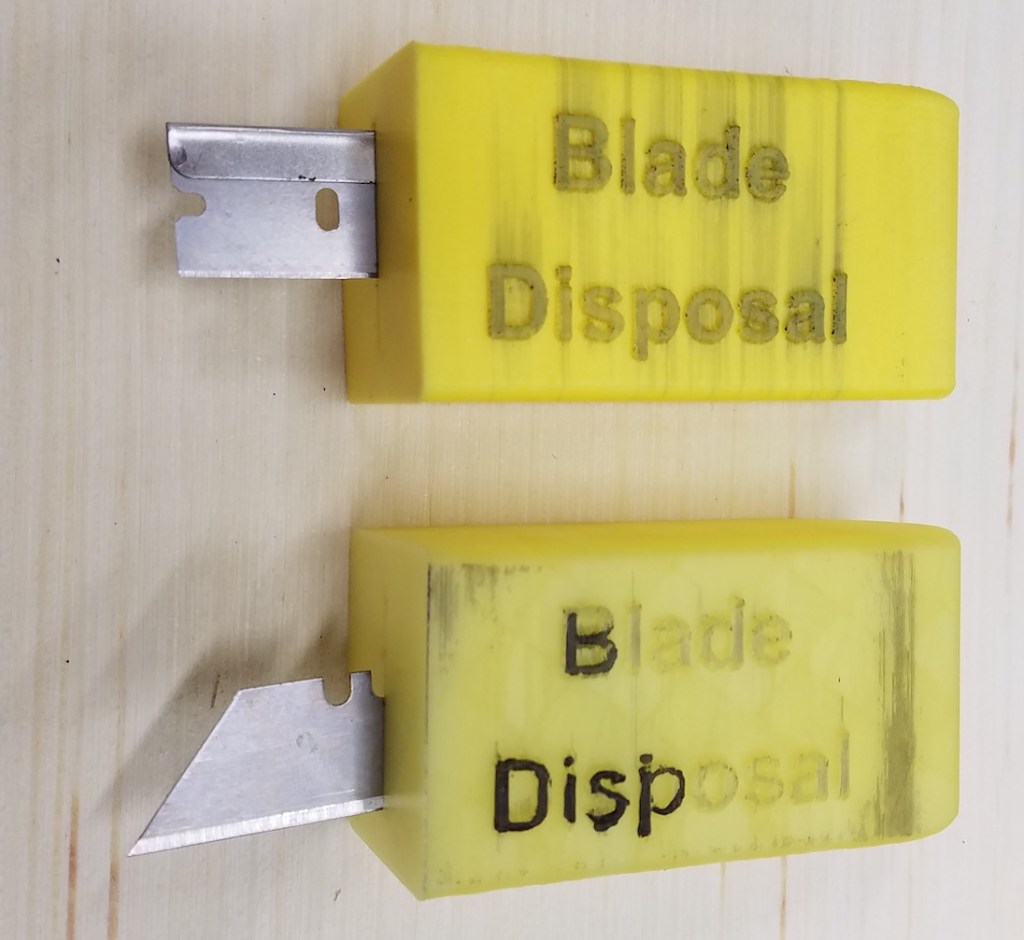
First up is a used blade storage box. A sharps container. I was brought up using traptezoidal utility blades. The two sided retractable blade is a standard and is widely available. I lose them a lot, so I have like 10 of them around. They are cheap, and all of them have cruddy blade because I am too lazy to grab a screwdriver to open them up and flip the blade. Enter a new contender, the snap blade.

I always thought of snap blade knives as cheap box cutters. I bought one to try out after some online recommendations, and have become increasingly impressed. I think they are sharper, can be extended longer, and if you need a new edge, you just snap a segment off and get back to cutting.

Both methods leave sharp rusty around, so I printed a small box that helps you break the blades off and keeps them trapped inside for safe storage. Inside, the entrance has a ramp so blades would have a really hard time rattling out. It is like a lobster or crab trap. The entrance slit is just big enough for the blades to slip in.

I designed it to accept the 18mm snap knife blades, standard utility knife blades, and single edge razor blades.

I made a few and tried colorizing the raised text. I started with a paint marker, but the text was small enough it was getting smeared. I moved on to an ink stamp, but the ink is too thin. It soaked into the print layers and ran everywhere. You need something thick like paint, but easy to apply to a whole surface like an ink stamp. They look ugly but work perfectly. Thingiverse Link


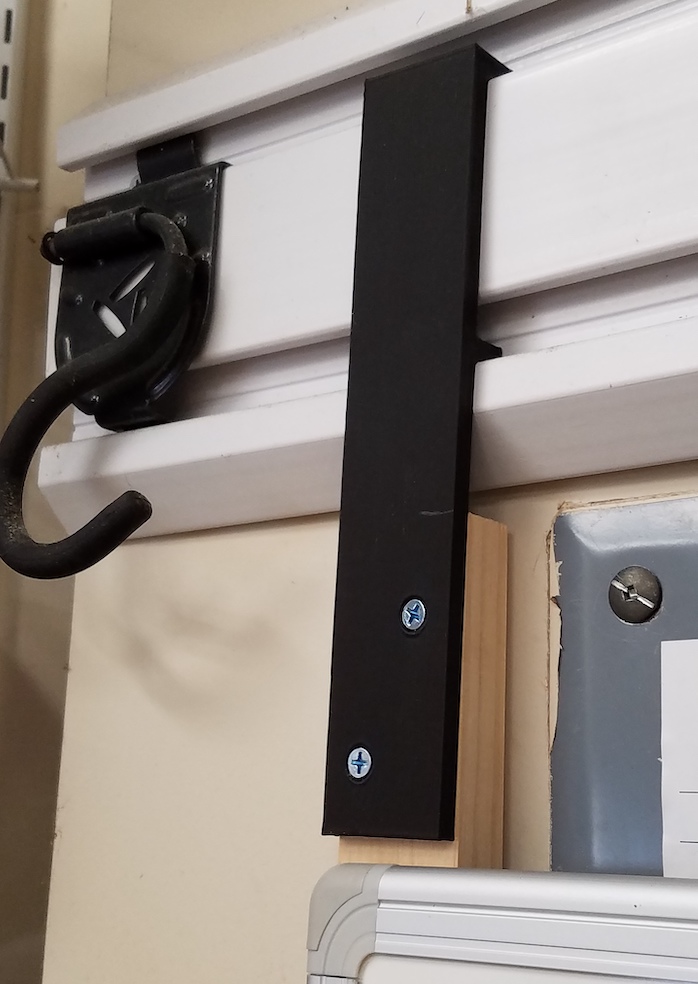
I really wanted to spring for a nice whiteboard for the shop. One that doesn’t have marker stains 6 months after you first get it. I did a little research and found an enamel coated board that looked good. Where to put it though? My new shop is big, but lacking in wall space. time to get creative.

The circuit breakers are in the right real estate. I need access to them, but only occasionally. I noticed the gear track above the panes and decided to take advantage of them. I did a few test prints and came up with a double hook that snaps in nicely. Those supported two strips of wood that the whiteboard mounts to. The whiteboard is very stable and can be removed quickly when I require circuit breaker access.


I picked up a dremel around Christmas and have been finding it really useful for small odd jobs. I ditched the organizers that came with it and have put everything into a clear organizer box. To keep the cut off blades separated, organized, and from getting broken I printed a simple wheel holder.


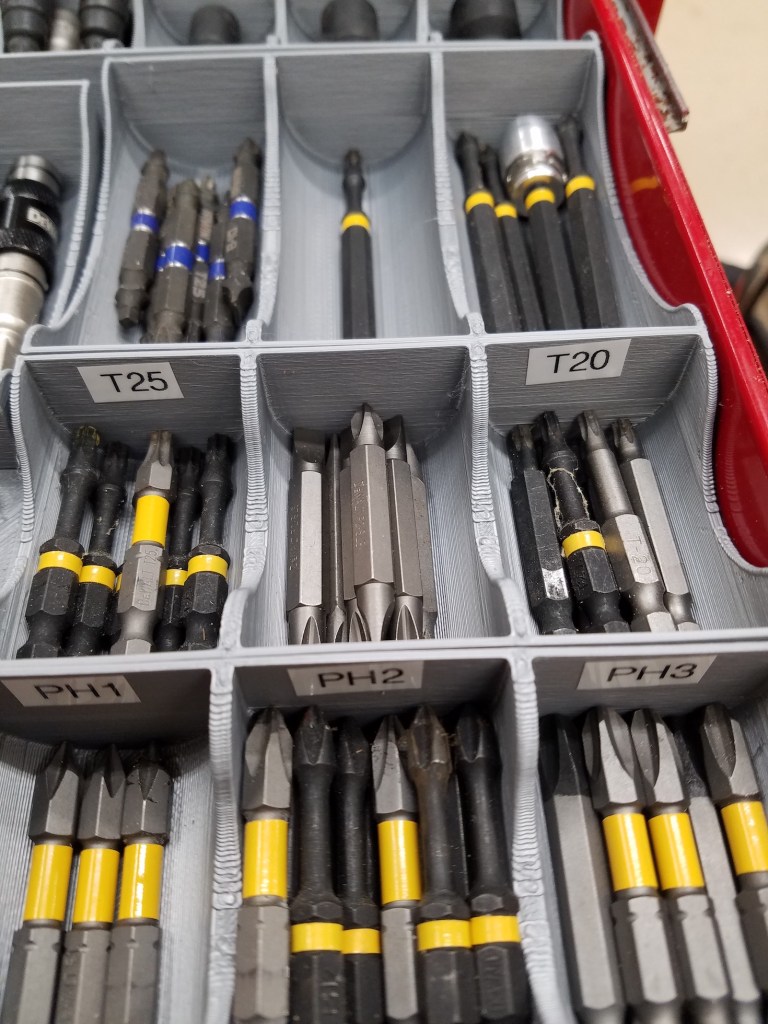
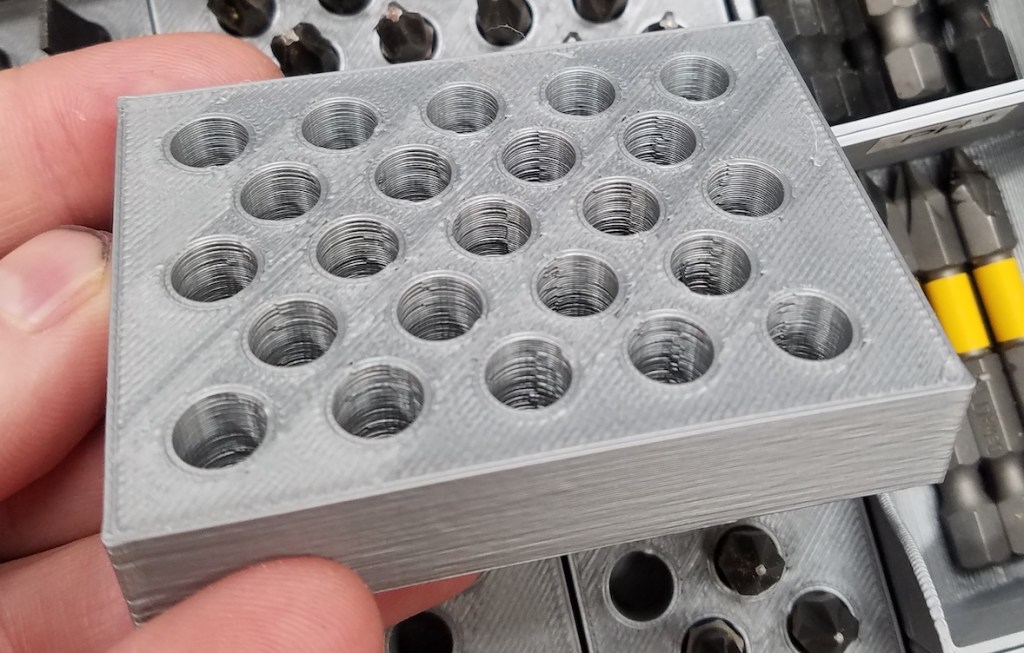
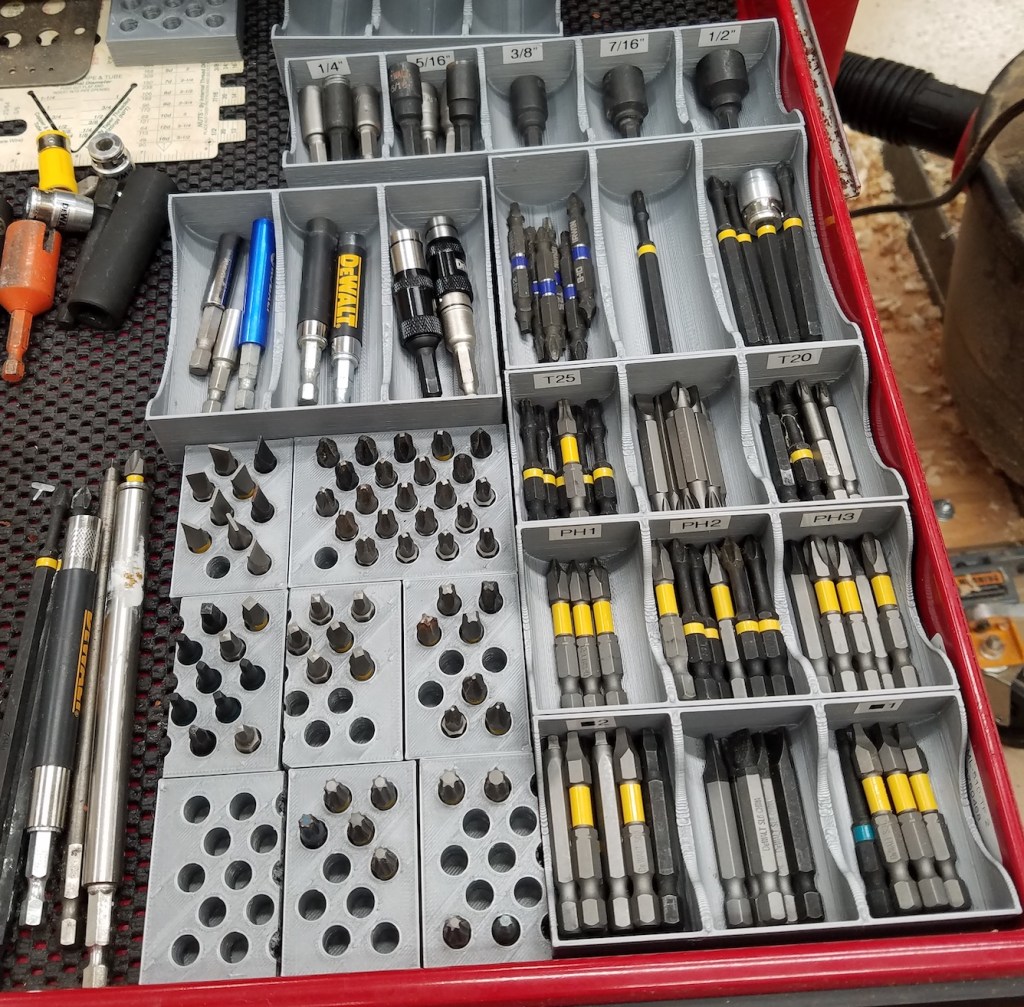
After working on the old and new house for months my driver bits were scattered to the winds. Over time I kind of piled them up in one place, but never managed to get them back into the right organizer box. Instead I decided to revamp the top drawer of the toolbox that holds all my drill press stuff to act as a driver bit organizer space. I printed blocks with well spaced round holes to hold the short bits, and longer trays to hold the various 2″ long bits.

I ended up making smaller versions of the holed blocks. I have a lot of #2 philips and #2 square drives, and only a small smattering of everything else. Now everything is really easy to access and find. I definitely don’t need to buy bits any time this century. Stash beyond life expectancy.

Bench Grinder Stand

My workbench has seen heavy use with lots of projects coming and going. I wouldn’t change a thing about it. My one complaint is that the bench grinder gets used so much it is always attached. Bench space is consumed, grinding grit and junk is often covering the work surface and vibrations tend to shake things off the table. Time for a dedicated stand. I had a pretty good idea of what to build in my head, but took this as an opportunity to practice drawing. I drew a few versions, a full assembly process (I found a better and worse order of operations when doing that), and finally tried to do a few perspective drawings. My ability isn’t great, but practice makes perfect and the process highlighted some minor issues with my original idea.

I picked up an 8 foot 2×8 and started cutting out a basic stand. The very bottom is a 2×12 bit of scrap I had that was about the right size. I screwed it all together and placed a long section of 2×8 on top to hold the grinder and an adjustable tool rest. I found some rubber pads to put on the bottom to keep the stand from walking around and cut down on vibrations.

To keep this thing in place I wanted to add a lot of weight. Sand is about the best thing I can think of that is dense, cheap, obtainable, and easy to store. It is about 100lb per cubic foot in density, and costs <$5 for a 50lb bag. Screws and silicone calking hold plywood to the uprights, making an open topped box shape. The space accepted a full bag of sand. A piece of 2×8 and just sits on top of the sand in case I want to empty it out at a later date.

I bolted down the grinder and attached a veritas tool rest that was previously on a small hand operated grinder. I think it will serve me better here on this highly used tool. The stand is a good height, access is easy, and the weight keeps the vibrations down.

Drill Organizer

The organization bonanza continues. My workbench has been the collector of all things used, but without a proper place to call home. In my last shop I had a place to store my dewalt drills in a hanging organizer above the toolbox. Bits were stored in a little shelf setup nearby. Neither of those made it through the move.

My previous drill hanger was a piece of plywood with some rough cutouts that hung, via zip ties, from wire shelving. It worked pretty well, so I will make a nicer version of that. I measured the drills and tried to make a careful slot for each.

The hammer drill (far right) was a little wider in spots than I thought, so it took a little freehand work to get right. The rest fit beautifully the first time. Everything got a chamfer inlet and a router roundover top and bottom. The back edge is cut at a 5 degree angle to tilt the whole board upward. It makes them want to slide to the front of the slot a little. No vibration or jostling will cause them to fall.

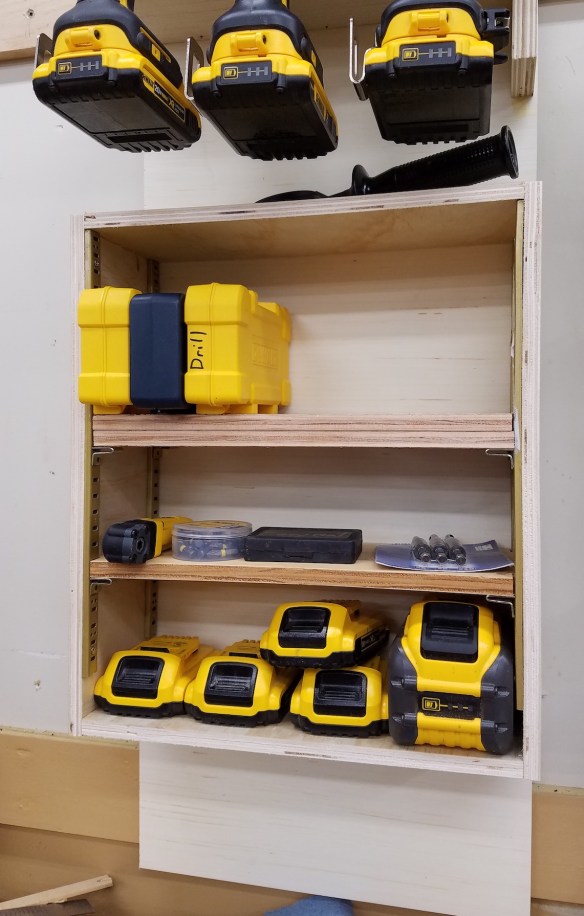
Everything hangs from the french cleat system I already had going. The drill holder was supported with some blocks underneath cut to the similar 5 degree upward angle. Underneath it all I put a box with pilaster rails. They accept shelf clips and are really easy to work with. I have used them in other shop applications like my hardware rack. 1/2 plywood serves as shelves for batteries, and drill accessories.

Instead of routing a groove for the pilaster rails I left them proud. This was easier to manage in the 1/2 plywood sides, and it meant cutting a notch in the shelves would lock them into place, front to back, between the pilaster rails. Everything fits with room to spare and adjustability to accommodate.

Dust Collector Upgrade

I picked up my current harbor freight dust collector probably some time in 2010. For the price it is an awesome deal, but after these years it is time for an upgrade. The motor (lower left in left picture) pulls in dust and blows it into the upright section. Everything swirls around so big dust falls to the clear bag while finer dust gets filtered in the white upper section.

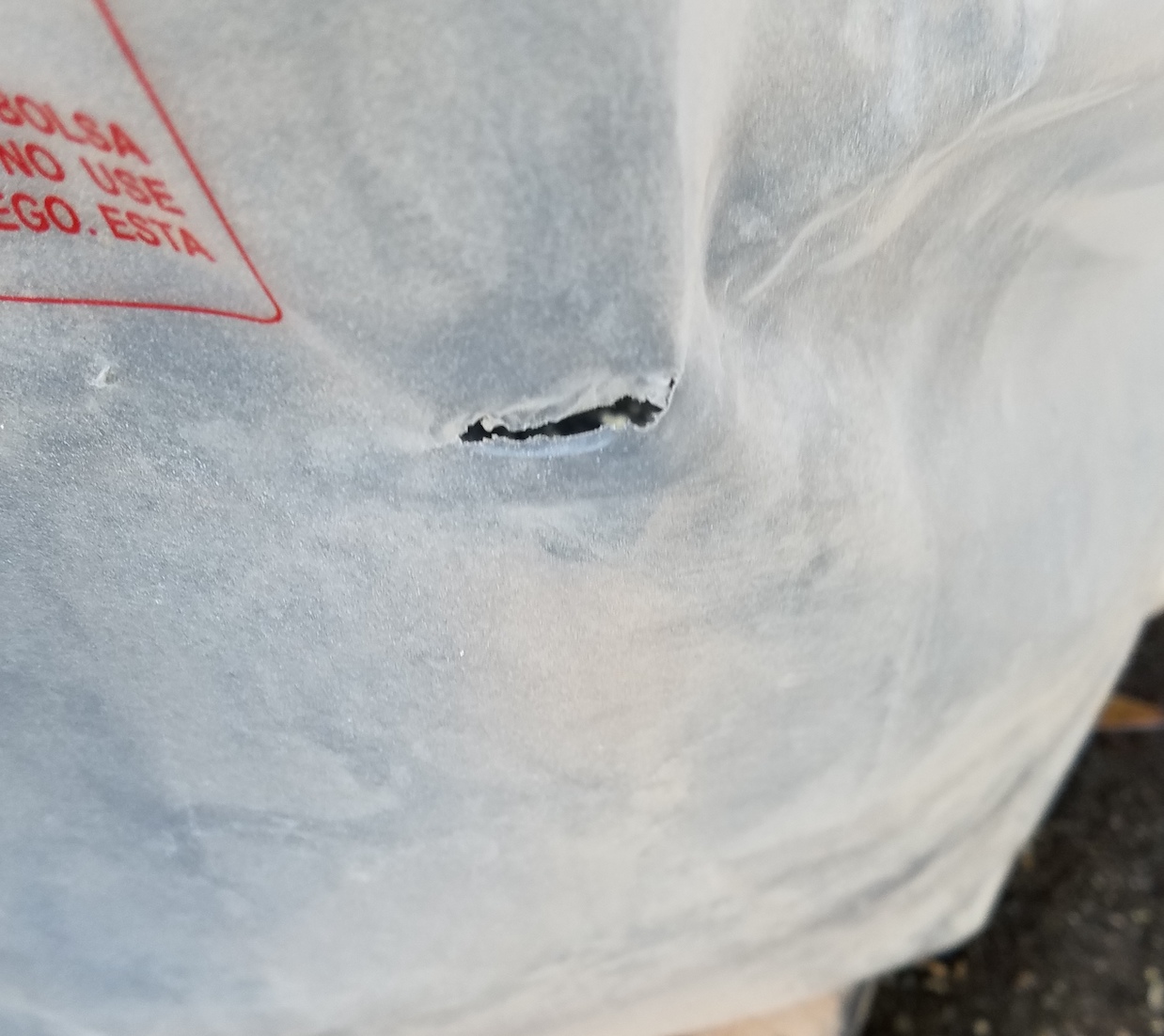
It is an ok principle, but has issues. The upper bag filters down to 5 micron, but no further. A very fine dust will land on everything in the shop when using this for a while. Those finer particles are bad for your lungs. The bag is a pain in the butt to replace and often gets rips in it from sucked up chunks of wood.

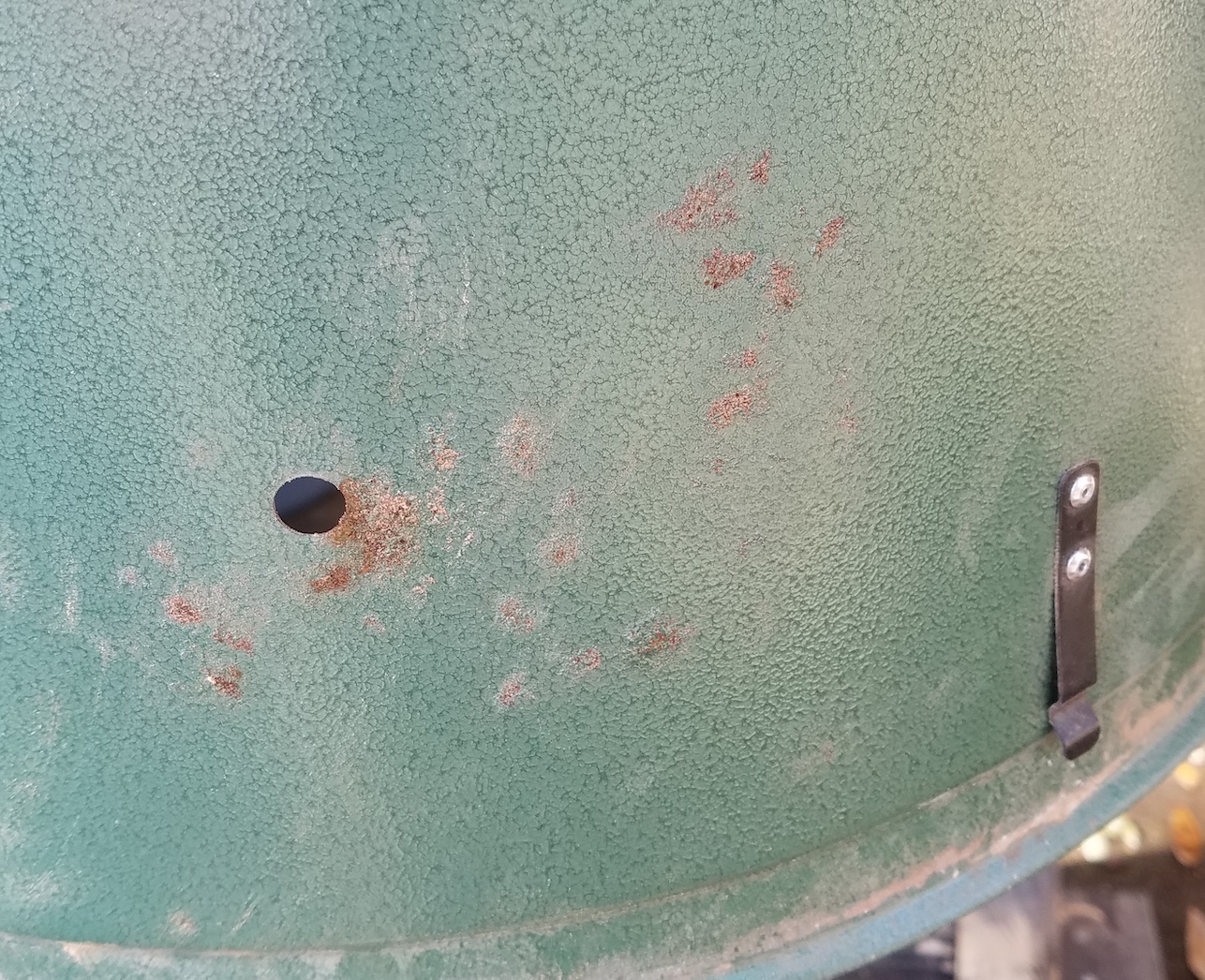
I spent about $350 on this upgrade. Over half of that was the filter. Considering a new harbor freight dust collector can be had for about $180, that is ludicrous. A new tool with good filtering and easier disposal is in the $1,500 neighborhood. We have had a ton of house expenses, so maybe a diy upgrade isn’t so ludicrous after all. I want to keep my lungs clear, so let’s get started. With a dust mask on, I ground off some rust spots and repainted with whatever green I had lying around.

I had thought about doing a lesser version of this many years ago, but never got around to it. I spent a lot of time thinking about how to do one upgrade and make it count. I will show where we are going, then explain the journey in steps.

The motor has been turned sideways from where it originally was. Below it is a pre-separator (red). It pulls out most of the junk before it gets to the filter area. As everything swirls in the upright the leftovers fall into my new bag replacement (blue), and finally out through a new hepa filter (green). Everything gets attached to a mobile base. Let’s start there.


Dropping Some Base

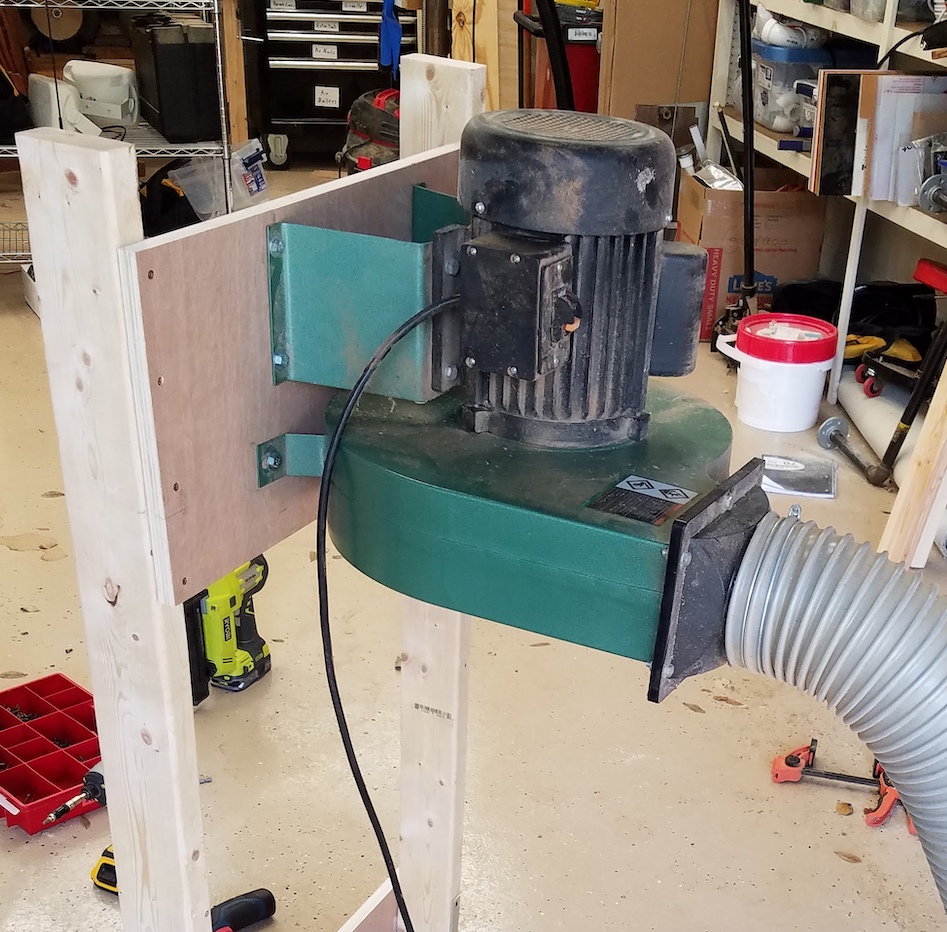
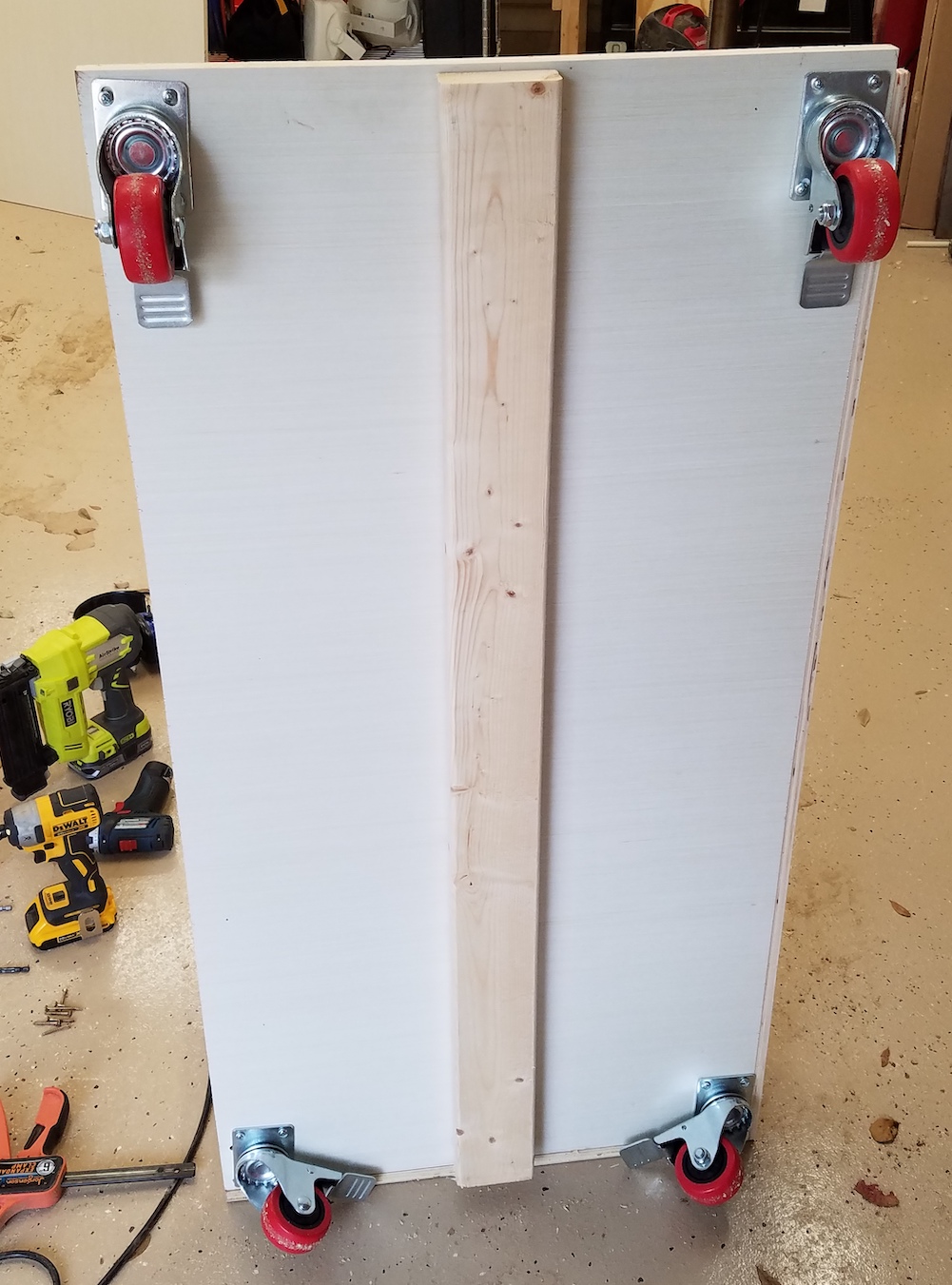
I was going to need more space for the pre-separator and wanted nicer casters than the original assembly, so I started with a cut bit of 3/4″ plywood. A set of 2×4 uprights with plywood and angle brackets support the motor in its new configuration.

The motor is really heavy and caused the base to flex a lot. I added a rib along the right side and eventually a 2×4 underneath to further stiffen the bottom. With that I had a good mobile base for my new dust collector.

I reused the circulator and upright rods to attach that section to the base.


Pre-Separator

Before hitting the motor or clogging up the filter most dust will be caught in the pre-separator. The design is called a Thien Baffle. The exact dimensions seem to be debated, so I just made it up as I went along. Basically everything comes in through a right angle port so it swirls around and gets flung to the edges. Gravity takes over for the particles and the air goes up through the center.

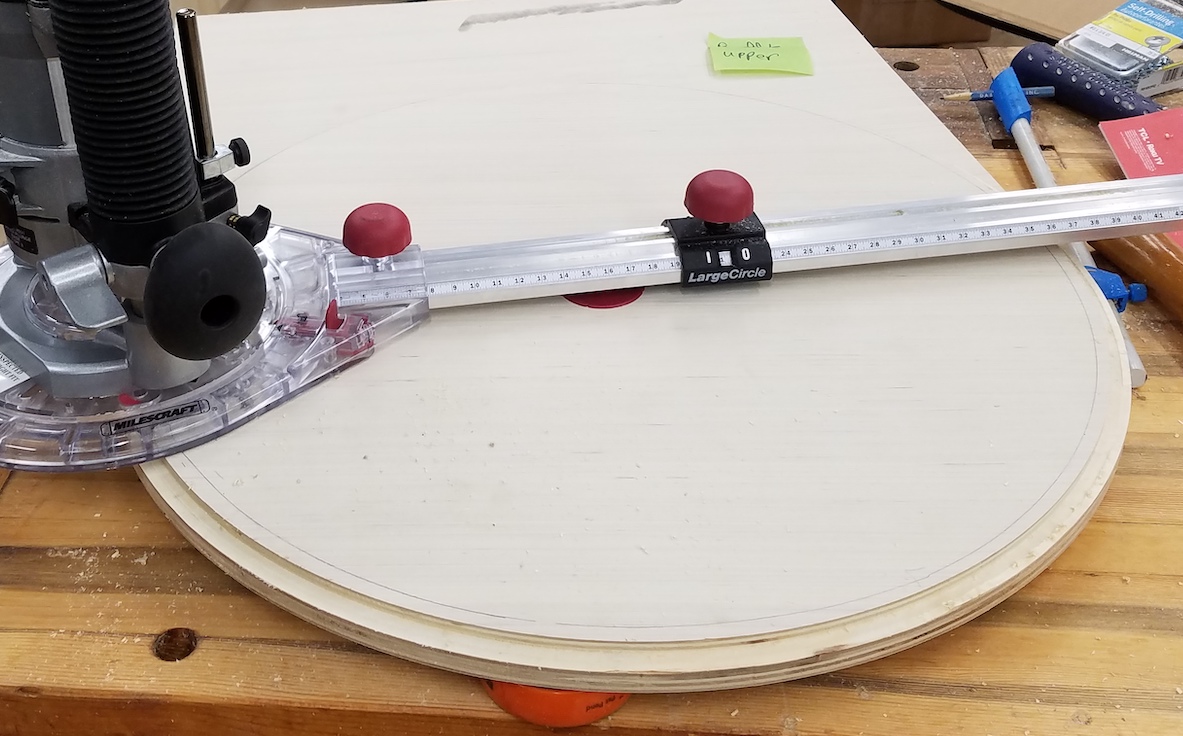
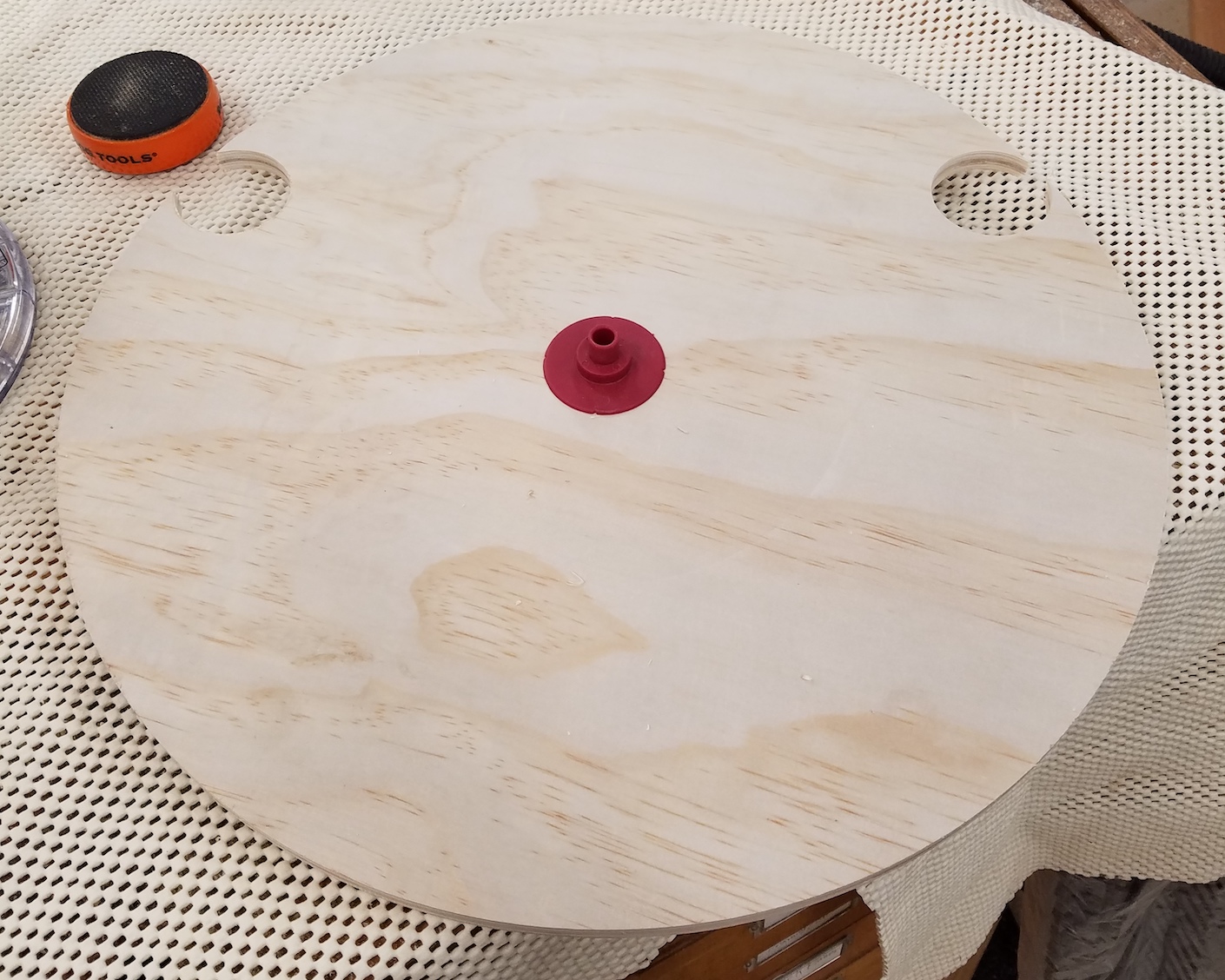
My circle cutting jig came back in full force with a lot of inside and outside cuts. I love this thing! I cut out a top for the separator and added a groove for the weather seal that would go up against the trash can top (left). Next I cut the baffle that keeps dust in the bin from getting pulled back up (right).

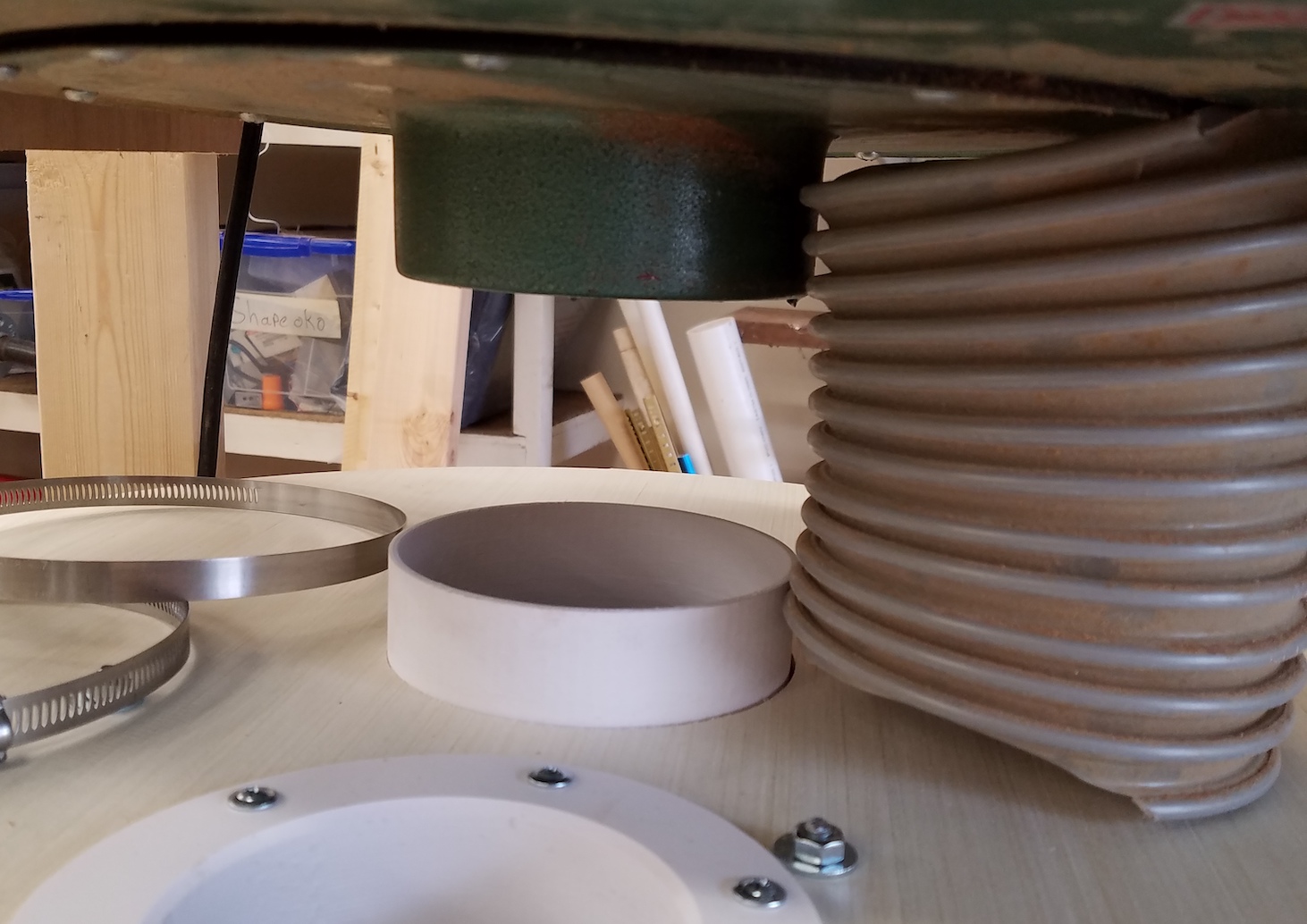
I clamped the two together and match drilled the 1/4″ threaded rods that hold the two sections together. I used the circle jig to drill out the 4″ inlet and 5″ exhaust ports. The inlet port is sized to allow a 4″ right angle dust fitting to slip into the top. The bottom goes onto a 4″ tight PVC drain elbow. I custom printed this to work with the parts I had around. I used silicone calking to seal it and screws to hold it in place. The center is larger and will accept 5″ hose to go between the separator and motor. Same method of silicone calking and screws to seal and hold.

I bolted the bottom baffle on and fitted it all to the metal trash can. This section is before the motor, so it will be under vacuum. I think the metal can will do better than a plastic one in preventing collapse.

I added weather stripping to the lid where it interacts with the trash can overlapping the interface to help form a better seal. With everything underneath I just needed a short segment of 5″ hose to attach the two.

Here is the pre-separator fully assembled and in place.


Bag Replacement

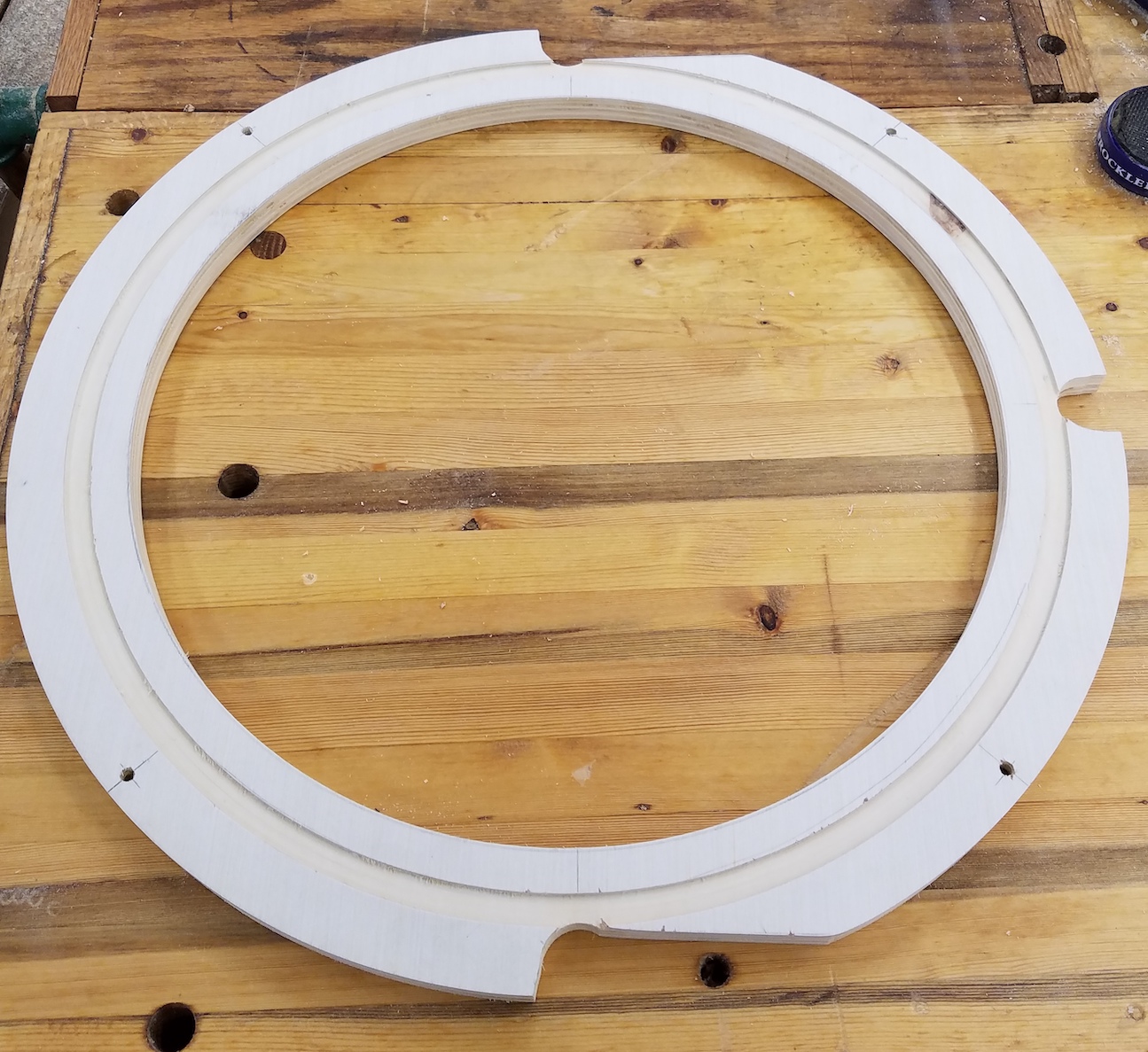
Ideally, most of the dust is already out by the time it passes the motor. Some will still exist and it will need a place to go. Instead of a thin plastic bag that rips and is difficult to install, I wanted another rigid bin. A 20 gallon rubbermade can was just about the right size. I temporary attached two pieces of 3/4″ plywood and match cut the interior and exterior diameters, the cutouts for clearing the metal upright bars, and holes for screwing the two halves together.

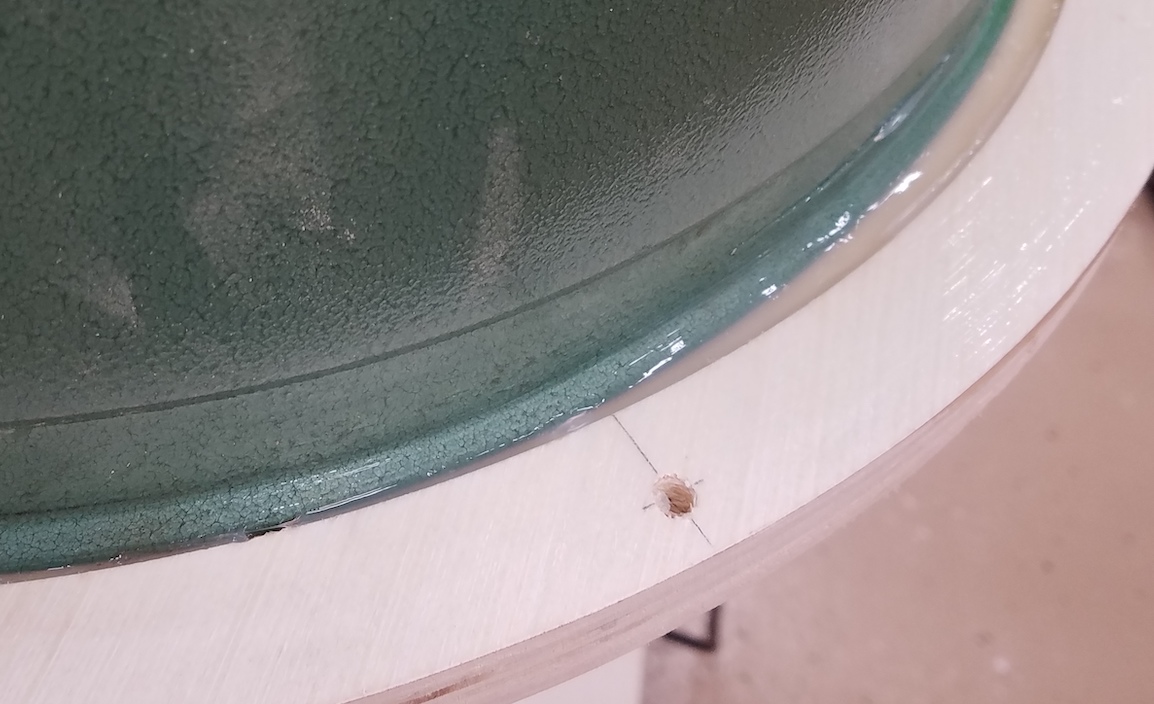
The upper section had a groove in it to lay a generous bead of silicone calking to help it seal with the metal ring of the circulator. It turns out that ring isn’t very circular, so the gap in that groove varies wildly.

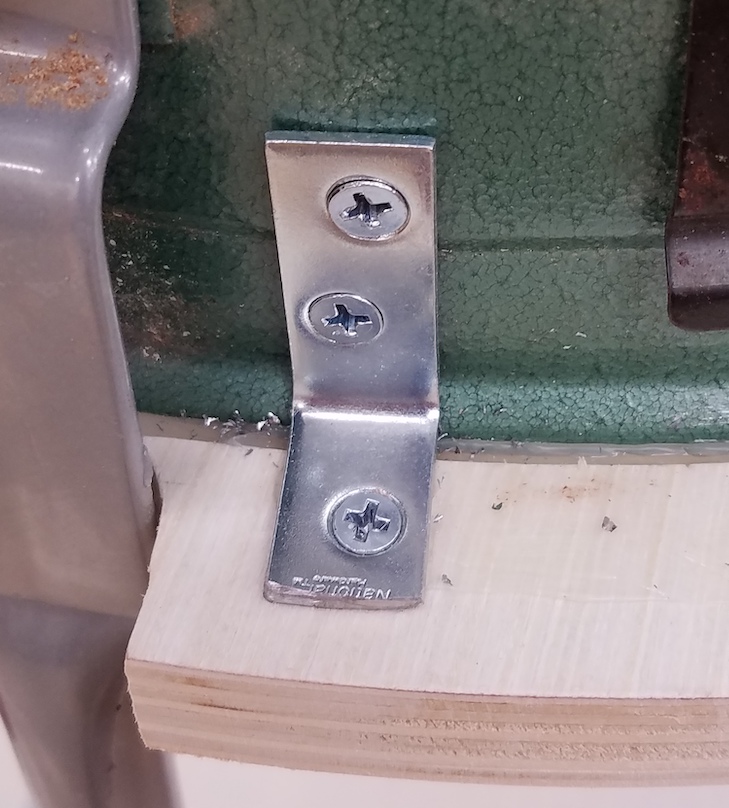
I didn’t trust the calking alone, so I cut down some right angle brackets and drilled/screwed them into place to help support this mating ring.

The bottom half of the mating ring will attach to the 20 gallon trash can. I installed 1/4-20 T-nuts so a bolt can come in from the top to draw the can up and seal it. I put another thick bead of silicon calking on the ring and screwed the can down through the lip. The combo of screws and silicon made for another slid connection.

It is pretty important that you don’t let this section get too full. Otherwise the circulation of dust might get up to the filter and damage it. I cut a thin section of clear plastic and added a viewing port to the can.


Last but not least is the filter. Made in America from Wynn Environmental, the filter is a majority of the cost of the project. The new filter gets down to 0.3 micron instead of 5 micron. That doesn’t hamper flow though, instead of the 30-something square feet of filter the bag had, this one has over 200. The kit comes with little cleats that look like modified hose clamps to strap everything down from the inside.

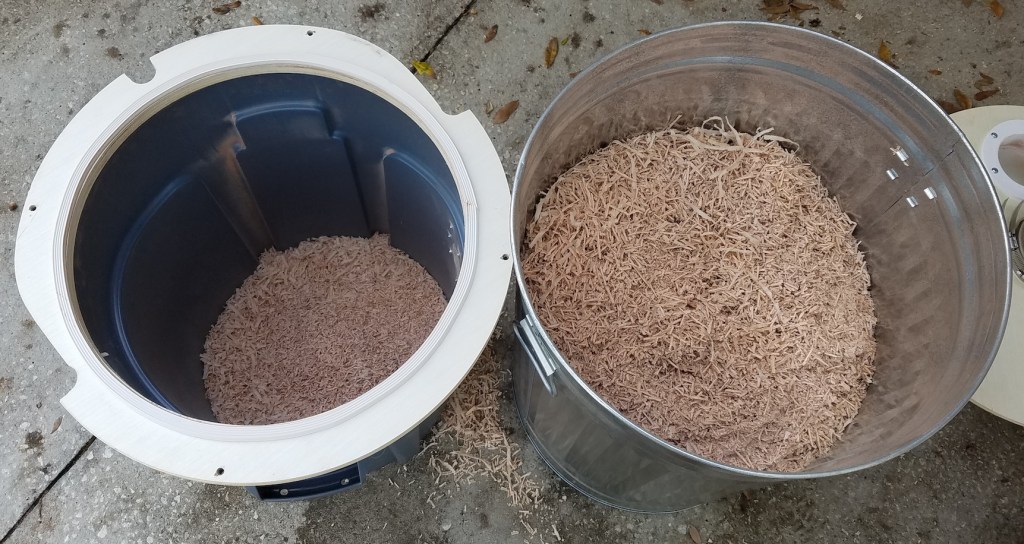
To test out my new vacuum rig I had 20 board feet of 4/4 maple to plane. I got through all the boards and looked into the grey plastic bin. I was horrified to see a pile of shavings in it. I thought the pre-separator had failed to… well separate.

Turns out the pre-separator was past full and the shavings had gotten up past the baffle into the final stage. Good thing emptying both sections is easy and only takes a minute. The newly revamped dust collection rig works well and the pleated filter on top makes it breathe even better than before the pre-separator was added. Very happy with this upgrade.

Vacuum Cart

I am trying to make a commitment to do better dust collection in the new shop. I want to prevent the thick layer of sawdust the was on everything in my last shop, and I want to keep my lungs healthy for another half century or so. I have a few projects coming up that are aimed at those goals. The first being a shop vacuum cart.

I have used a small shop vac for specific applications, but never had a general one to use at different places around the shop. My portable sanders, router, miter saw, and other dust generating tools often went un-vacuumed.

I picked out a decent sized vacuum that had good specs but wasn’t the highest end you could get. It seems like for another 100 bucks you got a few features and a marginal increase in performance. The next level above that would go to the pro-sumer version at 5x the price. Not gonna happen on my current budget. I took some of the old counter top material left over from the previous owner and routed a nice radius on the front.

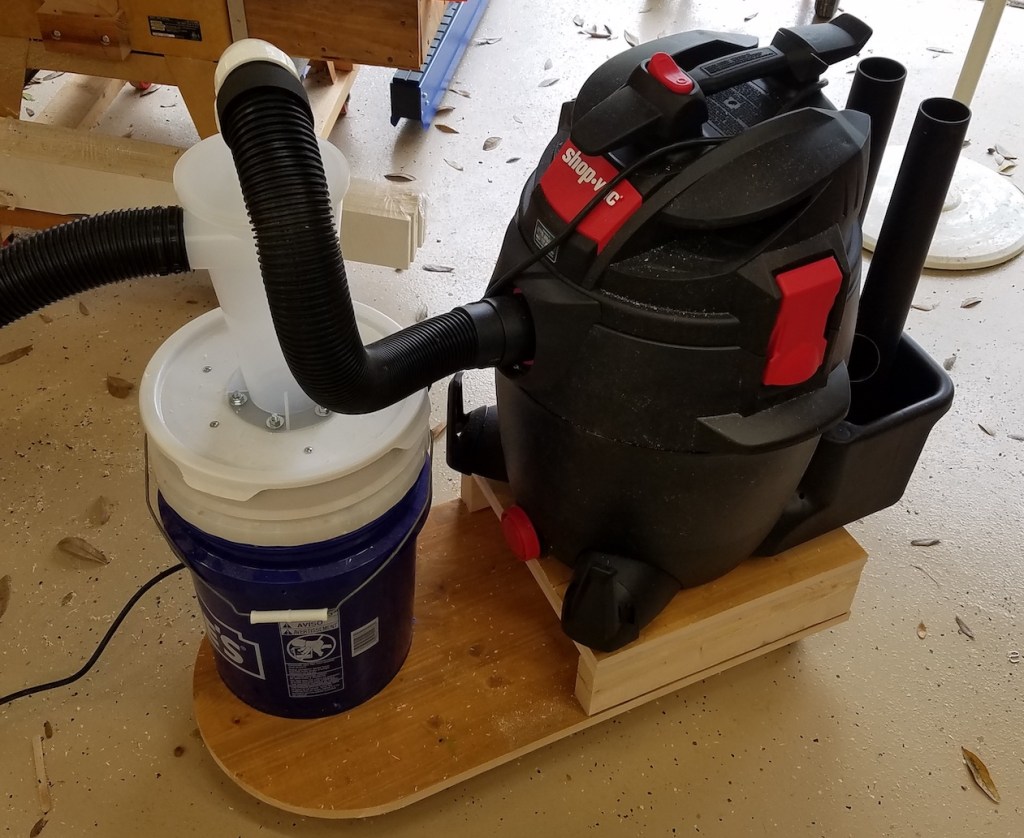
I picked up the milescraft circle cutting jig for an upcoming project, but decided to give it a test run here. What a great jig! Well worth 40 bucks. There is going to be a 5 gallon bucket pre-separator before the main vacuum. I screwed a bucket to the base to hold the separator bucket and built up a platform to get the shop vac higher.

I did a lot of positioning and found that moving the bucket to the right side and rotating the vacuum to the left let the inlet hose clear more easily. I screwed the shop vac down through the base into the platform. Hopefully these screws don’t rip out. If they do I will lose a lot of vacuum pressure.

I got a dust deputy brand cyclone separator. It is supposed to spin the dust out to remove most of it before it gets to your filter. The hose port situation is a little awkward. The port up top goes to the shop vac. Even with elevating the vacuum it is an odd stretch. The hose wants to kink in on itself.

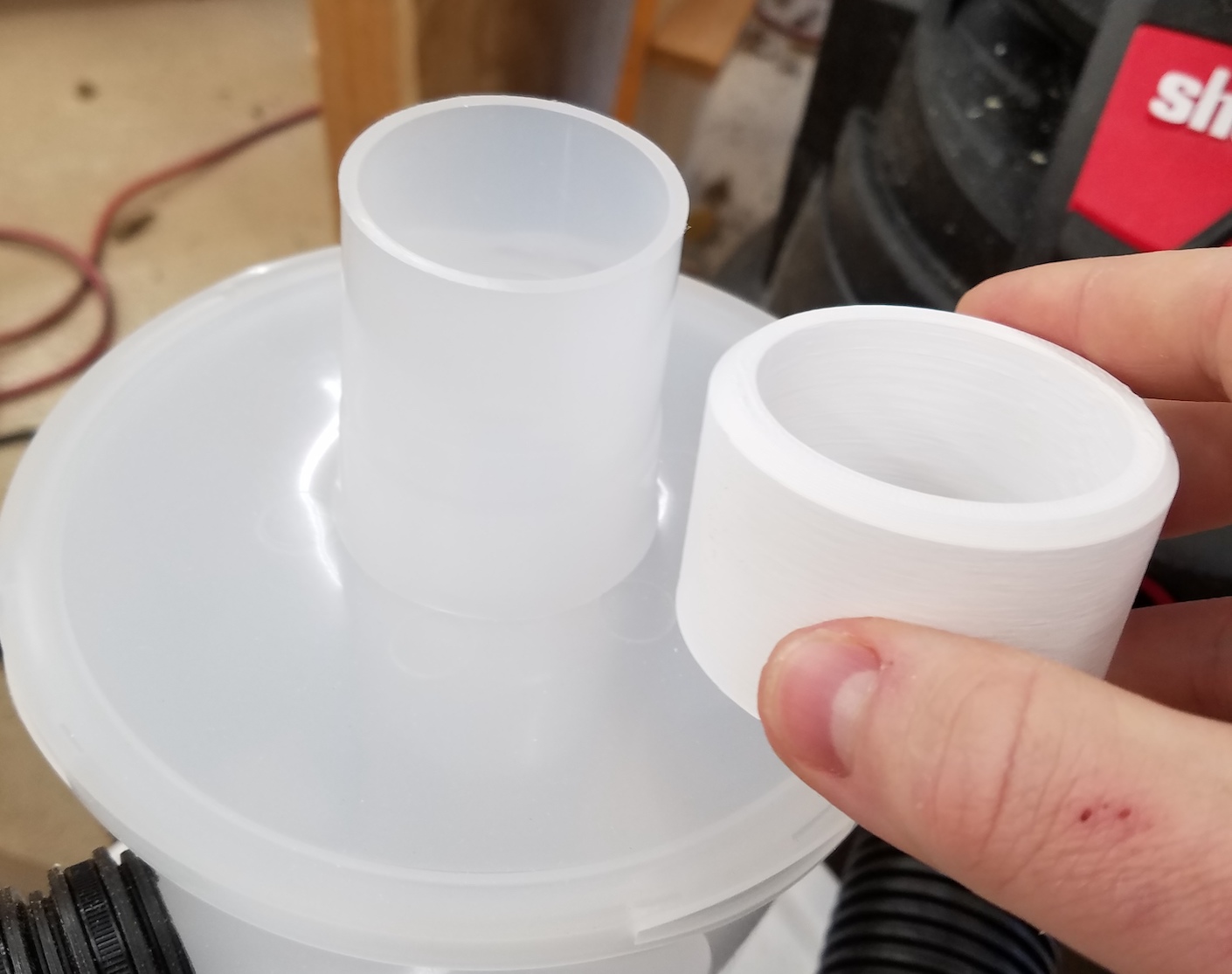
I took kind of a step back and had a think. This calls for some 3D printing. The top of the dust deputy has a tapered shape to it. I printed a matching ring that fits into a 2″ PVC elbow. The printed part got epoxied into the elbow and fits on the top of the dust deputy. The friction fit holds it well and makes a good seal, but lets it be removable.

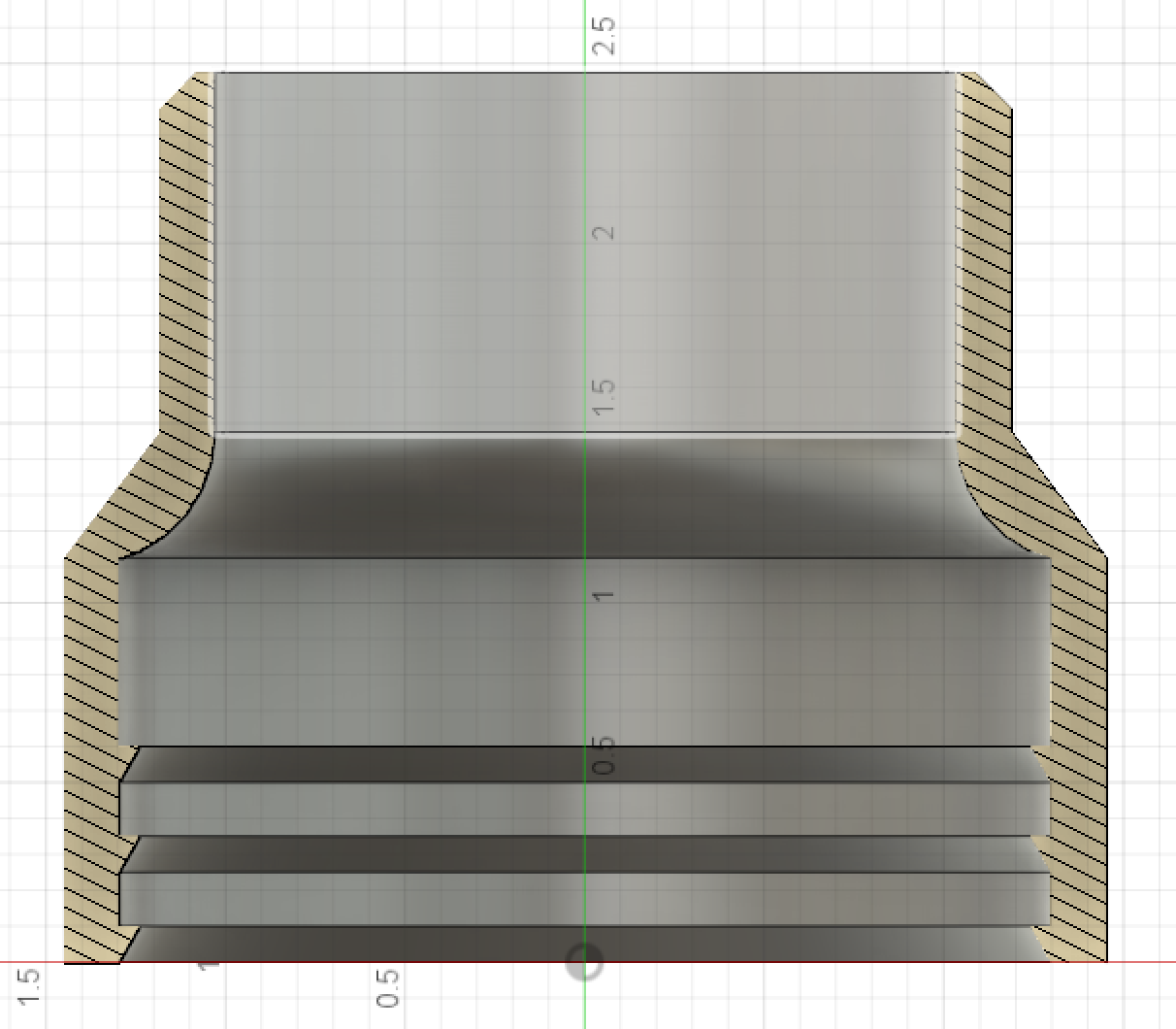
With the elbow taken care of I created another fitting to push onto the end of the corrugated vacuum hose. This one works a bit like the fitting that comes with the vacuum. It slips over the outside and locks into the ridges. They are a 1/4″ pitch. I made a fitting with ramped one way rings inside. It pushes on easily, but is tough to remove. That should form a decent seal as well.
I might bond this part in eventually, but for now, the hose can be removed, and so can the elbow. It makes taking the bucket lid off and dumping the dust easier.

All assembled, I wanted to perform a test. I dumped out the main vacuum body and the removable bucket. I then went around and vacuumed a section of the shop floor around my miter saw and where I had been working on this project. I came up with a few cups of dust, a bunch of leaves and some chunks of stuff. The vacuum chamber was basically empty.

This is great news. Now I can easily empty the smaller bucket instead of the big vacuum. Instead of running a standard pleated filter I can use a bag. The bags get disposed of, but have a finer filtration level. With 99% of the junk getting caught in the vortex, the bags will last a long time. Plus, anything that might puncture a bag will get filtered out.

I have been using this a lot with my router for a really big dust job and everything has been working wonderfully. If you are thinking about adding a dust deputy to your shop vac, do it!

Hanging Bosch Flexiclick Station

I happened across a Bosch flexiclick around the black friday season. It is a 12V driver with interchangeable heads; offset, hex driver, and regular 3/8″ chuck. Any of the 3 can go on a right angle attachment. It is pretty genius. I have owned their pocket driver for a few years and love it to death. I liked it so much I built it a portable caddy a while back. This new driver needs a home too.

I started by imaging a few things I wanted to make prints for on top of my cutting mat. It provides a good grid reference when making things in CAD. That usually gets you a 90% solution. The drill body will need a holder and the charger has no wall mount ability. Usually they have some key holes in the bottom to let you hang them from a screw.

I have a wall section with a french cleat so I arranged all the holders until I got a compact layout. Here are all the printed parts screwed down on a scrap board.

Starting off at the top is a plate that holds the charger. It is shaped like the charger with a channel underneath to allow a zip tie to pass through and hold it down. A cleat on the bottom keeps it from slipping down. The one zip tie wrap has been sufficient in holding it down with battery connects/disconnects.

The drill body has a nub sticking out where the various heads are removed. I used that to provide a good lock in mechanism. It is sturdy enough to have not fallen off yet, but is easy to plug in and out. The bottom bent section has some flex to it which is part of the magic.

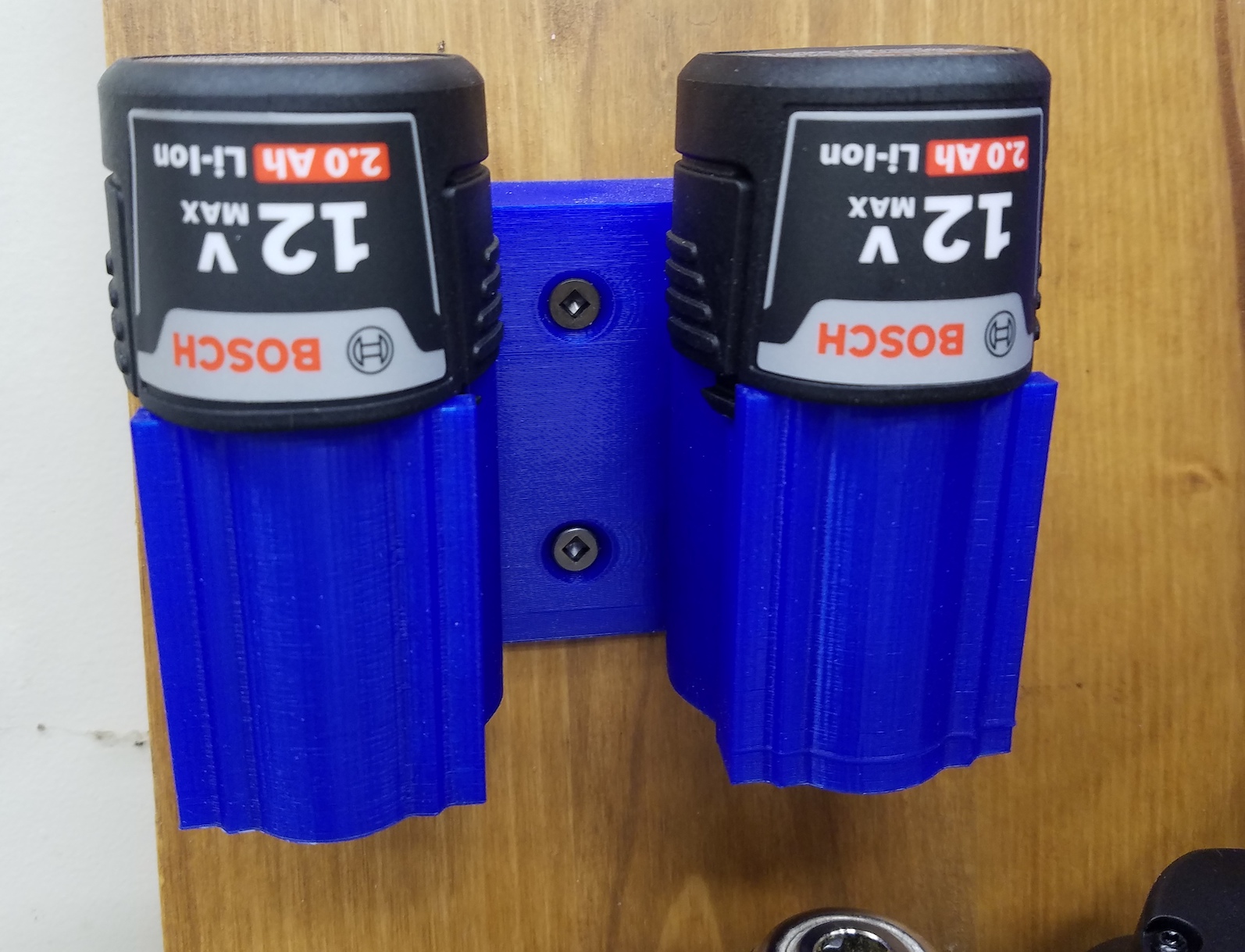
The battery holder is not my design, Thingiverse link to the original designer.

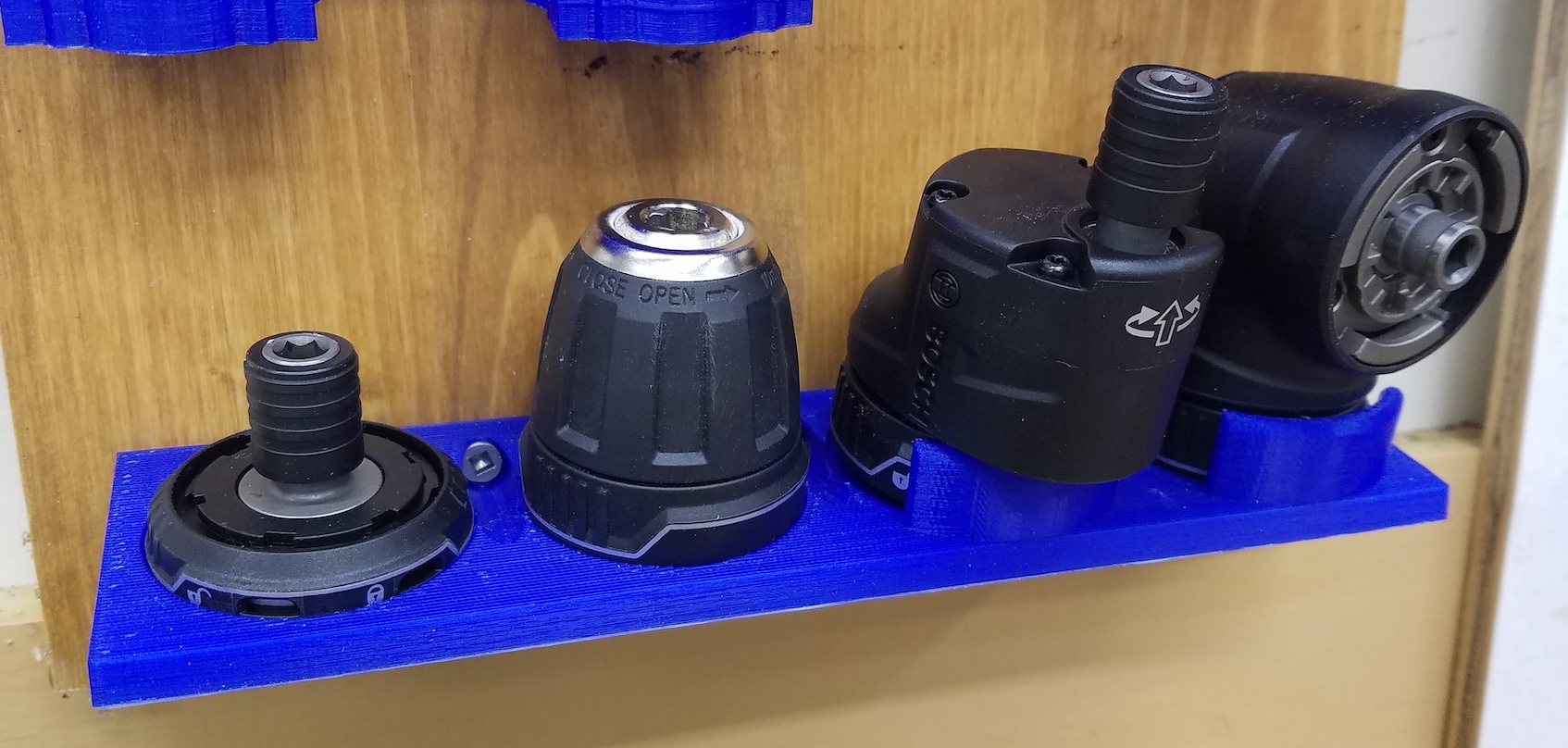
Last but not least is the tray that holds the flexiclick heads. The right angle and offset attachments have a high enough center of mass that they need a little helper support to keep them from toppling over.

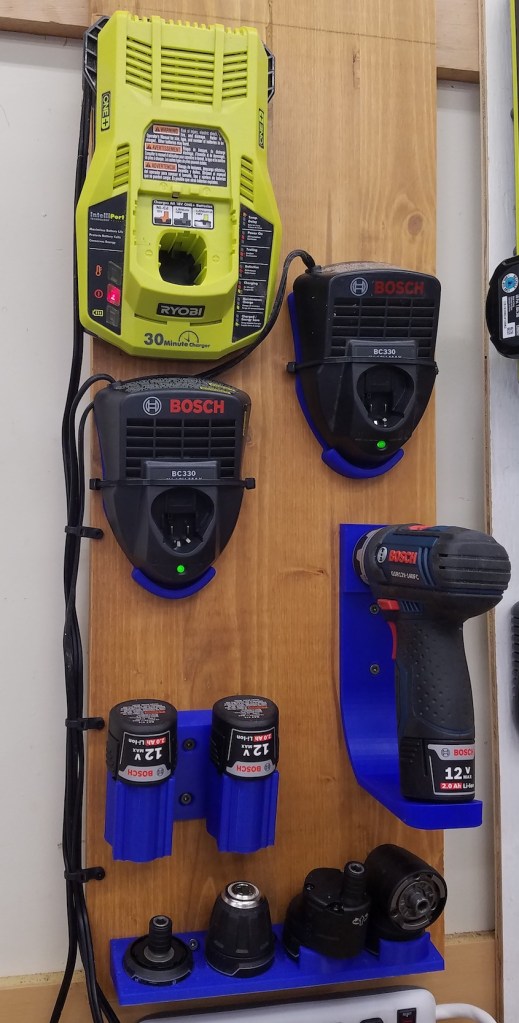
I bundled my three original designs and uploaded them as a group to Thingiverse. All together fully populated and with the wires bundled up, it looks like a nice drill station. I had room left over so I stuck a Ryobi charger on there for good measure.

If I were to do a review of this tool I would say it is good but would have been a lot better if it were brushless. Trying to mix this many functions together always results in some compromises. Still, I use it for small light drilling quite often, and the offset driver has gotten me out of a bind.