Drawer Dividers

While the cabinets were being installed I was hard at work making accessories for the drawers.  Most commercially available drawer dividers had a few strikes against them.  They were either plastic or bamboo (doesn’t match my maple cabinets), they weren’t very adjustable, and most don’t fit the narrow drawers next to my stove.  So I made my own.  The first trick is to take two thick boards and make four thin boards.

I resawed (cut standing on edge in the bandsaw) these two 3/4″ maple boards to make four slightly undersized 3/8″ boards.  After a few trips through the planer to clean up all the heavy bandsaw marks they were all about 1/4″.

I could have tried to glue various thin pieces together to make dividers, but wanted to include 1/4″ plywood as a bottom.  It would make the thin dividers a lot stronger to glue along those long edges.  I pulled out some silverware and got to settings sizes.
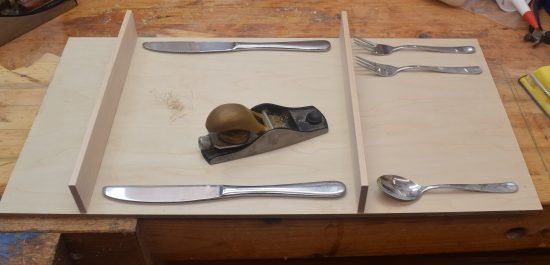
dsc_0654

Every edge got a few swipes from my lovely little lee neilson tiny block plane.  That thing is perfect for knocking down sharp corners.  Once I had all the dividers in place for a particular drawer I applied expert and professional clamps until the glue dried.

dsc_0656

Drawers full of spatulas and cooking spoons needed backup in the rear to keep them from leaning, so I used a short segment to shore them up.

dsc_0657

I had planned to divide out our junk drawer and a drawer full of odds and ends, but that doesn’t appear to be feasible.  Entropy will reign supreme in those drawers for the time being.  I did however get all the heavy use drawers near the stove well organized.


dsc_0683As a bonus I had extra thin cut maple left over.  I want to use this stuff up quickly.  At these sizes and with it being flat sawn, it will cup and bow quickly.  At work we stretch regularly using a deck of cards with different stretch moves.  The box the cards came in was complete junk.  I thought having a two sided card caddy would make transport and use easier.

The cards are in a tray at an angle to keep them from falling out when carried.  As you do a stretch the card moves from the face down side to the face up side.  Eventually you get through all the stretches, shuffle everything and start over.

dsc_0684

I took this as an opportunity to try two new things.  The first was liquid hide glue.  I have been hearing a lot about this (very old) product recently.  Long working time, reversible and low visibility under finishes made me very interested.  It was a fine glue, I will be using it more.  The next was my  new pin nailer.  It worked miracles on my quarter round baseboard molding and did a great job sneaking pins into this thin stock.  The pin heads are only somewhat visible on the flat sides.  It wasn’t the best usage case, but I like them a lot.  They kept it clamped and are much lower profile than brad nails.

Storage Bed Frame Phase 1

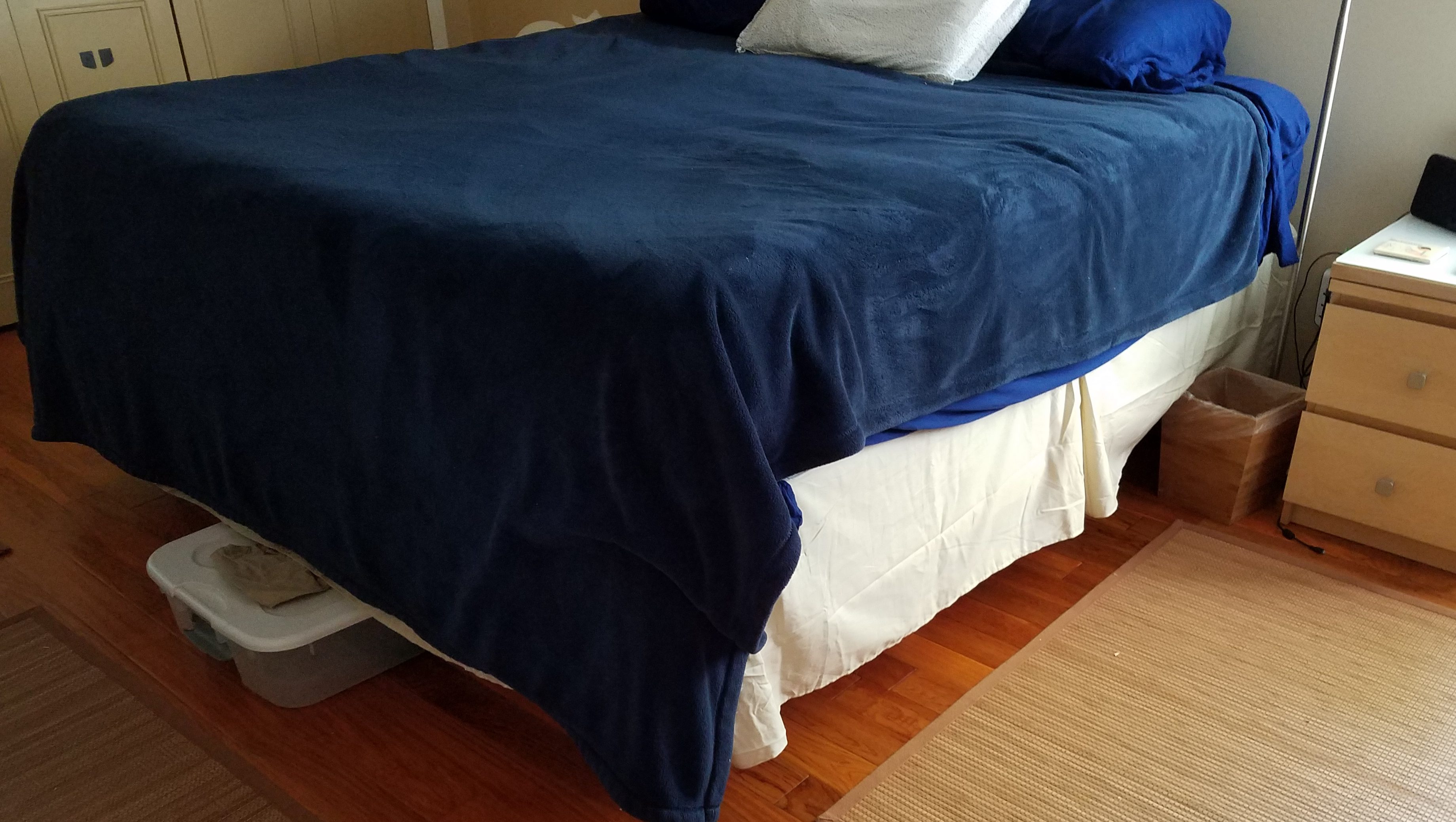
Storage is a premium in our house and rarely used bedroom items like blankets and extra pillows take up a lot of space.  I looked around for ideas and instead of trying to build a better chest of drawers than we currently have, I went for a new bed frame with storage.  I couldn’t find many good examples of bed frames that keep the boxsprings and provide a decent storage solution.  So I designed my own.

The frame is going to be in two halves that are joined by a narrow bit of plywood to tie the two together.  This makes each half narrower and lighter, and get it the right size for drawers.

Most of the body parts are made of plywood that will get covered in maple face framing.  I used pocket holes to aid in assembly and came back afterwards with screws from the other side to help with strength.  Each base has 3 cavities of the same size.  The ones closest to your head will have a false drawer front because our night stands sit too close for them to be useful.

The drawers are going to be big and heavy, so instead of messing with metal drawer slides I am just going to have them slide on the floor.  Each drawer cavity got some clean pine along the edges to help horizontally guide the eventual drawers.  Everything is recessed 6″ to prevent me from banging my foot on the corners like I always do with our metal bed frame.

DSC_0164

The left and right half with drawers all needed face framing.  I hand planed all the surfaces, and went with waterlox varnish (a thinned tung oil) for the finish based on my lessons at the tampa woodworking show.  I am pretty sure I applied it too heavy, but I really like the results.

I did the same for two long sets of rail to go across the upper portion of the drawer area.  It isn’t a traditional way to do face framing, but it was much easier to do and will still look good.  Everything got strapped down with pocket hole screws.

DSC_0209

With all the face work done I could finally assemble the whole lot.  Pocket holes around the edges will hold on the lip that keeps the box springs from falling off.  I screwed up a cut and had to do the center spanner in two pieces instead of one.  A few alignment instructions later and it was ready to install in the bedroom.

DSC_0163

The installation went pretty well and after a few weeks of sleeping on the frame we are really happy.  The height is good, the frame is sturdy and no banged toes!

20160524_184303

Currently I am using a few pieces of pine as the boarder to keep the box springs in place.  I need one across the head, because the boxsprings have slid up since we installed them.  The bedskirt ended up covering most everything.  I was going to be more decorative with the box spring trim, but now will probably keep it simple.  Phase 1 complete, phase 2 will be the trim and a piece to cover up the bottom face, and phase 3 will be the drawers.

20160524_184325

Cheese Boards (Part 1)

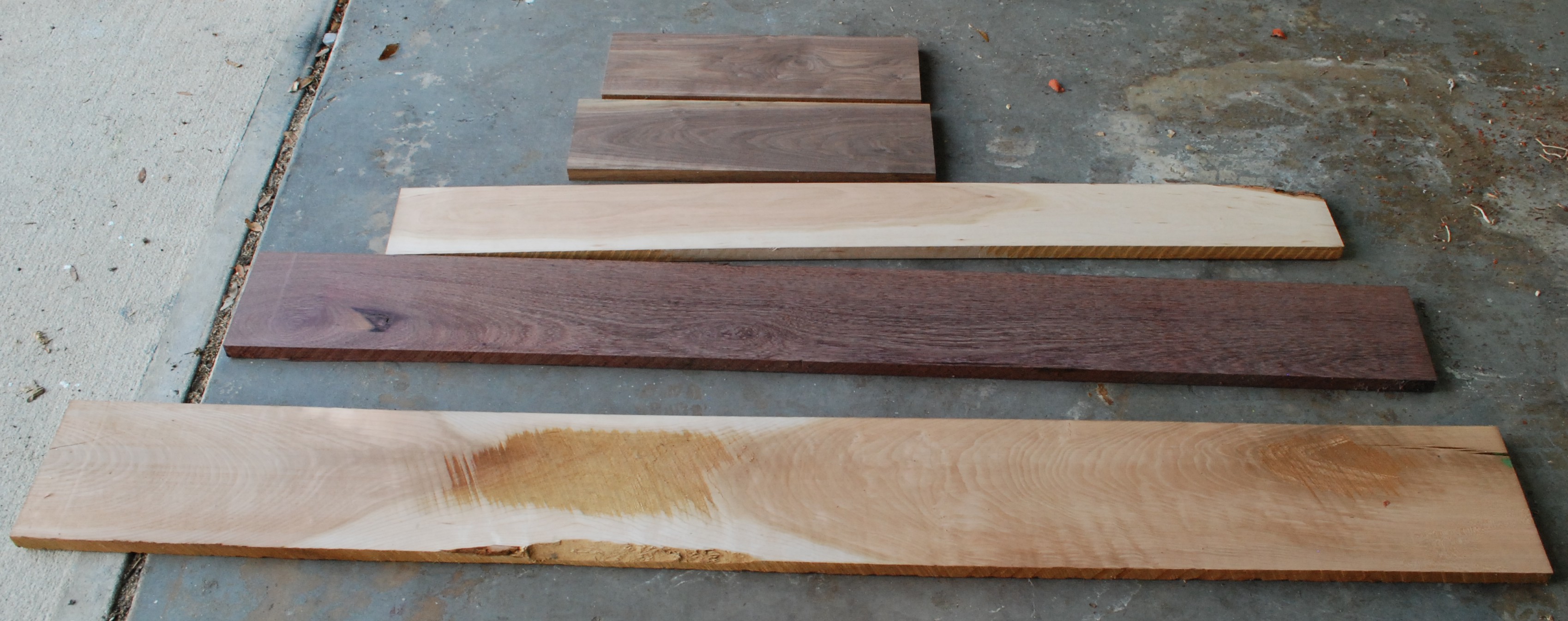
In the beginning of December I took a look at my wood pile and decided to kill two birds with one stone.  First, get rid of a lot of one off boards I have lying around, and two, make a ton of gifts.  I made a big pile of handles for pizza cutters, ice cream scoops and the like on my lathe.  Every once and a while I want a quick gift, and bam, there it is.  Lets start with my smattering of wood.

DSC_0481

DSC_0482

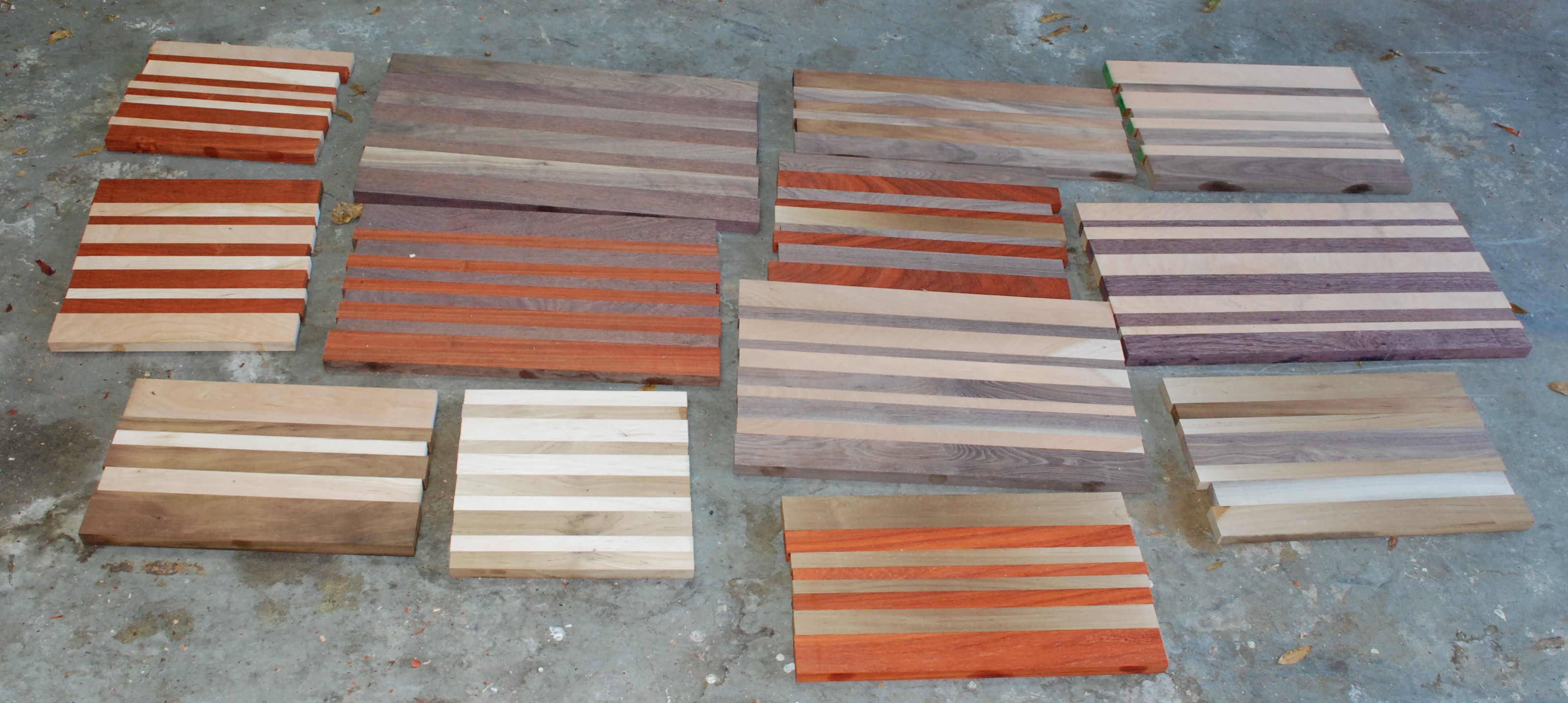
I later added my roasted hardwood to the pile.  Everything got planed down to an even thickness.  I started to take a picture of each board glueup, but I started going through them so quickly I forgot the pictures.  The plan was to run them through the thickness planer, so I didn’t need the top or bottom to be perfectly aligned.  This let me just use side clamps and ignore cawls.  It was quick and easy, and I had enough clamps to do 4 or 5 sets at a time.

I glued together everything I was going to make in three big waves.  Many of them I made long enough to cut into 2 or 3 cutting boards.  Much more efficient than doing each one individually.

After glue-up

After glue-up

Cleaned up from the power planer

Cleaned up from the power planer

I took about half the pile and moved forward.  I was running out of time before a big house renovation and wanted some to get finished before Christmas.  Everything got squared up on the table saw, and a nice round-over on the router table.

After a minimal sanding on the faces and round overs, they were ready to get oiled.  I like to use howard’s butcher block conditioner on these long grain cutting boards.  It has a little wax in it which works better for long grain in my opinion.  I love how the colors come out when you just start to hit them with oil.  Below is a shot of each one half oiled so you can see the before and after color.

DSC_0008

DSC_0009

I have already given most of these away, and will have to get started on the next batch soon.  I also plan on making a nice video to discuss the care and feeding of these cutting boards for anyone that has one.

Hardwood Roasting On An Open Oven

Tis the season for merriment, delight, and cooking wood.  No, I haven’t been hitting the egg nog too hard, but I did read a great article in popular woodworking recently.  It turns out you can roast some hardwoods in your oven and get a lot of great effects out of them.  I started with cherry (left) and maple (right).

DSC_0508

It turns out they couldn’t all fit in my oven.  I might have to get a rib rack or something to stand them all up next time.

DSC_0510

In they went for 4 hours at 360F.  There was an odd smell, and a mild smoke that was given off in the process.  Luckily the weather was good enough to have the doors open.  I wouldn’t attempt this if you don’t have some means of ventilation.

The results were quite striking.  Everything got darker, but it didn’t do so evenly.  Some boards have a really neat gradient across them.  The insides are a bit lighter than the surface, but not a lot.  The cherry is my favorite!

DSC_0512

Maple

DSC_0513

Cherry

One issue with using roasting wood is warpage.  I left them to re-stabilize in the shop for a few weeks before working with them.  Regardless, they were warped and twisted, and had a lot of internal stresses on the table saw.  Be really careful when cutting and make sure the splitter is properly in place.

I should be posting a project soon that used up some of these beauties.

Pinball in Cube

This goes nicely with my nail in the block “puzzle” as a way to confound coworkers.  Once again it takes advantage of wood’s ability to swell along the grain when wet.  I started with a 3″ block of maple and drilled centered holes all the way through.  I had a 3/4″ pinball, so 5/8″ was the drill diameter

After looking at it for a bit, I felt like the holes were too small for the total block size.  I needed bigger pinballs or a smaller block.  The install was pretty easy.  I dunked the block in a bucket for a day, and then pushed the ball in on my wood vice with the help of a small 1/4″ deep socket.  The hole still looked ok, but I threw it back in the bucket for a few hours to make sure it returned to its original shape and size.

With the ball installed and everything dry, I took it back to the table saw for a diet.  All the edges came down till the proportions seemed right.  I liked the look of the chamfer, but my crummy chamfer bit chewed up a few edges.  Still, overall it looks nice and should leave some heads scratching.

Wooden Comb

My goatee is getting pretty long and is need of some combing.  I could buy a regular comb for a few bucks, or I could spend hours making my own.  Is it even really a choice?!

Looking at what others have done, the table saw seems to be a popular choice for making the tines.  I figured a 1/8″ mill bit would do a pretty decent job, so lets mill this puppy.

I created a basic low profile pick that fit on some thinner scrap walnut I had available.  I really like how it looks with the lighter sapwood on the one edge.  A relief of half the thickness let me easily inlay some maple.  The grain runs counter to the walnut for strength and is proud a bit to help with holding.  It took a pile of sanding to point the ends of the tines.  A power sander made it pretty quick, but manual sanding is completely possible.  After glue-up and sanding I gave it all a coating of spray lacquer.

So far my goatee is happy with it.  A little oil and a comb post-shower seems to make it lot more manageable.  After all, there is nothing worse than a bad beard day!

DSC_0148


Yarn Swift Add On

My wife is into knitting in a serious way.  She was given a partial antique yarn swift by my mom some time back.  It is missing parts, but otherwise should work just fine.  It needs some kind of base, and a clamp to hold up the upper umbrella portion of the swift.  With her birthday coming up soon she suggested finishing the swift would be a good present.  Great!  I hadn’t had any good ideas on what to buy, so lets make something.  I don’t know what the original was made out of, but the wood and finish were very dark.  I made mine out of maple because it was what I had around, and it distinguishes the antique from my work.

Start with the finished product in action!


Clamp

I started with the clamp.  A small block with a hole in it and a slit cut across it acts as a clamping mechanism.  I drilled a hole through the forked section, and even chopped a small square hole so the head of the bolt does not spin while tightening.


Base

Next I moved on to the base.  The post needs a place to rest in, and I have a bit brace and some old screw bits that belonged to my wife’s grandfather.  Might as well use a family heirloom to make something that should hopefully stay in the family a long time.  After a few minutes of sharpening the bit sailed through the maple stock with ease!

wpid-20141023_191807.jpg


To make the clamp portion I cutout a wide center section.  I sawed out the edges and carefully pared out the rest with a wide chisel.  Yet another time when having a router plane would have been useful.  I used another bit to bore from underneath and install a threaded insert in the bottom.  A modified 1/4″-20 bolt will act as a screw clamp so the base can be clamped to any ledge.  A piece of maple is captured on top of the bolt with a small bent metal clip.  This keeps the moving portion of the clamp from falling off.  I used tung oil on everything and glued leather to the clamp faces to promote grip and prevent scratching.

Happy Birthday Honey!

Liquid Inlay Failure

AKA Always read directions carefully

The plan was to make a small sign that said “CUBE sweet CUBE” for a friend/co-worker and myself.  I was going to mill some lettering into a nice piece of wood, and fill the pocket with colored inlay resin.  I will introduce the mill in a post soon.  Until then, I want to share a complete screw up I had.

I started by re-sawing (Cutting in half length wise.  It turns a thick piece of wood into two thinner pieces of wood) a scrap piece of maple.  Some quick sanding got the tops flat and ready to go into the mill.  A 0.063″ mill bit did a great job of removing material where the text will be.  I sprayed both pieces with a quick coat of lacquer to keep the dye from soaking in along the grain.  With the woodworking over, I moved on to filling the text area with a colored epoxy resin.

I taped off the area to be filled with black and mixed up the product.  The inlay filler I used is a resin with dye made by Inlace.  I metered out an ounce of the black resin and put in the proper amount of hardener.  After a good mix I poured it into the “CUBE” letters and let it sit.  There was a bit of shrinkage, but the results seemed ok. Next I switched to the “sweet” area and mix up the red resin with a proper amount of hardener… or so I thought.

It turns out that the black I got was both resin AND dye pre-mixed together.  The red, was just dye.  It is supposed to be added to clear resin.  12 hours later, It is still liquid, and I am sad.  I can’t come up with any good way to wash out the offending dye.  I think this is going to have to be a do-over project.  In retrospect, the lettering is a lot deeper than it needs to be.  A big waste of resin.  Unfortunately this stuff is hard to get.  I can’t find it in town, and no one online carries inlace’s full product line.  I might try to find their clear resin and do it over, or I might try someone else’s epoxy dye that is more attainable.

Shooting Board Handle

I have been using my shooting board a lot the past week.  It was becoming hard on my hand because of a lack of handle.  You just kind of grip the side and push.  After a while that starts to hurt.  Some of the more expensive planes made for this purpose have an angled handle, or a “hot dog” handle near the middle of the plane.  I decided to make one that sits in the middle of the plane.

I took a chunk of maple I had sitting around and got to work tracing out the shape of the plane onto the wood.  The edges of the trace were chopped out to allow for pairing with a chisel.  This is one of the many times that I wish I had a router plane.  Maybe next year.  With the center area cleaned out I cut out the handle and did some rough shaping.  The plane sits well in the cut out pocket, and with a strip screwed down across the back, It feels very solid.  I can still get the blade in and out even with the handle installed.  I might continue to shape the handle for comfort as I use it.  Otherwise, it is a huge improvement over the nothing I had before.