Prusa Spool Upgrade

When I got my current 3D printer, I quickly upgraded the spool holder.  The original worked ok, but was a pain to load and adjust in width.  Every spool manufacturer has different widths to their spool.  The spool support I found on thingiverse was easy to adjust and load.  Eventually it had issues though.  The black threaded shafts that held the bearings in place started breaking off.  I installed 5/16″ bolts as a replacement.  Left photo was the original installation, right photo shows my bolt mod.

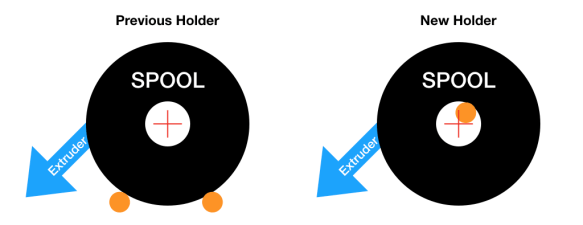
As those shafts failed they caused a lot of rolling resistance on the spool, and it ended up failing a few prints before I diagnosed the issue.  The bolts help, but there is a fundamental issue.  They hold the spool at the outer edge.  Any force imparted is a long distance from the axis of rotation.  If it were held in the center, then it would take a lot more resistance to induce the same torque.  That is how the original supports worked, so maybe they were on to something.  A diagram might help.
Spools.001

The extruder will pull at roughly the same angle and with the same force in either setup.  A full spool will be heavier and require more force to spin, but the filament will be at the outside edge, far away from the axis of rotation (red cross hairs).  This produces higher torque.  Think of putting a pipe on a wrench, you can push further away from the axis of rotation, which makes more torque.  My old setup (left) held the spool at the outside edge (orange dots), far from the axis of rotation.  My newly devised holder (right) runs through the middle.  Even if it doesn’t spin well, it can’t impart that much torque on the spool.


I heard Adam Savage give a good talk about how everything you try involves a lot of failure and trying again.  He was suggesting maker spaces nail to the wall (literally) the progression of projects to show that it takes effort and that nobody gets it right the first time.  I wanted to show some of my work on this one.
DSC_0964

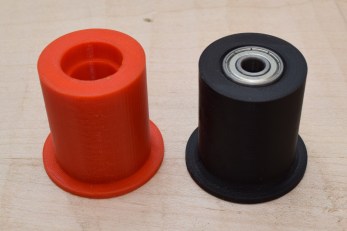
First I needed a way to hold the spools.  I decided a center hub (for reasons explained above) was best.  After measuring all my spools I set the outer lip just small enough to pass through the hubs, then made the center area a little smaller so the spool can’t walk off the hub.  Pressed in bearings mean it spins really effortlessly.  I had a bunch of red filament, so I started with that.  It was simple and worked right the first time.  So much for showing progression!  The next task took an extra try or 4.  I used jam nuts to hold the two spool halves (they are identical) together.  Don’t tighten the nuts against the hub, the bearings spin better without side loading.  To make handling easier I printed a handle with internal 5/16″ threads.  The first one was too short for my hand, so I cooked up a longer one.  The threaded rod goes 2.5″ into the handle.

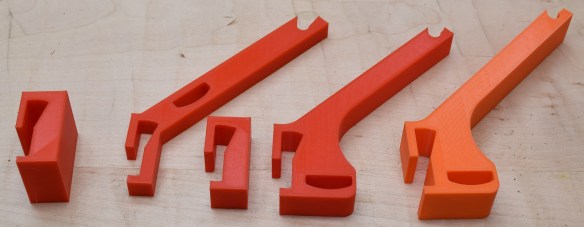
This hub system will need some kind of support to keep it up high on the printer.  I took some measurements of the printer frame and started with a thick test piece to make sure it would clip on and be secure (far left).  I thought it was good enough and went forward with a full spool support (second from left).
DSC_0967

This worked but was a little too thin and wobbly.  The odd rounded rectangle cutout is for my LED strip.  It was too close to where the spool will be.  I couldn’t have the light and spool installed at the same time.  Next I made a few minor adjustments to the frame clip and printed another test (middle).  That was more snug.  I moved the LED strip to a reasonable location and tried again (second from right).  I ran with this one for a week or two and liked the results.  The only changes to the last version was to increase the thickness for slightly less wobble, and an extension of the hub shaft holder.  My current spools fit, but a future spool might be larger in diameter.  The final design was printed in Prusa orange (right).

DSC_0969

Everything fits together nicely.  The large flange on the handle keeps it from sliding up your hand, and aids in alignment.  My LED strip slides in its slot with a little wiggle room.  The uprights can move if need be, but are in a good place.  The center hub is wide enough to accommodate a large range of spools.  I think this will be a great holder for a long while (until 5 minutes after this post when I run into an issue with it!).

This should be compatible with any of the Prusa i3s.  I think the MK1, 2, and 3s all have the same size and shape frame.  If I am wrong on that, then this only works for the MK2.  I uploaded it all to thingiverse.


As a bonus, it is holiday time, and that calls for cookies.  Cookies that come in fancy shapes taste better than normal ones.  True fact!  Add some pizzazz to your holiday gathering.

DSC_0973

Continued Jerky Lessons

This is my 4th round of jerky and I feel like I am still learning a lot every time.  My co-worker uses a 3/8″ nozzle, where as my jerky gun came with only a 1/2″ nozzle.  Thankfully the sell these little road cone looking things that you can cut to size.  DSC_0937I switched jerky seasoning brands because I had run out of the original stuff and wanted to try something different.  They recommended mixing their seasoning with water first, then mixing with meat.  This is a great idea, it helps ensure that the seasoning and cure are well mixed and distributed throughout.  I am feeling confident enough to wager 5 pounds of extra lean to make this happen.  In retrospect the seasoning should have been mixed in the big metal bowl before adding meat.  It saves a bowl.

Loading can be tricky.  One clean hand, one dirty.  You ball up a small wad with the dirty hand and load while holding the barrel with the clean hand.  They make a tool that helps tamp it all down.  Which hand holds that?  My new 3D printed hand of course!  I came up with this clip to hold the barrel while my clean hand tamps.  The overnight print came complete with a really good game of filament chicken.  About 2 wraps left before I would have been in trouble.


The mix and extrusion went well.  I used every tray I had and in 5 hours was able to dry a pretty good looking batch of jerky.

I weighed the final product and came up with about 2.5lb.  That is probably at the low end of dry enough, but it shouldn’t go bad in the 4 days it will take for me and everyone around to eat it.  It occurs to me that I could monitor the progress of my jerky simply by taking the initial weight and weights throughout the process.

DSC_0947

Ladder Feets

I have a trusty little 3 step Werner ladder that is great for doing work inside and outside the house.  It is small, light and provides enough height to be really useful without making you feel too high up.  I bought it when I got my house 8 years ago and have used it a lot since then.

20170929_111449

20170929_111455


The back two legs are basically straight tubes with rubber feet slipped on.  They did a good job keeping the ladder stable and level, but over the years the posts have pushed through the rubber.  The final straw was when I was doing something in the yard and the bag legs sank 6 inches down.

20170929_140541


I pulled the feet off and tried to salvage them.  The only real issue is the bars pushing through.  Maybe “re-soleing’ these shoes is all it takes.  I tried screwing down some plywood to the bottom, but ran into issues.  The post is only resting on its edge, and the squishiness of the feet means they want to wobble around a lot.  No good.

Time to ditch these feet and go with something new.  I would try to make it all in wood, but the post diameter is not close to any standard drill bits.  I want the new feet to fit tightly.  On to 3D printing!

The foot design resembles the original rubbery version.  The difference is that these will be hard.  I added a flat parallel to the bottom of the post.  The reason being is that when you fold the ladder up it only sits on the tips of these feet.  Probably a lot of the reason they pushed through.  This flat spot will help spread the load when stored and hopefully help it last longer.  The larger flat in the upper left picture is what touches the ground when the ladder is deployed and in use.

20171010_194300

I started with basic PLA, as a test, but they fit so well I am going to stick with the first prototypes.  I might make a higher infill PETG version in the future.  Until then the ladder folds up and stores well, and most importantly sits flat and stable when in use.


Tumbler Sanding

Long story short: I tried to use a tumbler to conformally sand 3D prints and clean up old metal parts.  It didn’t work that well.

Long story long: I wanted a way to sand complex parts such as 3D prints and old tools.  I can convert rust easily enough, but it leaves surfaces dark, and doesn’t handle other grunge.  Sanding 3D parts works, but never gets the nooks and crannies right.

Enter the tumbler!  It is a funny shaped open top globe that vibrates.  Shooters use them to tumble brass bullet casings to clean them up.  I started with sand because it is abrasive and cheap.

No luck, sand didn’t do much even after hours of work.  How do the rock tumbler guys do it?  Silicon carbide grit.  Lovely!  I will buy some and mix it with my sand.

20170823_184435

Watching it combine with the sand is a really fun trippy experience.

20170823_184505

I tried lower concentrations of carbide grit to sand, but eventually added the whole 5lb bag of grit.  The metal and printed parts both spent 2-3 hours in full concentration grit.  I feel like the metal parts may have benefited.  It is a little hard to tell in the photos, but the metal is a bit cleaner.

The 3D prints didn’t show much improvement.  The sanded one was a touch smoother in places, but picked up a lot of staining from the grit.  None of the ridged areas were knocked down well.  On the plus side, delicate features didn’t break off.

Poor pickle rick is just going to have to remain rough around the edges.  Don’t buy a tumbler and grit to sand your 3D prints, it doesn’t work well.

20170830_201430


Woodsaw 3D Printed Parts

Miter Saw Zero Clearance Insert

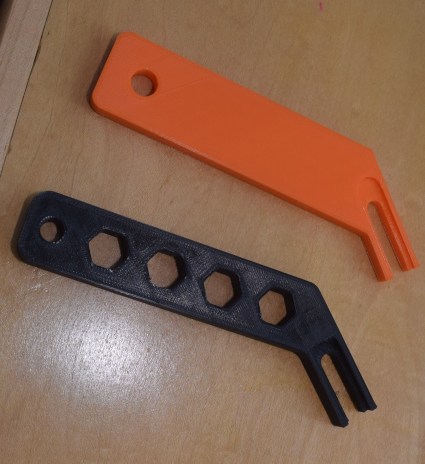
Sawing with a tight fitting insert is almost always the right way to go.  It supports the wood being cut and prevents the fibers from getting torn as the saw teeth punches through.  The plate that comes with the saw works, but has a wide gap.  I made a thin plywood insert, but they don’t last that long.  This is my attempt at a 3D printed one.  The original is on the right.  Notice how wide the saw blade gap is.  I took a picture of the original saw plate on one of those self healing cutting mats.  They have good ruled lines in both directions to make sure the image didn’t get distorted.

The first print out of the gate fit really well.

20170805_130315

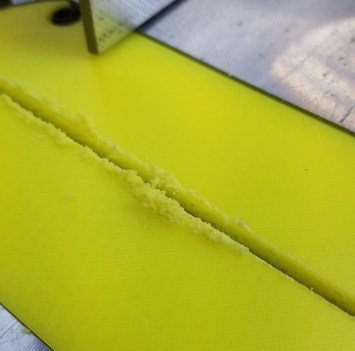
I made the first cut with no wood in the way.  It chopped right through the plastic and cut a self fitting slot that is just exactly the size of the blade.  I might have been a little too cautious.  Slow cutting built heat and there was a bit of plastic fuzz at the top edges of the cut.  A little light work with a utility knife had those cleaned up.  Some subsequent cuts have shown the insert to properly back the cuts.

I still need to find a spool of Dewalt yellow filament.

UPDATE: Decided to upload it to thingiverse.

Table Saw Organizers

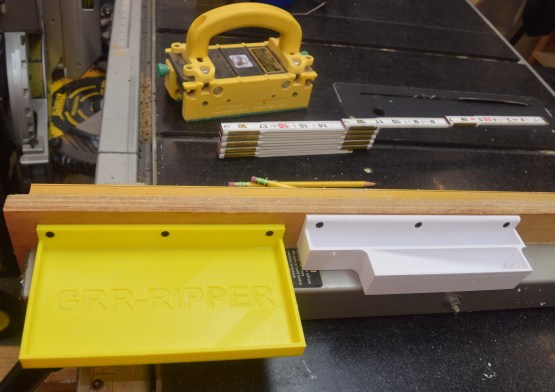
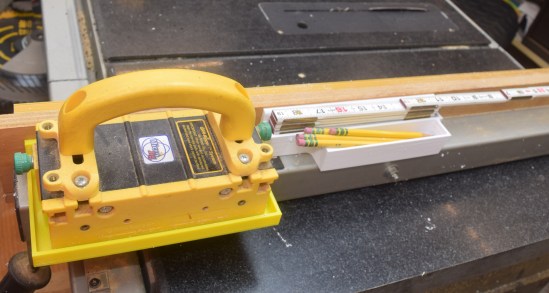
I am in a near constant state of looking for pencils and rulers/tape measures.  I should attach one of each to my body with a short retractable cable.  Until then I try to stage as many as possible at each work station.  At my table saw I made two different organizers to hold commonly used  items.  They both attach to the far side of my rip fence.

The white organizer holds my wooden ruler and a small stack of pencils.  The pencil well could have been a touch deeper, but otherwise it works well.  The yellow holder area keeps my grrripper push block.  It is at a really convenient hand position for quick use when sawing.

DSC_0927

DSC_0928

Cutting Corners

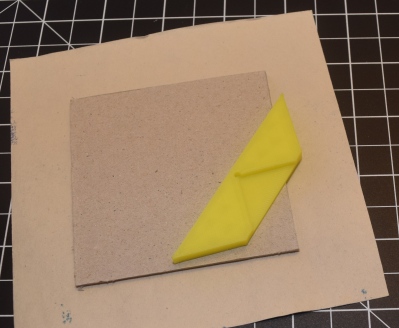
This was a fun collaboration with my dear madre!  She does bookmaking along with letterpress and about 100 other hobbies.  See where I get it from?  When making a hardcover book you have a solid material that is covered with something like fabric or heavy paper.  I forget all the terms, but in order for it to get covered nicely you need to cut the corner off the cover material so it folds in well.  It is kind of like wrapping a present.

I was directed to check out the cool 3D printed corner tool here: https://www.ibookbinding.com/tools/3d-printed-corner-cutting-tool/

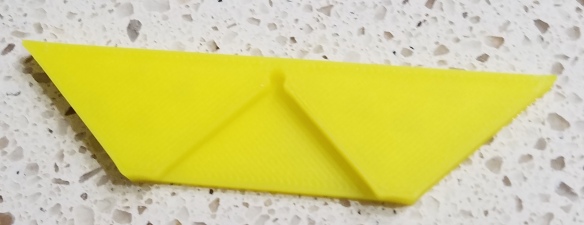
It was a good looking tool, but the tall wall used to protect fingers made it a lot harder to use.  In woodworking we use guides like this all the time to cut knife lines in wood.  You want it to be low so you can get a flat single beveled knife up against the guide.  I made a few changes and came up with this.

20170804_095831

It sits on the corner of binding material up to 1/8″ thick, and provides a 45 degree standoff of 1/8″ from the very tip of the corner.  I added that funny circle cutout to make sure the printer didn’t round the corner to the inside any.  This sits snugly.

DSC_0923

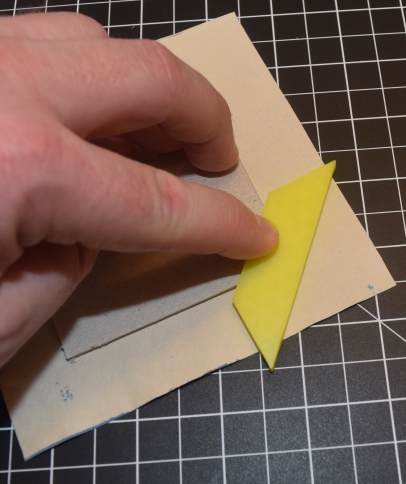
Here is an example of a binder board and the cover material.  The tool sits on the corner of the hard binder material.

DSC_0922

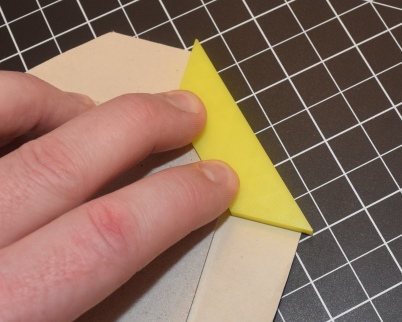
With fingers sufficiently out of the way, you can run a knife along the outside edge and trim the corner off.

DSC_0920

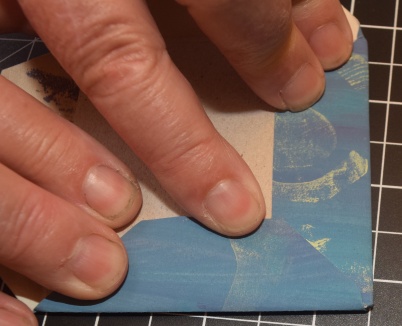
With all corners trimmed you can do a little fold and crease and get a smart looking book cover.

DSC_0921

Mom was happy and requested a dozen.  Easy enough!  Thingiverse link for those that want their own copy

Drill Caddy

I am in a caddy mood for some reason.  Having organized grab and go tool sets make life easier when you have a problem to solve somewhere.  Most repairs don’t happen within arms reach of the tool box.

Up next is this zazzy little 12V drill driver.  It is small and highly controllable.  I like it for use as an electric screwdriver for assembly/disassembly and for installing small and delicate hardware in wood.  First you need a holster.  I did some careful measurements and in just 1 iteration came up with this design.  It is easy to insert and holds really well even through heavy shaking.  The key was how it catches on the pull out chuck.  A rounded leadin helps it find hold, but a square edge keeps it from erroneously falling.

DSC_0911

I attached this to a piece of wood and started carving off a handle area at the bandsaw to give more finger room.  This needs to be the most accessible thing on this caddy.

DSC_0912

With the gun set in place I could start planning out other accessories.  satisfied I had enough room everything got a coat of paint.  My blue was running out so it is a little spotty of a job.  Once everything gets installed I doubt it will be noticeable.  It would be great to buy Bosch blue and Dewalt yellow filaments and paints.  I bet a lot of effort goes into picking the colors for tool companies, and they don’t want to give those away.  Plus I have way too many paints and filaments, I need to use my current stash.

DSC_0913

I had a pretty good idea at this point where I wanted everything from the layout stage.  The only change was the addition of the bottom blue short bit holder.  I was running out of “wall” space and realized that would be perfect.  The nut drivers came with an odd loop on the holder.  It made building a little slide on clip easy.  The red case is full of a zillion standard and security bits.  No hardware is safe from me!

The handle is a copy of the previous design with a switch to red to keep with this color scheme.  The kobalt set has some decent quality standard bits, sockets, and a basic assortment of drill bits with hex shanks.  I don’t plan on doing much drilling with this, but occasionally they might come in handy.  Ok, what needs fixing?

The only thing this might need is a removable magnetic parts tray.  Maybe a clever, secure yet removable, design will hit me in the shower.

Zip Tie Caddy

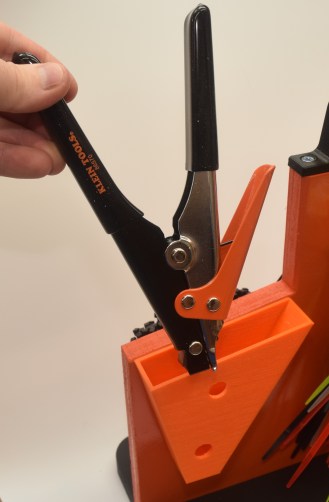
Zip ties are one of those magical inventions that are simple genius, and I can’t live without them.  I have a fancy zip tie gun at work that does a really good job of tensioning the tie, automatically cutting at a set point, and keeping the tail captured.  They are expensive, so I found a different design that works pretty well and is affordable by mere mortals.  This calls for a custom caddy to keep all my zip ties organized and ready to go.

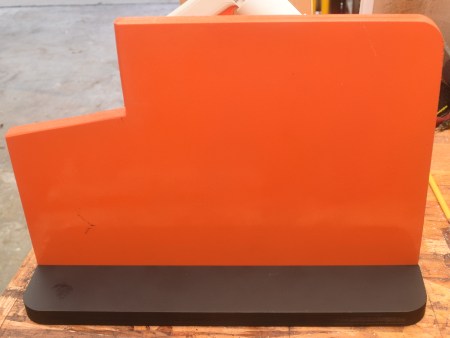
I cut up some spare plywood and played around with layouts a bit.  I think this is a good size.DSC_0899

I cut out a window to make tool access easier.

dsc_0900.jpg

I cut some more wood for a small base.  Narrow enough to make storage easier, but wide enough to keep it from tipping.  I really like how the rounded corners turned out from my router jig.

DSC_0905

I gave the two pieces a good painting and assembled.  I picked the color scheme of the zip tie tool.  The black zip ties contrast nicely against the orange background.

DSC_0906

To attach each zip tie bundle I used a zip tie that can be screwed down.  That looped into a zip tie around the bundle.  As you pull ties out you just tighten the bundle to keep things tight.

DSC_0907

It holds a variety of lengths and sizes along with my colorful re-useable ties and the screw down ones.  Plenty of room to grow too.

The handle was printed to match my hand size and keep with the color scheme.  Same deal with the zip tie tool holder.

DSC_0910

Corner Radius Routing Jig

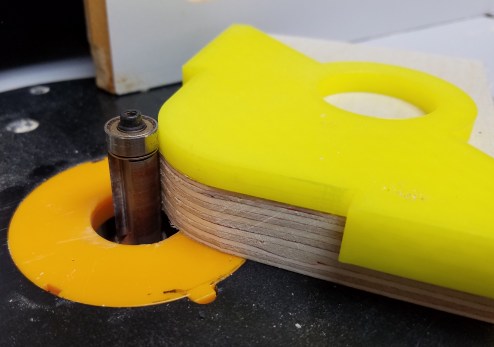
Two hobbies collide as I print something super nifty for my wood habits.  A cool thing you can do with router tables is apply a template onto wood, and use a templating bit to match cut.  The bit has a bearing of the same diameter as the cutting edges.  It rides against your template and cuts away any underlying wood that isn’t shaped like your template.  Super handy, but you need a good template to start with.  Enter the 3D printer.

I modeled up this little jig so that it hooks onto the edges of a board and gives an exact radius.  It is hard to see given the color, but I printed a 1″ text in the bottom to note the size of the radius.

20170716_205631

Here is a picture of the jig fully seated, and what the resulting cut looks like.  Very clean and smooth.  The large circular cutout gives a lot of finger purchase so you can hold it tight and far away from the spinning bit.

One concern I had was with the material.  Would the cutting friction heat up enough to melt the plastic.  I did 4 cuts on a 3/4″ bit of plywood and everything looked good.  If I had a hundred corners to do, I would worry.  I could always upgrade to PETG.

The part is available in multiple sizes on thingiverse

June 2017 3D Prints

Lots of good prints this month.  I have got the new printer pretty well figured out and have ventured out into new materials and longer prints.  First up is a cool blade guard I made.  I picked up this nice boning knife for bbq goodness.  It is crazy sharp but came with no guard.  I printed a two piece guard with magnets set into the one half.  The two bits glue together.  It keeps the edge and my fingers safe and fits snuggly.

DSC_0858

DSC_0859


Porch Cup Holder

I have some Adirondack chairs on the back porch.  They are reasonably comfortable, but have a distinct lack of cup holders.  I fashioned some a while back out of wood, but the sizing was all wrong.  These are perfect.  They hold coffee cups, large tumblers and small glasses alike.  The RTIC’s blue handle was printed back in September and is still alive after daily use.  Thingiverse Link


Thermocouple Kickstand

I got a cheap thermocouple reader for reasons beyond my obsession with measurements… I swear.  It works well, but didn’t come with a kickstand.  I am used to all my multimeters having some way to sit themselves upright.  This one clips together, then slides on snugly.  It doesn’t add too much bulk and stands steady.


PETG

I have a few high temperature projects, so it is time to venture beyond the safety of PLA.  It is a great material to print with, but loses strength quickly when things get hot.  Enter PETG.  It is higher temp and strength like ABS, but less toxic, and lower warping.  One of my firsts was the Franken-Cooler.  Not without issue, but largely a success.

Next I made a small clip to keep the USB cables in my car in order.  They always get pinched in the lid when I close my center console.  This will keep them in the pass through.  Simple but effective.  I needed the higher temp material because cars get hot in Florida.

I made some mods to the camera setup on my prusa.  Someone made a decent set of parts to attach a common webcam to the Y stage.  The only problem is their main bracket was a bit loose.  I started with PLA because that was all I had.  It sits up against the underside of the heated bed.  If I need higher bed temps the part could fail.  I designed a lighter tighter fitting version with speed holes to help cord wrangling.  The PETG part will not fail due to excessive bed heating.

DSC_0874

While I was at it I found a lens adapter that could replace the original webcam lens with a very wide angle one.

The new lens give a much better view of the print bed.  I can see the whole thing instead of just the middle third.

Screen Shot 2017-07-05 at 7.54.08 PM

Finally I can take time lapse videos that don’t look terrible.  Behold the birth of a baby groot.