Header Explained

I am working on a logo for myself and the website.  I have it partially finished, but have had a bit of writers block.  Or graphic artist block?  I was never very good with art.  I decided to take a tack and work on a header instead.  I was thinking about incorporating this into my logo, but dropped the idea.  It is a way to create a right angle using only a straight edge and a compass.

TriangleHeader

  1. Start with a straight line and pick any point above the line
  2. Use a compass to draw a circle that goes through the line, exact diameter isn’t important
  3. Draw a line from one intersection point of the line/circle through the center of the circle
  4. Come down from that second line hitting the outside of the circle to the other intersection with the original line

BAM!  Very few tools and you have a perfect right triangle.

My work on the logo continues.  I want to take my time and get it right.  That, and I am abysmal at graphics software, so it is going to take me a while to even put what little I can imagine to digital paper.  Stay creative!

Swarm Trap

Getting new bees can be expensive, and cutting them out of the floorboards of someone’s shed is a lot of work.  Why not try to catch a wild swarm in something convenient before they setup shop someplace tricky?  That is the idea behind a swarm trap.  You build a space that is right for a new bee swarm, bait it with essential oils, and hope they show up.

The general consensus is that something like a 5 frame deep nuc is what they naturally look for in size.  I only do mediums now a days, but hopefully they aren’t that picky.  While we were building the screech owl boxes my bee buddy and I put together a set of swarm traps to try and catch some bees!

I started with the dimensions for a langstroth medium and cut the width down so that 5 frames would fit comfortably.  I added a bit of height to allow space above and below the frames that would normally be there in a hive stack-up.  Cleats on the side help with picking it up.

Five frames with foundation went into each box and they got their lids screwed on.  The lid should keep it dry inside, but can easily be removed with a few screws once occupied.  I wanted the trap up in the oak tree in my backyard.  I added a tall piece of pine with screw holes so I could use long exterior screws for attachment.

I got a bunch of medium boxes put together in the mean time and went ahead with my lovely yellow paint for all of them.

DSC_0260

DSC_0261

I hope the bees aren’t put off by the wild yellow.  Who knows, maybe it will attract them to move in.

DSC_0268

The trap has been up in my oak tree for about a month now, and so far no bees.  I have heard that lemongrass oil is supposed to attract them.  I doubt it lasts more than a week or two, so I should probably refresh that.  Oh well, now we wait.

DSC_0298


Water Meter Hive Rescue

Our local bee group got another contact about a person with bees living in their water meter housing.  In Florida they are a plastic box set into the ground with a removable lid for servicing the meter and valves.  This one had apparently been occupied for a while.

wp-1467981535714.jpg

We were fighting dwindling daylight and some tricky comb.  It was quite tall and oddly shaped because of the shape of the water meter box and the piping inside.  We didn’t have time to cut the comb to size and fit it inside the frames so we just stuck it in between open frames.

wp-1467981535713.jpg

Everything fit inside a single medium super nicely, minus the bits of random comb on top.  I need to come up with a technique for quickly cutting and framing the comb.  Ideas are forming and updates should be coming soon.  This one went to my bee buddy that still doesn’t have a running hive.  So far they are making themselves at home.

Screech Owl Box

I got my latest hive from a co-worker by taking the owl box from his yard that was full of bees.  I got to learning about screech owls and even started hearing and seeing them in my neighborhood once I knew what to look and listen for.  I wanted to host some owls of my own, and I figured my co-worker at least deserved a replacement box.

I take no credit for the plans used to make this owl box.  The Treasure Coast Wildlife Center provides free plans to create owl nests from a single 1×10″ piece of lumber.  See those plans here.  They are great plans, easy to follow, and even include a little picture of a tiny screech owl to help motivate you!

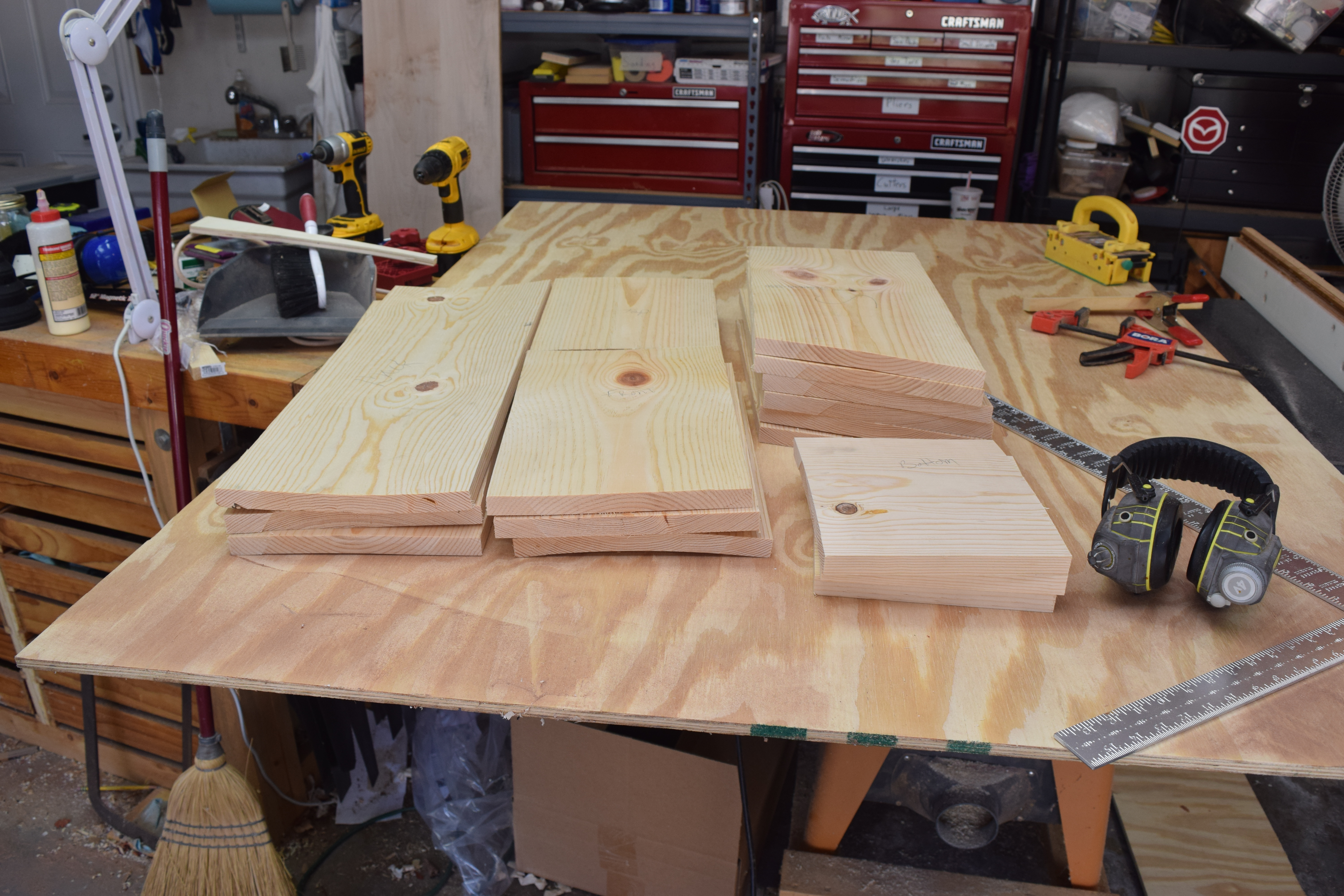
My bee buddy wanted a box too, so we got 3 eight foot 1×10″s and went to work chopping up the needed lengths.  One of the pieces was really badly bowed.  I really dropped the ball when picking lumber.  I always check for straightness, but sometimes neglect cupping.DSC_0239

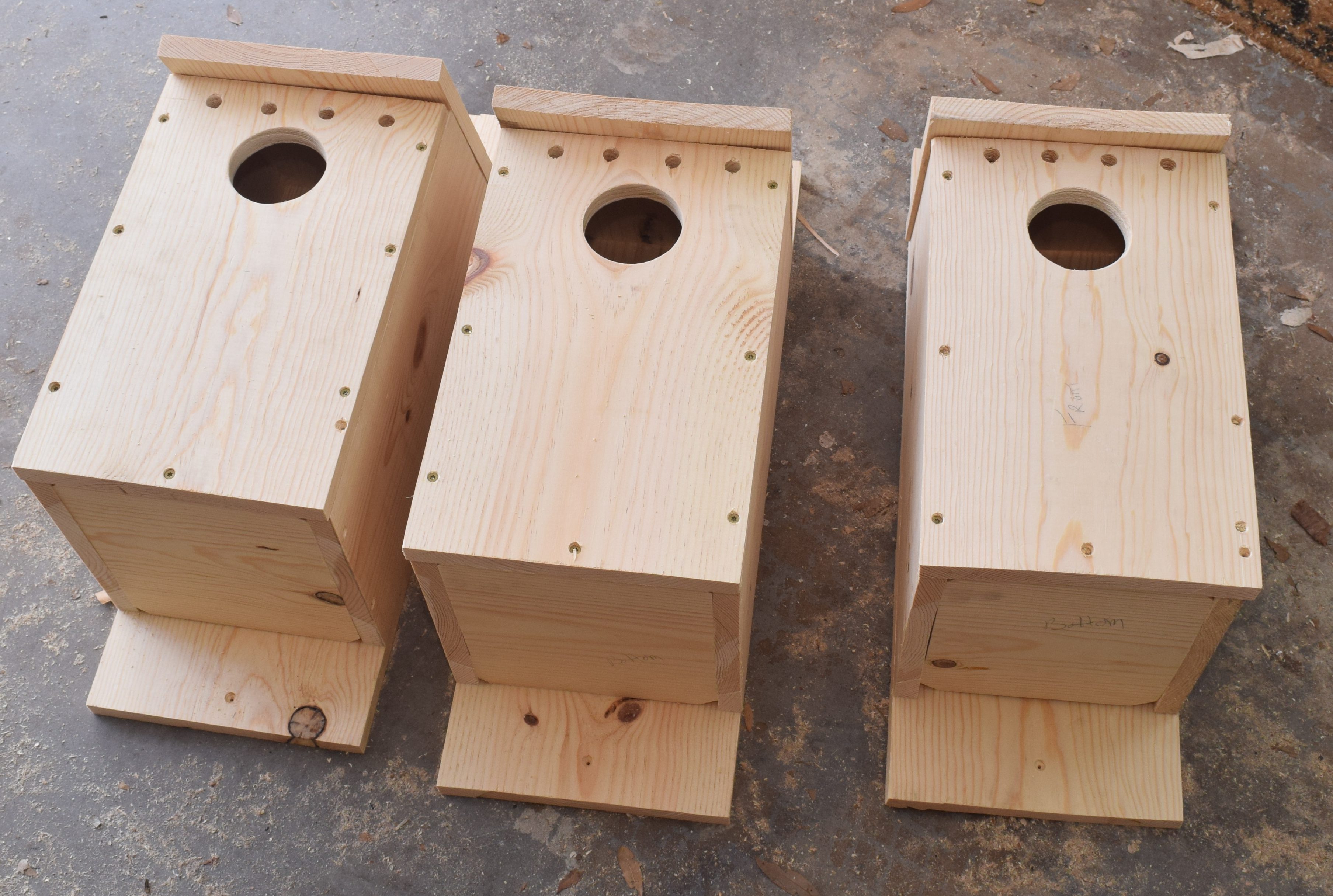
Everything went together with simple exterior screws, and some of the dimensions are flexible enough to make assembly a breeze.  Start with the back, add sides, then move on to bottom, front and top.  The directions should make it pretty clear.

DSC_0240

I used pine, but you might want to go with cedar.  They recommend against any kind of sealing or paint.  I guess the owls don’t like it.  Time will tell how long untreated pine like this lasts.

DSC_0243

The two of us were able to knock out three owl boxes in about 2 hours once we got into the swing of it.  I kept the bowed one, my bee buddy got one, and the co-worker got the last.  With any luck he will catch bees in it again and I can have it back!


I put the box up a month or so ago.  I am a bit late for mating season, but I know there are screech owls in the area.  So far no signs of them having found it, but it can take years for them to decide to use the box.  Now we wait!

DSC_0299

Drill Powered Honey Spinner Demonstration

I have gotten a lot of activity related to my Drill Powered Honey Spinner.  In fact probably 90% of all the traffic I have ever received has been to that post.  I guess it was a good idea!  My explanation was pretty good, but could really be supplemented with a nice video.  I finally found the time to shoot and edit one, so enjoy and thank you for watching.

Father’s Day Knives

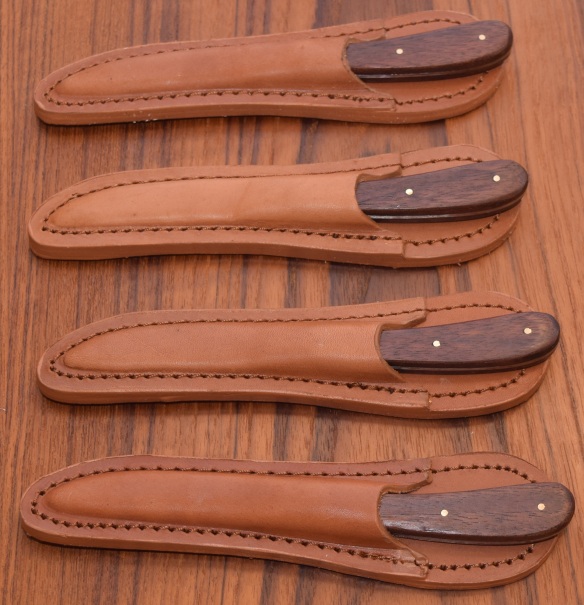
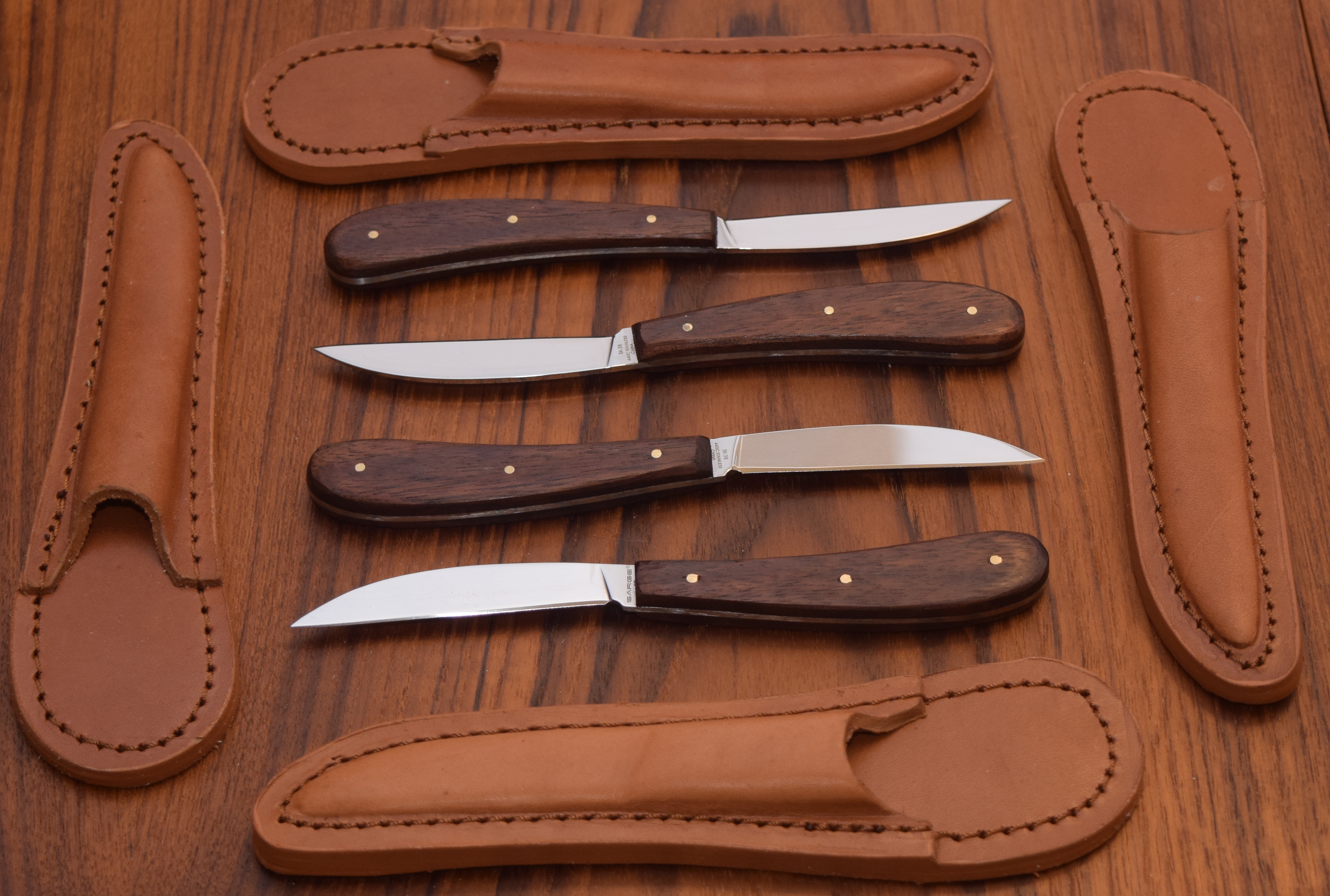
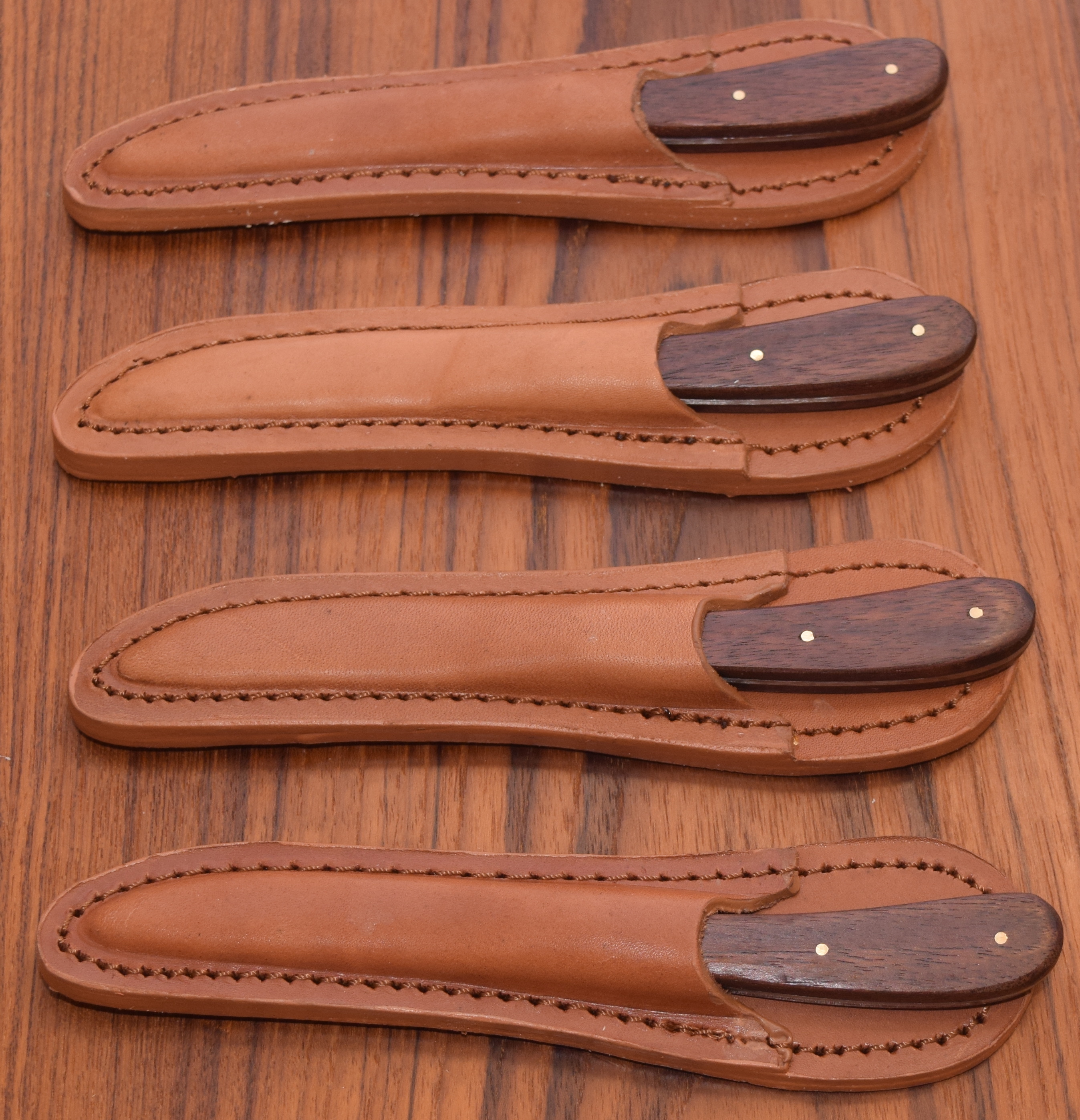
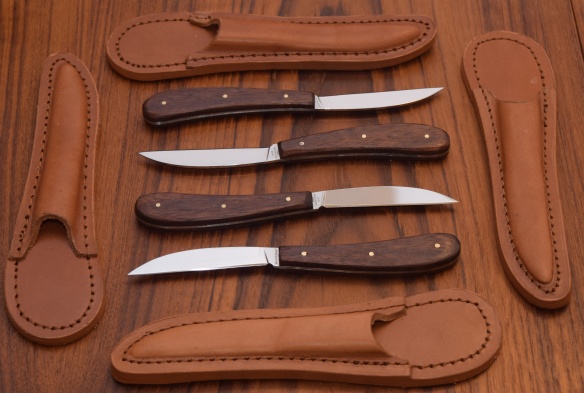
The family wood strikes again.  Mother’s day gifts one and two have already been delivered, and it is time for the dads.  I found these letter opener kits at woodcraft, and they include a blade, leather holster and brass pins.  All you have to do is make up the scales, bond them on, and sand away the excess.  It was actually that simple, and by going really slowly and carefully they turned out great.

I wanted three total.  One for my dad, one for my father in law, and one for me.  This is far enough out of my comfort zone that I bought a fourth kit to build first as a test article.  I have watched enough forged in fire to know that things can go wrong at the handle assembly.  Enter the family wood, and a thin slice via my bandsaw.

I cut down two small rectangles and held them together temporarily with carpet tape.  I clamped the blade on and match drilled the holes all the way through.  Once bonded on everything excess will have to get sanded, so I trimmed as close as I dared with my band saw.  The metal surfaces got a light sanding for bond strength and everything got a wipe down with alcohol.  I used T-88 which has a really long working time and high bond strength.

The next day the clamps came off, everything seemed solid, and it was time for the sanding.  I have a junky harbor freight 1×30″ belt sander.  It rattles and shakes, but really did the job.  First I went over with an 80 grit to remove everything sticking beyond the metal.  Once squared I went to 400, then 1000 grit belts to refine the shape and polish the metal interface.

It turned out really well.  The instructions wanted you to cut the scales to match exactly, then bond.  I figured this way guaranteed that everything fit smoothly, and if you used high enough grit, the metal could be put back to a polish.  I was right!


With one down and finished I had everything figured out to do the other three.  Doing them in a batch made things go quickly and efficiently.

My only point of confusion comes with the pin insertion.  Do you put them in the bottom scale, then install the tang, then the top scale?  It is hard to see if the pins are a little crooked, and everything is sticky with glue.  Pounding them in from the top with all pieces sandwiched means you are hitting the bottom scale’s holes blind.  I tried variations, and still haven’t refined that part of the build well yet.

The last picture on the right shows the first one with a coat of tung oil on it.  It looks good and feels smooth in my hand.  All of them turned out great, and the 4th one was kind of unnecessary.  I’ll bet I can find a worth recipient.
DSC_0288

DSC_0289

DSC_0292

Montreal Vacation

For a fun family trip we decided to head up north to Canada and visit Montreal for a week.  We are both big fans of Formula 1 racing so we picked up tickets and soaked up the sights and sounds of a great city.  What a neat place!  There is a lot of history involved in the city, and they celebrate it with statues and fountains everywhere.

They also posses a lot of public art and structures.  They hosted an olympic games and a world’s fair.  It has left them with some neat places to visit.

The food is to die for.  We ate a lot of great things from fancy restaurants to public markets.  We couldn’t leave without a few helpings of french pastries and poutine.  Cheese curds rock!

We barely scratched the surface with their museums, but did manage to spend some time at one art museum.  They had a display from Pompeii.  It had a lot of artifacts that have been excavated from the buried roman city.  Most interesting to me was the tools.  They were under a lot of construction at the time, so squares and plumb bobs were everywhere.  They were quite skilled with bronze.  Nearly 2000 years old, but some of those tools look serviceable.

Last but not least was the race.  We watched some of the practice, qualifying, and the entire race.  Our seats were near the first set of turns, and we got a great view of the race start.

20160610_104556

Montreal is a great town, and we can’t wait to return.

20160613_151629

Bun-servation Tower

Our bunnies are spoiled.  That much is certain.  They sit in our chairs on the porch constantly, and I think part of it might be that it gets them high enough above the screened in porch edge to be able to see the yard.  So, I built a bunny tower they could climb up in to chill and observe their domain.  It took a few iterations to get it right, so hold on.

First I thought a two level floor plan with ramps coming through the floor would work.  Take some 2x4s, notch them with fun hand tools, notch the plywood and screw it all together.  I wrapped the two levels in 1/4″ metal mesh to keep the buns from jumping out and hurting themselves.

And there it sat for weeks.  No takers.  I made the ramps too steep.  I saw one or two try to climb up, but they weren’t able.  Eventually I relented and made a longer gentler ramp for the first level that entered at the edge instead of the floor.  That went over well.

I couldn’t figure out how to save the top, so I eventually cut it off.  The ramp has a cleat every 4 inches.  I started with that, but they would slide on the plywood in between the cleats.  I added non-skid tread material in-between the cleats and they seem to be able to handle that really well.

wp-1465001666874.jpg

It is less of an eye sore with the second floor removed and the new ramp is working well.  As a bonus, I set the top section down, and they started using it.  We moved it back from the edge so they wouldn’t try to jump through the screen.  They have been using their carriers as a step to get on top.  I guess I should have gone with stairs instead of a ramp.

wp-1465001666869.jpg

In short, if you are going to build something for your buns, they are going to disapprove.  Just get used to it.  Aside from that, do any ramps at no steeper than around 1:2 rise to run.  My first ramp was closer to 1:1 and they couldn’t do it.  Use cleats and non-skid to help their feetsies.  Last but not least, they will chew on everything you make, so keep that in mind.

I am Tyrion the bunny, and I approve this message

wp-1465001666873.jpg


Rolling Shop Storage Cabinet

Organization is a sickness that you catch from time to time.  When it hits, things can get out of hand.  My drawers are getting cleaner, but now my shelves are in order.  I am going to go from Left to Right in a few short cuts.

Yeah, the one on the left is a huge mess, I get it.  The shelves were made of particle board and started sagging soon after installing the unit.  It was deep enough that most things sat in the front which waisted a lot of space.  I did some thinking and tried to come up with as simple of an easy and efficient design as possible.  Here are the parts cut out from my sheet goods.  It was a compromise of materials and what I wanted to store.  The design gets you both 4′ high cabinets but only 6 shelves.

I used another sheet of 1/2″ plywood to get more shelves and to make some drawers that will come in at a later date.  I started by cutting up the 3/4″ plywood and building a basic box with no front or back.  Before assembling I gave the sides a small dado to accommodate the pilaster strips.

A 1/2″ piece went across the back making every very stiff.  I used pilaster strips, which can be found in your hardware store in the shelf section.  They are very affordable at able 3 bucks a strip, and the clips costing 1 dollar per shelf.  They can hold a lot of weight, are incremental in 1/2″ steps, and the clips are very low profile.  Each shelf got a small cleat on the backside for stiffness and to keep it from sliding forward when pulling something out.

DSC_0284

I did a lot of sorting, throwing junk away, and repacking organizers.  It came together and never looked so good.  Everything got a coat of BLO, and both cabinets got a set of casters for easy placement.

The project took a few days when mixed with a lot of other projects and turned out great.  The left one is kind of sparse and is missing some hardware still.  At some point I will use my remaining plywood stock to build a set of drawers to hold the sanding supplies and misc hardware.  Total, both cabinets together cost me about 175 dollars.  A little expensive, but there was very little waste, and they ought to last a really long time.


I said organization is contagious, and I mean it.  I piled my battery charging stuff on top like always, and it just didn’t look right.  I had some off cuts and spare pieces and in no time had a smart looking drill station built.  My drills hang over by my tool box, this just has the chargers, batteries, and drill/bit kits.

DSC_0282

Foam Drawer Organizer

Organization is a constant battle in my shop.  I vary my interests and tactics a lot, and I am into a lot of different types of making.  Woodworking has been pretty consistent and hand tools are probably here to stay.  I built my workbench a few years back and added a lot of drawers into the base.  It has been good, but the drawers turn into a mess.  Stuff sliding everywhere and items ending up crammed in the back.

Enter kaizen foam.  There are a few products out there like this, but I happened to find it at my woodcraft less than a week after researching it on the manufacturer’s website.  It is super expensive to ship unless you buy a lot, but woodcraft had it at a good price so I picked up two different thicknesses.

20160527_141330

This was the only drawer I had in mind.  It has some delicate measurement devices in it, and they get banged around and lost often.  After doing this drawer though, I got inspired.

20160527_160424

Gorgeous!  Can I just say that I love marking gauges?  At first I really wanted their product that had the white core and black outside.  Now, I think that is a mistake.  My cut jobs were kind of poor in places, but it looks fine because everything is the same color.  A white core would show any mistakes.  Seriously, go with all black.  Or white if they have it, I bet this will show sawdust like crazy in a few months.

20160527_160350

The foam is in layers.  You cut to a depth and tear out enough to make a pocket for your tool.  Tearing layers wasn’t bad, but sometimes making consistent levels was difficult.  The foam is tough enough to stand up to abuse, but easy to cut.  It is kind of cathartic to trace everything out and slowly cut the shapes.  I will not be using this in all my tool boxes, but will probably pick up a few more sheets the next time I have the chance.