Home Jerky Recipe Failure

Why buy a spice packet when you can just gin up your own flavors for a lot less?  Failed jerky apparently!  I thought I was going to be cute, and make my own seasoned jerky from now on.  I may still, but I hit a huge setback.  Everything started nice, I looked at a few recipes online and came up with two ideas to try on my own.  A basic traditional style, and a taco seasoning style.

dsc_0948.jpg

I mixed them both and ran into my first difference.  Normally, the meat is really sticky.  Even wearing nitrile gloves it sticks like crazy.  These didn’t seem to leave much of anything on my gloves.

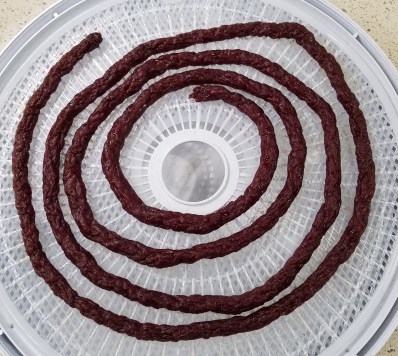
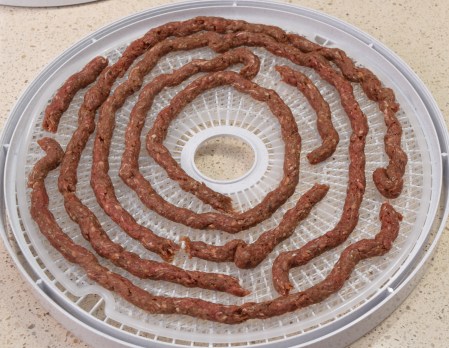
I left them overnight for the flavors to mingle, then fired up the jerky cannon.  Another odd feature, they don’t hold together well at all.  Normally I can get long continuous strands, but these fall apart immediately.
DSC_0949

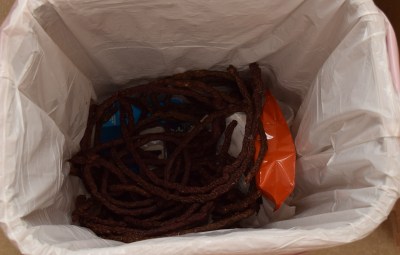
One thing I remembered after firing up the dehydrator was that I forgot the curing salt on the taco version.  That was going to hurt the shelf life, but no reason to stop.  The final results were garbage.
DSC_0950

Instead of being chewy this stuff was dry and crumbly.  I did some reading and found a few possible explanations that could apply to my batches.

Don’t use acids: I didn’t use any in the traditional recipe, but my taco version had a few tablespoons of hot sauce.  Lots of vinegar in that sauce. That one was worse than the traditional.

Low salt: This is possible with both batches, I didn’t want it to be too salty.  Checking around, salting ground beef can do important things.  Serious Eats has an article on the subject.

My next experiment will be with a simple recipe of just ground beef, salt, and maybe a single seasoning like garlic powder.  I will increase the salt content and see how that goes.  An early indication of stickiness while mixing might help bound the lower end of salt.  Too salty won’t be clear until I have cooked and eaten some.

Continued Jerky Lessons

This is my 4th round of jerky and I feel like I am still learning a lot every time.  My co-worker uses a 3/8″ nozzle, where as my jerky gun came with only a 1/2″ nozzle.  Thankfully the sell these little road cone looking things that you can cut to size.  DSC_0937I switched jerky seasoning brands because I had run out of the original stuff and wanted to try something different.  They recommended mixing their seasoning with water first, then mixing with meat.  This is a great idea, it helps ensure that the seasoning and cure are well mixed and distributed throughout.  I am feeling confident enough to wager 5 pounds of extra lean to make this happen.  In retrospect the seasoning should have been mixed in the big metal bowl before adding meat.  It saves a bowl.

Loading can be tricky.  One clean hand, one dirty.  You ball up a small wad with the dirty hand and load while holding the barrel with the clean hand.  They make a tool that helps tamp it all down.  Which hand holds that?  My new 3D printed hand of course!  I came up with this clip to hold the barrel while my clean hand tamps.  The overnight print came complete with a really good game of filament chicken.  About 2 wraps left before I would have been in trouble.


The mix and extrusion went well.  I used every tray I had and in 5 hours was able to dry a pretty good looking batch of jerky.

I weighed the final product and came up with about 2.5lb.  That is probably at the low end of dry enough, but it shouldn’t go bad in the 4 days it will take for me and everyone around to eat it.  It occurs to me that I could monitor the progress of my jerky simply by taking the initial weight and weights throughout the process.

DSC_0947

Jerky Dehydrator Hack

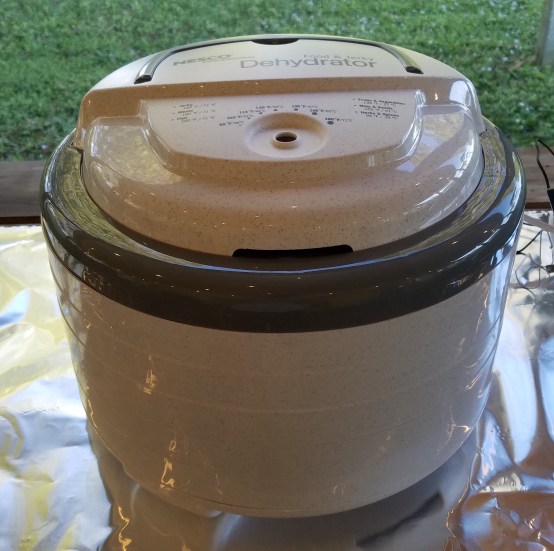
I have been experimenting with jerky in the oven after a co-worker introduced me to the idea of making jerky from ground beef.  I had no idea such a thing was even possible.  It is easier and can be cheaper than whole muscle jerky.  Plus it isn’t nearly as jaw bruisingly chewy.  I started in my oven, but the long lingering cooking smell is disagreeable with my wonderful wife and the oven doesn’t seem to vent enough to properly dry the meat.  Enter my new Nesco Snackmaster!

20171125_161652

Good ole black Friday deals got me a discount on a damaged box item.  I cleaned and assembled everything and used the dehydrator to dry all the piece parts.  I stuck my grill probe in various places checking for consistency.  It is a surprisingly consistent unit, but there was an issue.  The temp was too low.  You are supposed to dry jerky at 160F, and it stalled at 145.  An hour later, it was still at 145.  I didn’t really feel like sending it back, or finding out the bad way that my jerky wasn’t cooked enough.

The dial has a hard stop (brass piece in lower right picture).  I wondered if it needed adjustment.  I tried tweaking the metal shim that hits the hard stop, and broke it off completely (Sad bent metal in lower left picture).  No sending it back now!  I gave it a slight turn past the previous hard stop and reassembled everything.  Hey presto, 160F without issue.  It super voids the warranty, but now I know I can get one of these things to higher temps if I ever need to.


Fast forward to actually mixing up some meat and making a test run.  I had a jerky seasoning sampler pack, and wanted to stick with known spices while I worked on the mechanics of jerky making.  Once I get the basics down I will venture off into recipe development land.  I mixed it all up, put it in my jerky gun and shot 1/2″ round extrusions into the snackmaster.

20171125_154536

Not highly appetizing at this point, but give it some time.  I was dubious of the temperature control still, so I put my probe back in and monitored.  It still didn’t come out to the right temp, so I had to do more adjusting.  No clue if I am being overly controlling, or if something is wong with the built in temperature control.  6 hours later it was looking a bit more like jerky, and I was looking for bed time.

20171126_082235.jpg

My previous batches got stopped before this point.  They weren’t chewy enough, but lasted about a week before mold set in.  I figured they would be ok overnight, and restarted them in the morning.  Not ideal, but it should be safe. After 4 more hours of drying I had other events that were becoming press, so it was time to call it quits.

20171126_113622.jpg

10 Hours total yielded a pretty good looking jerky.  Drier than my previous attempts with a good amount of chewiness.  I will hold a small sample of this in a bag and check it for mold routinely to get an idea of shelf life. The only round nozzle I have is 1/2″ in diameter. I need to get a thinner diameter to help speed this process up. Then again, 10 hours would be easy to do overnight.

More jerky updates to come over the next few weeks. I hope to have a full suite available for Christmas gifts.

iPad Stand

I recently bought an iPad for use during travel and for things around the house.  One such thing is for use as a recipe holder while I cook.  I have slowly been collecting my various scraps of paper and bookmarks into an organized google drive collection.  Most fit nicely on a single page in portrait mode.  I needed a way to prop it upright and started with a nice swoopy 3D printed part.  I liked the shape, but it was a little too light and the color clashed with my kitchen.

20171013_113039

Unusual for me, I built a test piece first.  Typically I just launch into this sort of thing head first and start making mistakes.  The pine shape was made using the green 3D print as a tracing template.  I liked how it came out and proceeded with maple.

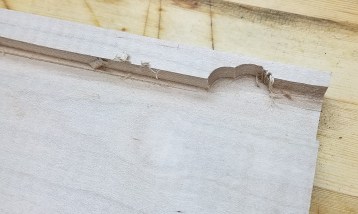
As I was cutting the groove on my router I made a huge mistake.  I wanted to rout the groove a little wider, and moved the fence closer to the bit to make a second pass.  CHOMP!

20171013_120158

I forgot, when I moved the fence closer I used the wrong side of the bit.  When pinched between the fence and bit, the bit bites in and drags everything forward.  I made a little graphic below to show the issue.  The bit rotates counter-clockwise.  Keep out of the red zone and use the green side.

I recovered by starting over and moving on to a new piece of wood.  This time without any issues.  20171013_121914

Once I got the groove completed I tapered the back a little.  It doesn’t need to be 3/4″ thick all the way across, so I thinned the back end down.  I like the effect a lot, but in retrospect I could have gotten a lot more aggressive.

20171013_123053

With the tapering done I used the green printed part as a template to lay out the two curved cutouts of this part.  I made the center cut wide enough to help lighten the look, and provide a cutout around the speaker ports at the bottom edge of the iPad.  I was able to orient the front to show off some lovely rays (little speckles in right hand picture) in the maple.

I am really happy with this, a past version of me would have cut the groove and called it good.  The block would have been functional, but chunky and brutal.  This is lighter and more elegant.  Truth be told I could have done more lightening and still had a functional part, but as always it is a learning-by-doing experience.  A spray coat of lacquer sealed the deal.

Ladder Feets

I have a trusty little 3 step Werner ladder that is great for doing work inside and outside the house.  It is small, light and provides enough height to be really useful without making you feel too high up.  I bought it when I got my house 8 years ago and have used it a lot since then.

20170929_111449

20170929_111455


The back two legs are basically straight tubes with rubber feet slipped on.  They did a good job keeping the ladder stable and level, but over the years the posts have pushed through the rubber.  The final straw was when I was doing something in the yard and the bag legs sank 6 inches down.

20170929_140541


I pulled the feet off and tried to salvage them.  The only real issue is the bars pushing through.  Maybe “re-soleing’ these shoes is all it takes.  I tried screwing down some plywood to the bottom, but ran into issues.  The post is only resting on its edge, and the squishiness of the feet means they want to wobble around a lot.  No good.

Time to ditch these feet and go with something new.  I would try to make it all in wood, but the post diameter is not close to any standard drill bits.  I want the new feet to fit tightly.  On to 3D printing!

The foot design resembles the original rubbery version.  The difference is that these will be hard.  I added a flat parallel to the bottom of the post.  The reason being is that when you fold the ladder up it only sits on the tips of these feet.  Probably a lot of the reason they pushed through.  This flat spot will help spread the load when stored and hopefully help it last longer.  The larger flat in the upper left picture is what touches the ground when the ladder is deployed and in use.

20171010_194300

I started with basic PLA, as a test, but they fit so well I am going to stick with the first prototypes.  I might make a higher infill PETG version in the future.  Until then the ladder folds up and stores well, and most importantly sits flat and stable when in use.


Hurricane Irma Update

Irma came and went and we are alive and well.  The battery box performed admirably, but didn’t provide enough cooling.  80+ degree days and nights with very high humidity meant we lost the fridge faster than I had hoped, and sleeping was very dreadful at best.  In the end we broke down and now own a generator and window shaker.

As always you learn a lot from these experiences.  I am no hurricane expert, but have gathered enough knowledge that I think a guide is in order.  For the leathered 3rd generation native Floridian, and the newcomer to our wondrous state.  Expect a guide to be posted in the coming weeks.

Until then my only projects this month have involved getting myself and others ready for the hurricane, and cleaning up afterwards.  Here is the pile of yard debris I have collected from the storm.  I still need to trim the palm tree on the left, and there is a lot of oak trimming that could go on near my shed.

20170924_154139.jpg

Tumbler Sanding

Long story short: I tried to use a tumbler to conformally sand 3D prints and clean up old metal parts.  It didn’t work that well.

Long story long: I wanted a way to sand complex parts such as 3D prints and old tools.  I can convert rust easily enough, but it leaves surfaces dark, and doesn’t handle other grunge.  Sanding 3D parts works, but never gets the nooks and crannies right.

Enter the tumbler!  It is a funny shaped open top globe that vibrates.  Shooters use them to tumble brass bullet casings to clean them up.  I started with sand because it is abrasive and cheap.

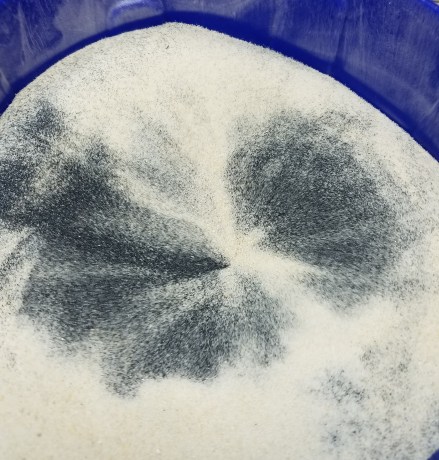
No luck, sand didn’t do much even after hours of work.  How do the rock tumbler guys do it?  Silicon carbide grit.  Lovely!  I will buy some and mix it with my sand.

20170823_184435

Watching it combine with the sand is a really fun trippy experience.

20170823_184505

I tried lower concentrations of carbide grit to sand, but eventually added the whole 5lb bag of grit.  The metal and printed parts both spent 2-3 hours in full concentration grit.  I feel like the metal parts may have benefited.  It is a little hard to tell in the photos, but the metal is a bit cleaner.

The 3D prints didn’t show much improvement.  The sanded one was a touch smoother in places, but picked up a lot of staining from the grit.  None of the ridged areas were knocked down well.  On the plus side, delicate features didn’t break off.

Poor pickle rick is just going to have to remain rough around the edges.  Don’t buy a tumbler and grit to sand your 3D prints, it doesn’t work well.

20170830_201430


Woodsaw 3D Printed Parts

Miter Saw Zero Clearance Insert

Sawing with a tight fitting insert is almost always the right way to go.  It supports the wood being cut and prevents the fibers from getting torn as the saw teeth punches through.  The plate that comes with the saw works, but has a wide gap.  I made a thin plywood insert, but they don’t last that long.  This is my attempt at a 3D printed one.  The original is on the right.  Notice how wide the saw blade gap is.  I took a picture of the original saw plate on one of those self healing cutting mats.  They have good ruled lines in both directions to make sure the image didn’t get distorted.

The first print out of the gate fit really well.

20170805_130315

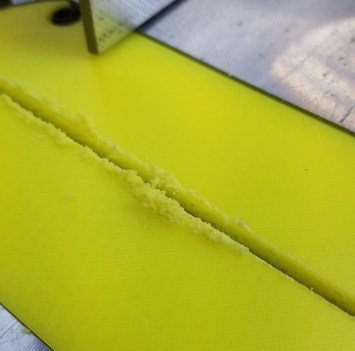
I made the first cut with no wood in the way.  It chopped right through the plastic and cut a self fitting slot that is just exactly the size of the blade.  I might have been a little too cautious.  Slow cutting built heat and there was a bit of plastic fuzz at the top edges of the cut.  A little light work with a utility knife had those cleaned up.  Some subsequent cuts have shown the insert to properly back the cuts.

I still need to find a spool of Dewalt yellow filament.

UPDATE: Decided to upload it to thingiverse.

Table Saw Organizers

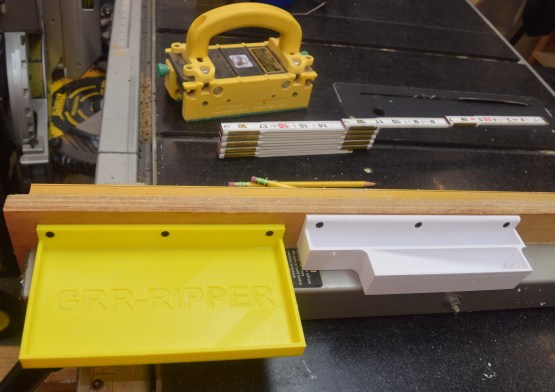
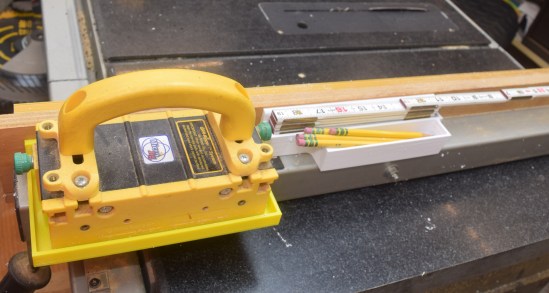
I am in a near constant state of looking for pencils and rulers/tape measures.  I should attach one of each to my body with a short retractable cable.  Until then I try to stage as many as possible at each work station.  At my table saw I made two different organizers to hold commonly used  items.  They both attach to the far side of my rip fence.

The white organizer holds my wooden ruler and a small stack of pencils.  The pencil well could have been a touch deeper, but otherwise it works well.  The yellow holder area keeps my grrripper push block.  It is at a really convenient hand position for quick use when sawing.

DSC_0927

DSC_0928