Table Saw Inserts

Professionally made zero clearance table saw inserts are an important add-on for any table saw.  They make the cuts come out cleaner and ensure small scraps don’t get lodged inside the throat.  They are quite expensive though.  They run over 30 bucks a piece for my saw.  No more, time to make my own.  I bought a smallish piece of phenolic coated plywood for 40 dollars.  It has enough material to make at least 8 inserts.

I started off trying to make a jig that would hold the plywood and make all the blade relief undercuts and slots for the riving knife behind the blade.  It was difficult to hold everything and produced mixed results.

DSC_1361

Eventually I just used carpet tape to tape down one of my old store bought inserts.  A guide bushing on my plunge router let me remove all the area where the riving knife should be.

From there I printed a 7/16″ radius template for the tracing router bit.  I could have used the already taped on insert as a template, but it had a few weird features I didn’t want copied.  With a finger hole drilled in, things were starting to look right.

I need a way to level out the insert.  The pocket they go in is always deeper than a 1/2″ sheet of plywood so you can raise it up to be flush with the top.  I used brass threaded inserts for #6 set screws to give each one leveling feet.  The set screws can be adjust from above with the insert in place.

DSC_1367

The surface coating on this plywood is hard and very slick.  A great material for fences or inserts like this.  The phenolic chips like mad though.  I will stick with these and have left over material, but probably not buy it again.  A few coats of polyurethane and wax would be easier to work with and also reasonably slick.

Because of how high the 10″ saw blade is in the housing I had to use a 8″ dado blade to start the cut before switching back to the full sized blade.  I made 4 total, and once I got the swing of things they came pretty quickly.  Two will be for dado cuts, so they don’t need the riving knife slot.  Hopefully this batch lasts me a few years.

Nailer Cabinet

Air nailers are a pretty wonderful invention.  They can provide low visibility fastening in a lot of different applications.  I have had a brad nailer for ages, and picked up a good pin nailer when I redid the kitchen.  The cordless electric nailers are a lot heavier than their air counterparts, but for just a few quick hits, they are awesome.  I recently built up a full inventory of air and electric brad and pin nailers.  Time to put those nailers to work building a little home for all these gadgets.

I planned out a cavity to hold all the nailers up top, and a set of drawers below to keep the nails and other accessories.  1/2″ maple made up all the components except the drawer bottoms.

Once assembled I cut more plywood with a 45 degree angle on it to act as a french cleat across the back.  The electric nailers sit nicely on their own, but the air ones will need hangers.  Plus, this lets me rearrange things, or add dividers if I feel the need later down the line.

I played with the arrangements, and there are lots of spacing options that work.  Big enough to be flexible, but not so big as to waste space.

DSC_1298

This is a decent looking cabinet on its own, and is about where I would stop in my previous builds.  I wanted to add a little something, so I made my own maple edge banding.

The pin nailer came in handy for securing it all, and hand planing really lets you sneak those parts into a good fit.  With the body of the cabinet in shape I turned to the drawers.  I thought drawer fronts with chamfers might be a neat flare, and I had a new router bit to try out.  I cut all the end grain chamfer while it was still a solid long block, then cut the two fronts out and routed the long grain.  It completely mitigated any tear-out issues.  I finally feel like all those minor screw ups of the past are congealing into wisdom.

Everything got multiple coats of danish oil.  Not a bad finish, I like the wipe on aspect and how it looks.  Honestly though, it is just some kind of thinned linseed oil.  At probably 4x the price of basic linseed oil, I might just figure out how to thin that stuff myself.

I 3D printed organizers to keep each set of nails contained and labeled.  The drawer I had these in was a mess with different nail lengths all mixed up.  Mishaps have occurred from pulling the wrong length nail ream.  If I ditched the manuals I could have probably combined everything in one drawer.  Oh well, this provides ample expansion for new nail lengths, or other jigs/accessories I might acquire.

The final design looks pretty nice.  I will see how much dust it collects and consider adding doors later, but for now it is perfect.

DSC_1311

June 2018 Prints

A bountiful harvest of prints this month.  I had a lot of work going on in the shop, and that typically ends up producing different jigs and prints to help out.

First up, I reorganized all of my machine screws into one central organizer.  To help with organization and to tell them apart I printed a screw ruler and hardware guide.

20180617_152833

The ruler measures screw lengths of either flat head or other style.  The guide has through holes that match my common hardware styles along with examples of washers and nuts.  It makes matching a random bit of hardware easier.


I do a pretty good job keeping my eye and ear protection on when in the shop.  Dust masks are another thing.  A lot of my tools have vacuum, but certainly not all.  Most masks I have tried don’t work well with the beard and mustache, and most are pretty hot.  This one works well for me.  I built it a little home to prevent damage, and so I always know where it is.  I feel a little like bane when I wear it.

I took a photo of it on the cutting mat, then used the lines to help design an appropriate housing shape.  The hinge required a single screw and nut, and a magnet in the lid and body keep it closed.  The backplane screws down so I tucked it under a cabinet with other PPE.


I had a lot of flat parts that needed holes drilled in them in the same location.  Instead of marking every one I made a drill template with bushings.  The bushings are sized so a particular drill bit just fits inside.  It keeps the bit on location and perpendicular to the surface.  They will wear out eventually, but are easy to replace.  These all fit in a 5/8″ hole and have two screws to keep them in place.  Once built this saved me a ton of time and increased repeatability.

20180612_203922


Dust collection fittings never fit.  There was an article about it in one of my woodworking magazines.  The guy basically threw up his hands and told the industry to get their act together.  I emailed him with my solution.  He said it was cool, but a workaround for an issue that shouldn’t exist.  Agreed, but here is my workaround for my miter saw.

DSC_1305


I switched to using these small bottles from woodcraft for my glue.  I like them a lot better than the bottles that most glues come in.  The only trick is that the little red caps blink out of existence once dropped.  I did a few test prints with a segment missing to get the taper size and groove right for this one, but I think I have a winner.  It is much easier to handle, harder to lose, and is more easily replaceable.


I had kind of a failed attempt at a vacuum system for degassing epoxy.  I might revisit it at some point, but for now it is a defunct project.  I needed to tap some polycarbonate for pipe fittings and bought a pipe thread tap.  It didn’t come with any case or even pouch, so I printed one.  I sprayed it good with oil to prevent rust.  Hopefully stored this way it will not get lost, broken, or rust.

Car Phone Charger Dock

My phone has wireless charging built in, and it is a wonderful feature.  Very futuristic.  I wanted this ability in my car when doing road trips or errands.  I started with a flat lipped bed that would keep the phone in place.  There is a spot behind the gear select knob that was just big enough for it to sit.

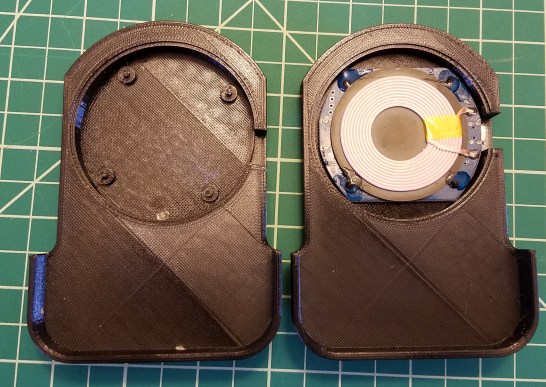
I took apart a small puck wireless charger and pulled the internals out.  It was all one piece with 4 holes for me to mount to.  Very convenient.  Below are the first 3 PLA iterations of my design.

20180525_141934

The first one on the left was too wide, and din’t have enough space cut out for fingers.  The cover (below) didn’t sit well in the cavity either.  The next one was better, and had more rounding.  The last one had a tapered bottom to lighten the look, and a simple disk to cover up the electronics.

I put it in the car and test drove it for a few days.  It was an awkward fit.  the rubber pads underneath kept it from sliding around, but it was tight navigating it between the shifter and console.  I sat it upright in the change well and found that orientation a lot easier to use.

This sticks up a lot higher than was really needed, but The principle is sound.  I switched to PETG because the other car parts I printed in that material have held up well.  I thought I had a slam dunk with the left one, but the angle of the cable was too low, and the circuit card needed a little fit adjustment.  PLA and PETG shrink differently.  If you prototype something in one material, then switch to another, tight fights might need adjustment.

20180608_085402.jpg

I have run around with this version for a week now and love it.  My phone falls right in and is picked up easily.  The cable is well controlled and doesn’t get in the way.  It took a few iterations to get here, but was worth it.


The only issue with using that space for my phone is that I typically put trash there.  It was easy to see and clean out at the end of the day.  Time for another print!  I can fit a little trash can in the side pocket of my door.  Measuring down inside the pocket calls for something like a pair of inside dividers.  I didn’t have any, but I do now!

With tool created I measured the pocket width in a few spots and came up with a profile.  It took some adjustments, but the second version clicked into place.  That area of the car has a ton of curves.  This didn’t match them perfectly, but it sits well and doesn’t stress the door mold too much.  I gave this design a week as well.

It worked out like a charm, but could stand to be wider.  I printed it 50% wider out of PETG to survive the heat, and called my car project done.

DSC_1271

Father’s Day Flippers

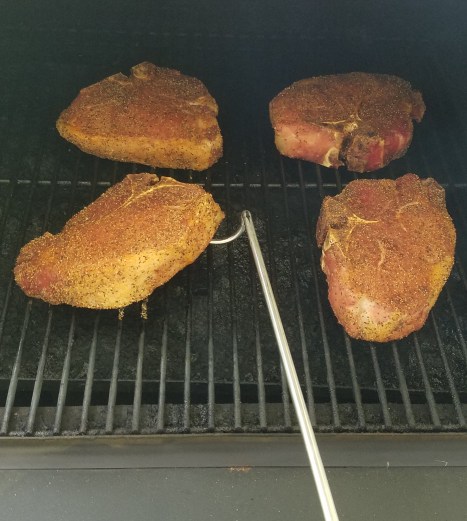
These are called pigtail flippers, bbq turners, or I have also heard Texas toothpicks.  Whatever you call them, they are cool tools for the grill.  Here is me demonstrating their use on a set of serious pork chops for my father in law.

20180616_120333I wanted to try one of these tools, and my localish woodcraft had these new kits on sale.  Why not make one for myself and the dads in my life?  I picked up some thick maple dowel to make these handles.  I was building the handles for my mom’s bookbinding press at the same time, so it all worked out.


The first step is to drill out a hole for the threaded insert, and carefully thread it in.  I had an issue.  Most kits use 1/4-20 or 5/16-18 threaded inserts.  This one had an M6 insert for the metal turner rod.  I don’t have an M6 mandrel, and I couldn’t find one online.  Time to make one!  I played around, but ultimately a nut and bolt with the head cut off did the trick.

DSC_1251

That let me thread the brass insert into the handle, but I would normally flip the part around and chuck the mandrel up so I could spin with no tail stock.  No such luck here, the bolt is too small for all of my chuck jaws (right picture).  I could try to chuck up the nut, but it has 6 sides and the jaws all have 4.  If I did a lot of these, I would have to figure out how to make my own mandrel.


Instead of holding it by the threaded insert I turned down a shoulder to accept a brass bushing, then chucked up that shouldered section.  It marred the surface, but that will get covered anyways.

With 4 different variations turned I remembered I was supposed to drill a hole in them for their hanging cable.  This would have been a lot easier when they were simple cylinders still.  Order of operations on the lathe is super critical.  I put the whole lot of them on little sticks and went to town with the spray polyurethane.

I pressed on the brass bushing with epoxy and threaded on the turner.  The wire cable as a hanging strap adds a nice touch.  I hadn’t broken out the lathe in quite a while, so this was quite satisfying to get these done with minimal screw ups.

DSC_1284

DSC_1285


One other minor experiment that happened when I had my lathe out was to try and smooth out my 3D printed can koozie.  It turns out that you can really shine that stuff up if you go through the grits.  There are minor voids that show through upon close inspection.  Still, that is a nice shiny looking part.  You could polish up most of a chess set this way!

Bookbinding Press

During a visit to my crafty mother, I came across a good build to support her habits.  She showed me a series of bookbinding finishing presses.  I am not super familiar with how they work, but they looked a lot like a moxon vise.  I am planning out a moxon vise build of my own, so this would be a good learning experience and make a great gift.

DSC_1280

DSC_1281

Traditional books have a lot of layers of material that need gluing together.  This helps keep it all clamped for various operations.  The side wings let you clamp it to a table, and with it hanging over the edge, any length book can be held.  The jaws will open to accept a 3″ thick book, and there are 13 inches between the screws, allowing for a very tall book.  5/16″-18 hand screws should provide plenty of clamping force.  The hand screws come out, so it can be disassembled and packed into a smaller space.


I started with the backbone and dovetails.  If something was going to get screwed up, it was the dovetails.  I need to cut a lot for an upcoming project and I am beyond rusty.  Mark, saw edges, fret away waste and pare the rest.

My dovetail transfer jig has already come in handy.  The pins look pretty rotten, but they should be very structurally sound.  Sorry mom!


With that taken care of I glued up two pieces for the front, and added another to the backbone.  One piece was taller than the other which eventually got planed to an angle.  That gives your fingers easier access to the book spine.

DSC_1236

DSC_1237

DSC_1238

I assembled the dovetails and put on side wings that let you clamp this jig to any table or workbench.

DSC_1240

DSC_1242

When all the glue was well cured I put on a few coats of polyurethane in the hopes that bookbinding glue wouldn’t stick to it.  Felt pads on the bottom should keep it from scuffing any tables.  I pounded in some threaded inserts meant for wood.  They should hold just fine, but to be sure I sank a few screws beside them.


To run the threaded rods in and out you are going to need a stout handle.  I chopped some maple dowels down to size, drilled out for a 5/16 threaded insert, reduced the entry shoulder for a brass sleeve, then flipped it around, threaded it onto a 5/16 mandril, and smoothed out the back side.

The bare wood got multiple coats of spray polyurethane, then when cured, I epoxied the brass sleeve on the handles, and the threaded rod in place.  DSC_1276.JPG

Spring 3D Prints 2018

I haven’t done a “Prints Of The Month” post in a while, but that doesn’t mean I haven’t had a pile of stuff popping off the printer.  Here is a smattering of prints I completed in the last 2 months or so.


I needed extra retainer cases for some orthodontics equipment I have (bummer).  I could buy them, but where is the fun in that?  Fusion 360 has a half decent thread database, so I dug into it and made a screw together case.  I started with the default settings and couldn’t get the top to screw down all the way.  It turns out I was using a Class 3 thread.  Class 1 is the loosest, while Class 3 is high precision.

I eventually oiled the threads and worked the Class 3 one back and forth a number of times and it closes now.  The Class 1 set I printed worked itself into fully closing a lot faster.  If you are worried about your prints coming together, pay attention to the thread class.


Continuing with the gaudy yellow color, I added a magnifying light to my shop.  They sell screw on bases you can plug the light post into, but they charge 20 bucks each.  I can print as many as I want for less than a dollar a piece.


A co-worker builds guitars with a CNC mill, but occasionally needs chisels to help clean up segments.  I took his flunky grade D chisels and put a nice shine on them.  3D prints and a magnet means nobody gets stabbed by accident when transporting them back to the owner.

20180512_114215


I printed a small cable guide for my car a year ago.  It lasted a while, but fell off recently.  The tape failed to hold the printed part.  Time for an upgrade.  I increased the width by 50% and made it three times taller.  Before attaching the tape I scuffed up the back to help it grip well.  The PETG didn’t melt or deform in the summer heat, so I am sticking with that material.


Not my own invention, but rather a Thingiverse submission by user iamjonlawrence.  They are a set of printable radius gauges.  They have inside radius, outside radius, and a set of circles.  The hole of the circle has the radius marked on the gauge, the outside has twice the radius.  The metric versions have that fact labeled better.  They pack a lot of function in a few small prints.  They are available every 1/16″ up to 1″.  I might have to make a set that goes over 1″.

An example of how to use them is on the right.  A pair of calipers wouldn’t really tell you the proper radius, but this gauge has it pegged.


Last but not least, we have a beloved octopus stained glass in our kitchen window named Eddy.  He guards over the cooking and cleaning activities and always lends a limb.  He is too heavy to hang on a suction cup for more than a few weeks, so we always just sit him on the window edge.  He has fallen before, and that will not do.  I printed this basic profile to clip into the window frame and provide a little spot for Eddy to stay firmly in place.

Dovetail Transfer Jig

I have quite a few dovetails to cut in the upcoming months.  One part of the process I always felt very weak was in the transfer of markings from one piece to another.  Whether you do tails first or pints first, at some point you need to clamp the to parts together and do a transfer.

I have seen a few different variations on this idea, this is just my take.  Essentially the two boards need to be held at right angles, and up against a fence that references two sides of the boards as co-planar.  I don’t normally keep around extra big plywood because I don’t have the room to store it.  I found out lowe’s has 1/4 sheets of “lauan grade” plywood.  Not as good or as pretty as birch, but it looks stable enough for jigs, and was much cheaper.

I started by using pocket holes to join the base. together.  I relieved the edges up against the fence with a plane to make sure no dust would keep the aligned boards from interfacing with the fence.  A 90 degree cut of plywood made a fence/reference surface for the boards.  I made sure the base was good and square before nailing in the fence.  The fence only protrudes enough to act as a reliable alignment surface.

This might have been good enough, but I wanted additional assurance that it was square, and a little help lifting it up off the table.  These blocks do both as well as stiffen the jig.

DSC_1224


To demonstrate the use of this jig I have a (admittedly poorly cut) dovetail that needs transferring.  The jig sits on the bench top, or could be clamped down.  Adjust the two boards to be jointed until they are lined up.  When set, transfer the edges of the cut dovetail to the pin board as shown.  Because the jig hangs out over the edge, a really tall board could be dovetailed without issue.

This simple easy jig should be helpful in the months to come.  Hopefully I reference it soon with high praises.

Hurricane Season Start

Hurricane season hasn’t started yet, but we already have our first named storm of the year.  Happy hurricane season everyone!  As of writing this it is still subtropical (I guess for specific weather nerd reasons it isn’t called a tropical depression), but expected to become a tropical storm.  As a wise guide once stated, it is never too early to start thinking about getting yourself ready for the storm.

I went around and found a few minor issues that could be a big problem if a storm were to hit.  These are easy to do now when I have free time, but would be stressful to complete when a storm is coming.

First up on the list, my screened in porch is getting old and one of the vertical supports broke loose.  It doesn’t hold the roof up, there are 4×4 posts for that, but buffeting winds would do a lot more damage with this part flapping around.  A few right angle brackets and metal screws secured it in place.


Second, I have a set of areca palms that have gotten too close to the house.  I probably shouldn’t have planted them that close in the first place, and might cut them out completely when they start pushing out the fence.  For now, I like them, but need them to be away from the house.  Again, under normal storms they aren’t a problem, but heavy winds could whip those fronds around enough to do real damage to the corner of the roof.


Last but not least my poor fence had another post shear off.  Not sure why they all happen on just this one side, but they do.  The left picture shows a distinct bend.  As it turns out the most bent post is actually rock solid, just not straight.  The one closer to the camera has broken off at the ground.  I left the broken post in place and sank another one next to it.  Everything is much more solid.  Thats it for now.  Time to enjoy a margarita and hope we have quiet season.

Printer Upgrade Part 2

Last we left our printer saga, everything was quite broken, and I was waiting on parts.  The 625z bearings came in and I put the extruder motor back together.  When I could easily turn it by hand, I knew my extruder problems were solved.  Sure enough, I can extrude PETG at high speeds and no jams.  The hot end was not to blame.  I did develop a new problem though.

20180430_202617

That is the status of my end stops.  The printer thinks the inductive sensor is touching the bed even though it is nowhere close.  I had an occasional issue with the inductive sensor reading poorly.  That has become constant now, all my messing with the cables finished off my probe.  I can’t start a print without that probe.  I massaged the cable and found a spot that flipped the 1 to a 0.  Time to troubleshoot.

Ok, so the cable is pretty well shot.  I opened the jacket where the issues was, but couldn’t figure out the exact problem.  They used very thin wire, it could be a break within the jacket.  I just cut most of the cable and redid the wiring.  That got me back up and running.  I printed everything I needed for the upgrade plus spares in both PETG and PLA.


I double checked all the instructions to make sure I wasn’t missing anything and started with the tear down.  On the plus side I am really good at disassembling the whole hot end/extruder!  It looks so naked.

DSC_1210

I only ran into one small snag.  The part that holds the x-belt wasn’t accepting the belt on the right hand side.  I printed 3 different versions, and they all had the same issue.  I took that part off and worked around the groove with a hobby knife.  It eventually relented and let the belt seat fully.

After that, the extruder assembly was pretty straight forward.

The bed assembly was a breeze.  I like most of the changes they made to the cable management, and think this will be more robust.  How the rats nest gets handled in the controller box could be a little better though.  Maybe just a bigger box.

I went through the calibration wizard, did some nozzle height testing, then printed a smart looking benchy.  Dimensionally it is great, but course settings mean it isn’t cosmetically the best.

I am thrilled to be over the failures, and proud of myself for solving all the issues.  Given that is almost exactly the 1 year anniversary of getting this printer, I decided to share a few stats.

Printer Stats:

  • 380 successful prints (more than a few failures, especially these last 2 weeks)
  • 44.7 days spent printing (12% of its life)
  • 6.3km of filament