Bunny Feeding Fix

Our rabbits are many things, and one of them is tenacious when it comes to food and treats.  We got them an automatic feeder to make sure they get pellets at the same time every morning.  Honey found she could chew, claw, dig, and ram the feeder to get more.  Screwing it all down to a wooden base made tipping harder, but didn’t stop the chewing.

dsc_0642

I needed to remove their access to the device.  Listening to Honey claw and dig at the bowl for hours on end is getting old.  I ditched the old bowl and used a 4″ to 2″ PVC coupling as a funnel.

I mounted it with some small screws run in through the side.  I can remove it and make repairs or changes if need be.  The dispenser sits over it nicely and is held in place with a few low cleats.  They keep it from shifting, but you can pick it right up if adjustments are needed.

dsc_0647

dsc_0649Next a length of pipe acted as a down spout.  I start with only this downspout, but the pellets came out too quickly from the drop.  They would hit the bowl and go everywhere.  The bunnies didn’t mind the game of 52 pellet pickup, but some pellets would escape the fence.

A few elbows helped slow everything down.  They have enough velocity coming down the chute to not get stuck in the first one, but aren’t going so fast to scatter all over when they hit the bowl.

The whole contraption sits nicely on the bun-servation tower, and a few screws ensures they can’t knock it down on themselves.  It has been a week and the silence is golden.  The furry raptors don’t seem to mind the change, they get food all the same.  Now they just don’t short tomorrow’s meal by shaking it out early.

dsc_0648


Backyard Ballistic Target

The kitchen renovation rages on, but between painting and tiling there is time to work on a little side project.  A backyard knife throwing target.  It also works for hatchets!

wp-1483059011512.jpgThis project took only 3 2x4s, a bit of glue, and a hand full of screws.  I started by cutting up a pile of 3.5″ long 2×4 segments.  These are going to go together like a end grain cutting board.

At 5 across and 10 tall the target comes out roughly square.  15 x 17.5.  You could add another row to make it very square, but that would have required additional 2x4s and this seemed like a big enough target.  Easy to say now when I hadn’t missed 10 times in a row.

Titebond type 3 is an outdoor compatible glue, even if standard 2x4s aren’t.  Not sure if that matters or not.  It will be a race between the environment rotting and pulling the target apart, and my ability to actually hit something and cause damage.  My monster belt sander came in handy for leveling the edges of the rows after the first glue up.

wp-1483059011520.jpgWith everything glued I had a big block target.  This alone would probably last a while, but could somewhat easily cleave in half along the grains.  To help with strength I wrapped the edges with 2x4s screwed into the core.  This will help hold the relatively delicate center together longer.

A bit of throwing shows that I am no good at this.  Maybe the environment will get to it before my accuracy chunks out the center.

Porch Fuel Organizer

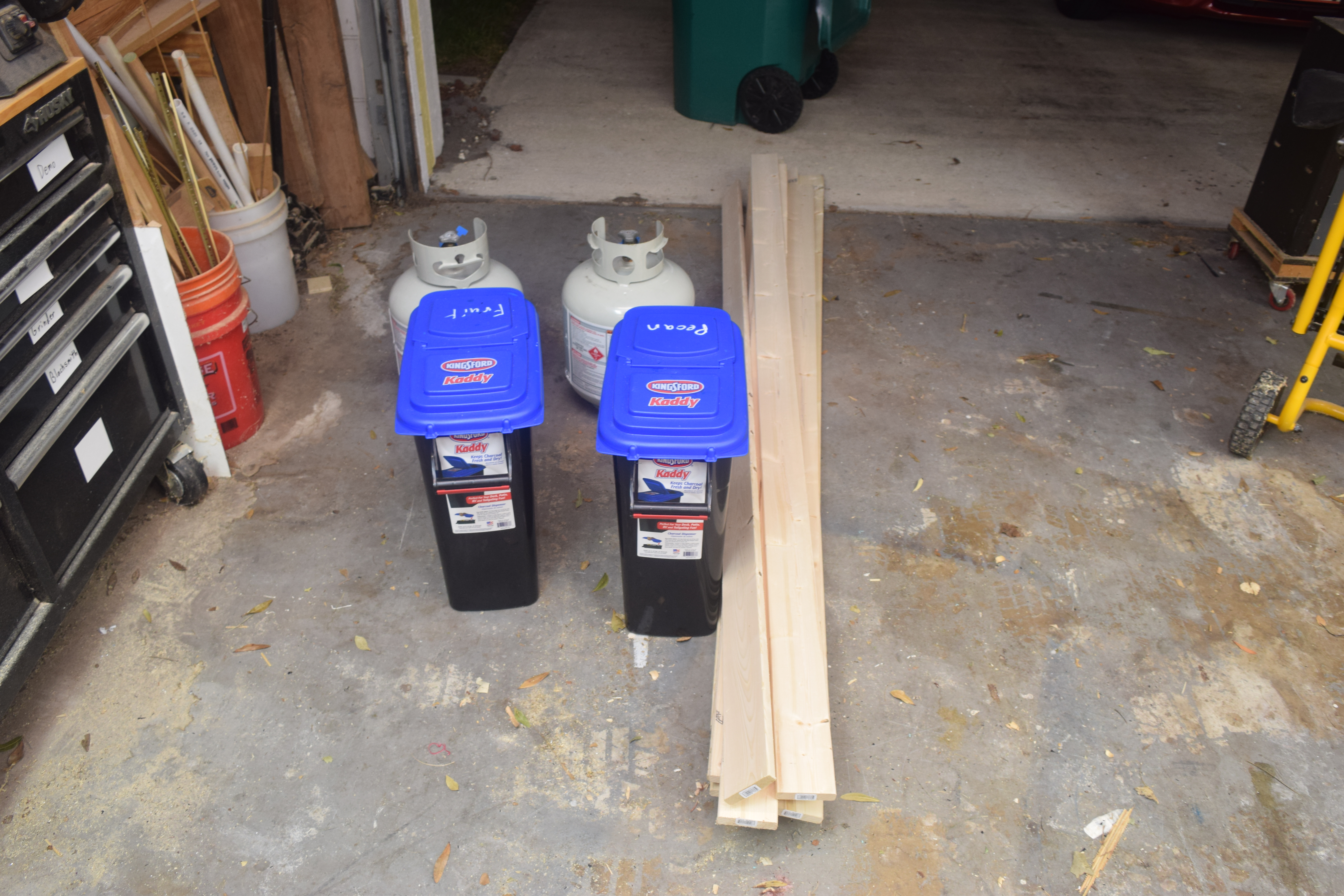
The slow take-back of the porch continues.  With all the bunny stuff gone, I have to get things organized so we can maximize the available space.  I have grill stuff everywhere.  Three propane cylinders for the grill, outdoor cooker, and spares for hurricane season.  I put all my Traeger pellets into kingsford charcoal bins to keep them organized and from spilling all over the place.  This all needs a nice storage rack.

dsc_0561I was planning on using 1x4s to do a majority of the building, but found that the store was out of their basic grade boards.  Instead I noticed their furring strips.  1×4 with nicely rounded edges for about a 1.70 a piece.  The quality is terrible.  They are very light rough and soft pine.  Many were so bent and twisted you couldn’t even use them for boat building.  Still, with enough cherry picking I got some good boards and was able to keep my whole project cost to less than 15 bucks.

A few scraps of 2×4 made uprights for the two level contraption.  I set the width so that I could store the 3 propane tanks comfortably below with a few pellet bins on top.  Keeping the propane low seems like a good idea.  Less distance to fall.

dsc_0562

Short pickets run between the two frames to tie them together and give the propane tanks a stable surface to sit on.

dsc_0564

The top shelf could hold a lot of weight in pellets.  To help stiffen the two existing runs I wrapped a vertical boarder around the edge.  It added a lot of strength to the shelf, keeps the pellet bins from sliding off, and looks nice!

dsc_0565

dsc_0567

Everything fits as intended, and I am ready to give it all a heavy coating of boiled linseed oil.  Never used this on an outdoor project, but it will live under cover on the porch, so it should work out.

dsc_0568

24 hours later the coating was nicely cured, and the wood took on a lovely golden yellow look.  I may have to use furring strips more often!  It looks good on the back porch and helped clean up a lot of space.  I wish I had gone a few inches wider though, I could have gotten another bucket of pellets up there.  Oh well, next time!

dsc_0569


Printer Cabinet

I am keeping with the printer theme, but this is the 2d paper chewing variety.  Our old printer was on the fritz, so I upgraded to a more professional model that does document scanning and yada yada.  It has been over a month and it prints well, scans fast, and is cheaper to operate than the last one.  It is quite big though, and the old location in the closet isn’t going to cut it anymore.  I need to be able to get to the top and have lots of room to flip up the scanner.  We are gonna need another cabinet.

DSC_0441I wanted to build this quickly so I could clean up our office a bit.  Plywood is what I have used on many of my previous shop cabinets.  It looks decent out in the garage, but I wanted something nicer for inside the house.  Edge banding is a possibility, but I wanted to try something else.  This product is available at most home centers.  It is pre-made laminated pine boards.  The price is pretty reasonable and it has a nice rustic look while still looking better than plywood.  Never buy it.  The thickness varied from board to board, and once I cross cut it there was a lot of warpage.

Consider yourself warned.  I built a basic box using rabbeted edges, glue, and brad nails.  The thickness differences made doing a proper rabbet really tough, and the warping kept the joints from being tight.

I did a basic framed panel door to go across the front opening.  My issues continued, I cut the panel right at the edge of too short.  It will work, but I have to be careful to prevent it from shifting and showing a gap.  I used some of the left over laminated material to build a pull out drawer.  Cutting at the angle relieved more stress and showed a lot of bad warping.


For a finish I decided to try out a home built shellac.  Fine woodworking had a decent article and video on making your own and application.  I like it!  This is kind of a big project for wiping, but it was easy to mix, went on really fast, and didn’t alter the color too much.  I used a very blonde shellac.  Next time I will do something darker and see how it works with soft woods like pine.
DSC_0450

The screw-ups keep on coming.  I cut the panel groove all the way through the side board.  I should have stopped it.  Not only does it look bad, but it compromises the strength of the pocket hole screws.  They don’t have as much to bite into.

The drawer went in on a set of full extension metal drawer slides. This will house my paper shredder and paper storage.

The warping of everything showed up in the front door.  Tight on one side, slightly open on the other.  Oh well, it is going in a closet.

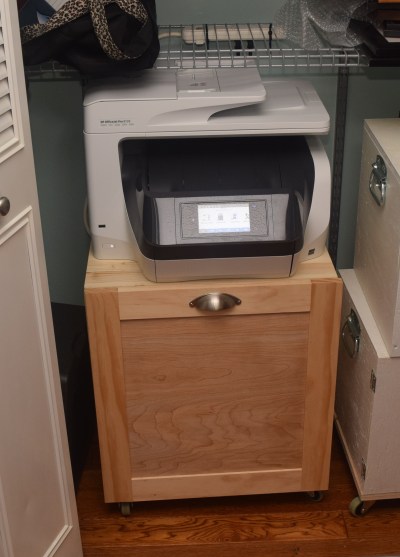
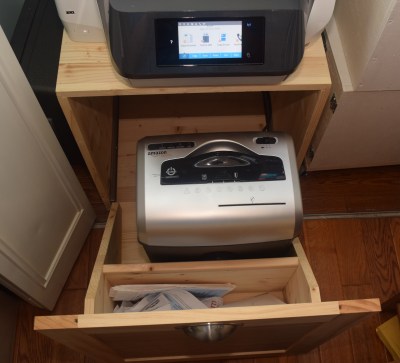
Speaking of closet, here is the final resting place.  It slides under the existing shelf nicely, and is short enough front to back so that you can close the closet door and conceal the printer.  If you just need to make a few prints, the front area is accessible enough to do so.  If you need to scan, the whole cabinet is on wheels, so you can just pull it out, do your work, then shove it back in.
DSC_0459

The best part is what is housed inside.  I put my shredder on the back side of the drawer, and used the front as paper storage.  Now instead of a pile growing around the shredder it collects neatly here until I can get to it.  My implementation and the materials leave a lot to be desired, but it still looks decent, and is super functional.  I learned, didn’t get hurt, and got a useful piece of furniture.  I’ll call that a win.
DSC_0460


Bandsaw Lighting

My drill press lighting scheme worked out really well and I have other tools that could use a helping light.  Enter a few useful items.  1.  Is a pair of car accent headlight strips (7 bucks for the pair and super bright)  2.  Inline switch  3.  12v power supply.  All told, about 20 bucks of stuff.  DSC_0433

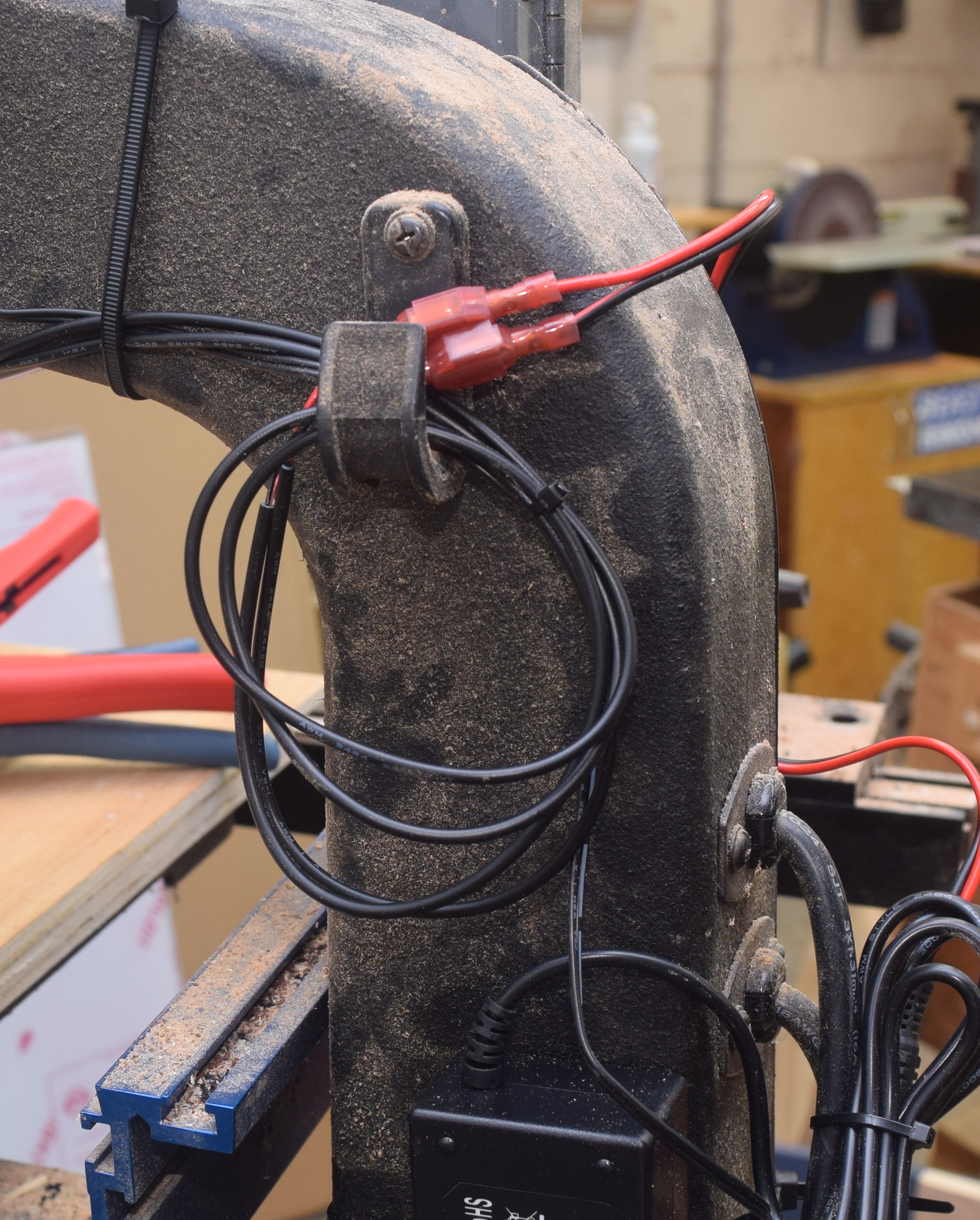
I started by zip tying the power brick to the back side of the bandsaw housing.  Make sure all the cables and zip ties are in places that won’t get snagged by wood passing through the bandsaw.

DSC_0434

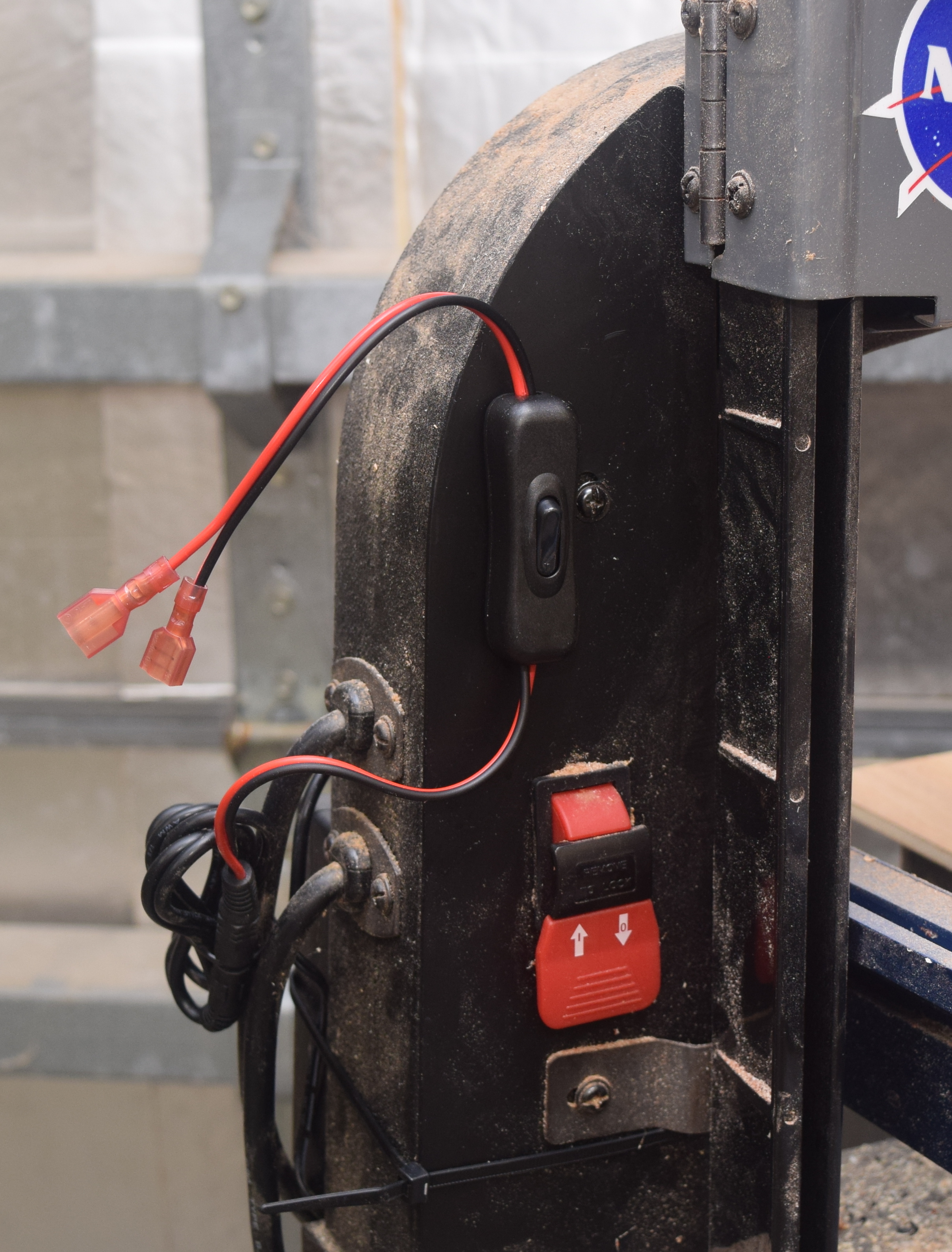
I used some 3M VHB tape to stick the switch to the front of the machine within easy reach of the tool’s power switch.  VHB tape is a bit pricy, but really good stuff if you need something to stick and stay stuck.

DSC_0435The light strips fit nicely under the top section of the cast band saw structure.  The strips came with some basic double stick foam tape.  For now they are sticking ok, but the cast housing is rather rough, so I expect they will need additional shoring up after a bit of Florida summer gets to them.

DSC_0436

All the lighting wiring comes to this point behind the switch.  I tied the two lights together and connectorized them to the switch.  I used a lot of zip ties to keep all the wires out of the wood aperture, and I think it was pretty successful.

DSC_0437

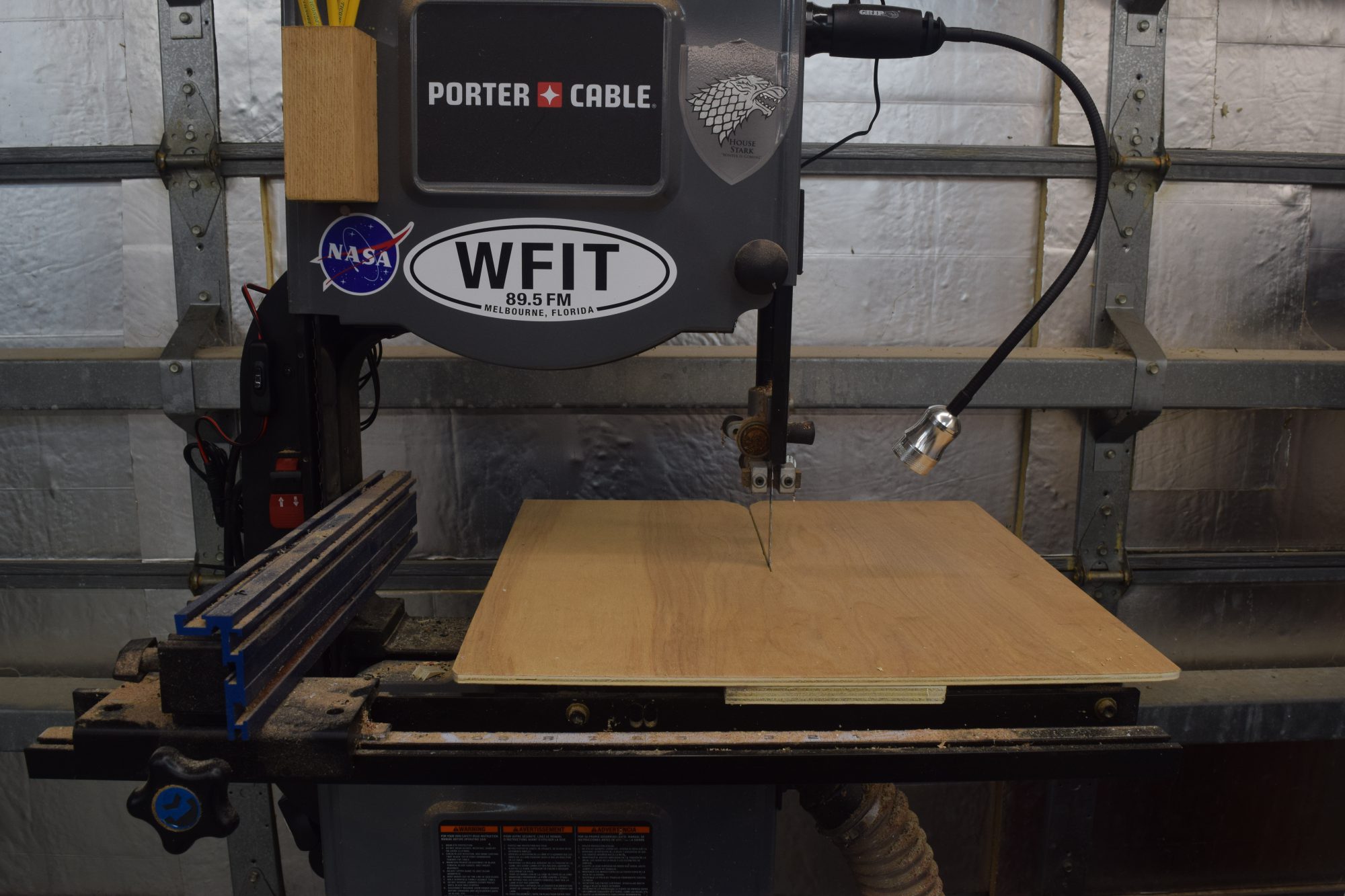
I had a goose necklight already installed from a while back.  It does an ok job, but with the new lighting strips everything is really nice and bright when working on the bandsaw.


Lighting Test

DSC_0438

No Lights

DSC_0439

LED Strips

DSC_0440

LED Strip with Spot Light


Sander Cabinet

DSC_0350

This is my new beast.  I posted about it a few weeks back and have been really happy with it since.  Happy with the machine, but not the stand.  It is too low, and my little shop vac doesn’t really fit under it.  Time for a new cabinet.

I designed this to work with a single sheet of 3/4″ plywood.  The doors, drawer, and back could have easily been made with 1/2″ plywood, but I didn’t have any, and buying one sheet of each didn’t make sense to me considering I can’t really store half sheets.  Besides, the price difference is minimal.

Started with an open box that would house the dust collection, and raise the tool up high enough when castors are installed.

With a shelf added I had room for a drawer in the bottom, and was able to cut holes for the intake and exhaust hose.

DSC_0356

The drawer is a simple box like I have been making for other cabinets and drawer organizers recently.  No handle on the front, just a finger cutout.  This is big and deep enough to hold all the sander’s spare belts and disks as well as some random miter saw parts that needed a good home.

At this point it was assembled enough to apply the boiled linseed oil finish and castors.


Accessory Holders

The sander has two different allen keys to make adjustments and remove guide plates.  Additionally it has a small miter guide for use on the disk sander.  I milled two pine blocks to make custom holders for the keys and guide.  Both sets of tool holders screwed to the inside of the doors.


The BestDSC_0364

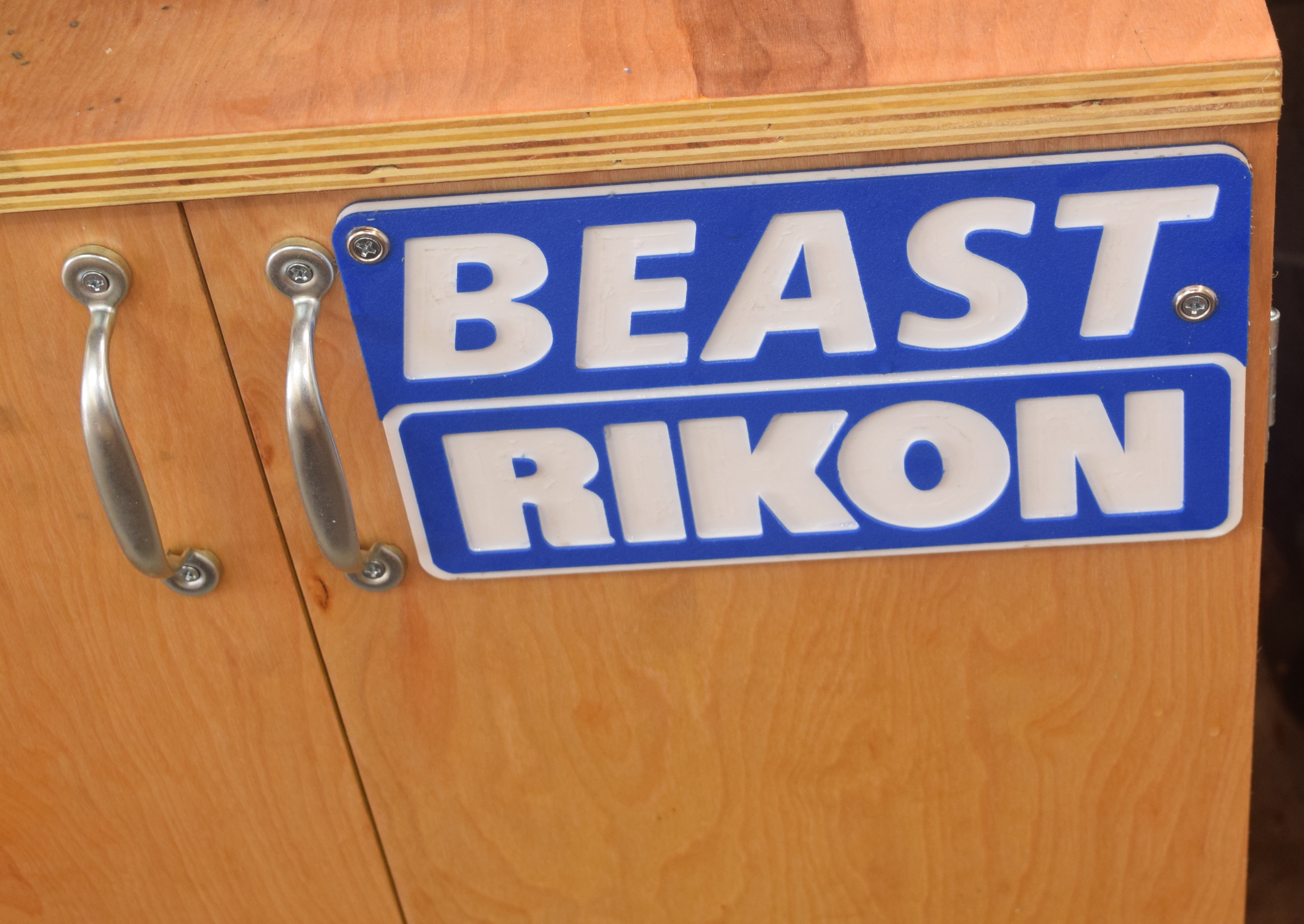
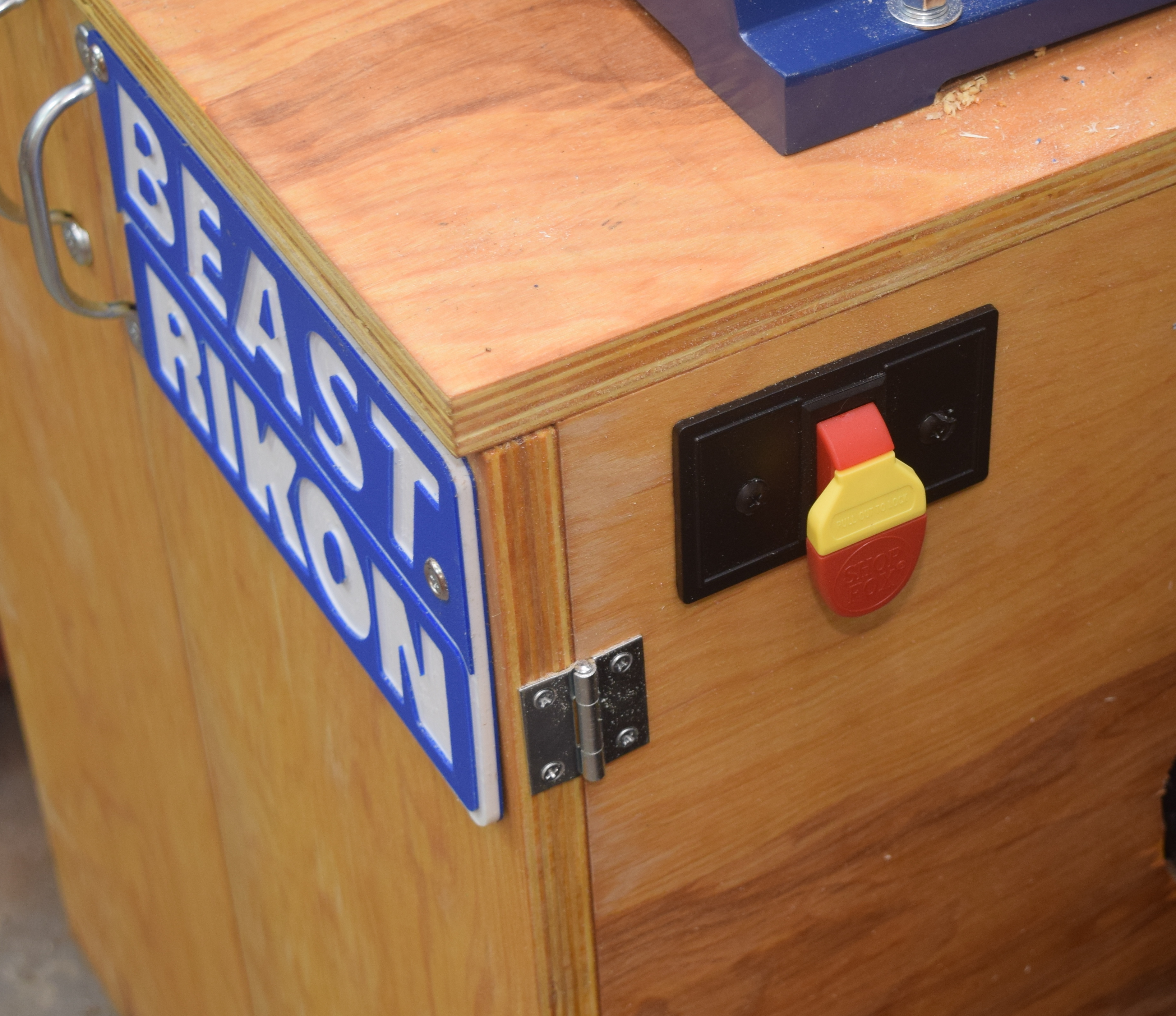
Speaking of my CNC mill, I employed it a bit more for this job.  I think calling this thing a beast is really fitting.  I took some two color HPDE and milled out a BEAST Rikon logo.


Dust Switch

It won’t do to fumble around inside the box every time I need the vacuum on.  I found safety tool switches online that come with a split up power cord.  You can plug it into the wall, and plug your tool into the cord.  It took some trimming of the flange to make it sit flush on the cabinet side.  Once trimmed and screwed in place though, it looks and works wonderfully.

DSC_0406


Storage, integral dust collection with an easy switch, and a perfect working height.  What more could you ask for in a beast?

20160820_183040.jpg

Drill Press Lighting

I love my drill press.  It is a 1980s era craftsman floor standing drill press.  The table I made for it is honestly not my best idea, but that isn’t the drill press’ fault.  The lighting scheme is a little lacking.  It has a single bulb tucked behind the spindle, and it does ok, but LEDs will make it better!

DSC_0417

I found these things called “angel eyes” for cars.  They are used to make cars look like they have fancy rings around their headlights.  You can get a two pack of different diameters for around 10 bucks.  They are perfectly suited for ring lights.

DSC_0416

I took the ring and bonded it down to a bit of plywood cut with an inner diameter that just presses onto the un-moving part of my drill press.  To add additional lighting I found these patches of packaged LEDs used to replace in-car dome lights.  They can be found in 4 packs for around 10 bucks.  All of these parts already have resistors built in because they are designed to be hooked up to a car’s 12V line.

The plywood square will go over the area that previously had the drill’s light bulb.  I used recessed magnets to hold them in place.  The wires got wrapped around to the back, and soldered together along with the ring light.  Hot glue helped with all the cable management.


I connectorized the lighting half and the power supply so I could separate the two if need be.  Speaking of power supply, the ring light and each light patch take a few hundred mili-amps each.  Get a 12V supply with at least an amp output.  I used an adapter that screws into a regular bulb socket and gives a plug outlet.

DSC_0424

The power supply is screwed into where the bulb used to be, wires are routed, and lights installed.  Lets see how it looks with no light, with the old bulb, and with my new lighting system.

DSC_0427

No Lights

DSC_0428

Old Bulb

DSC_0429

New LEDs

Very bright!  I guess for the 30-40 bucks I spent on parts I could have bought an off the shelf drill press ring light.  Maybe it would provide more light, but I kind of doubt it.  I know it wouldn’t be as compact or fit as snugly as this thing does.  The last thing to keep in mind when doing this is free slack on the ring light.  The section I attached the light to moves when the drill press comes down.  Provide enough slack to allow free movement.

Resonator Uke Upgrade

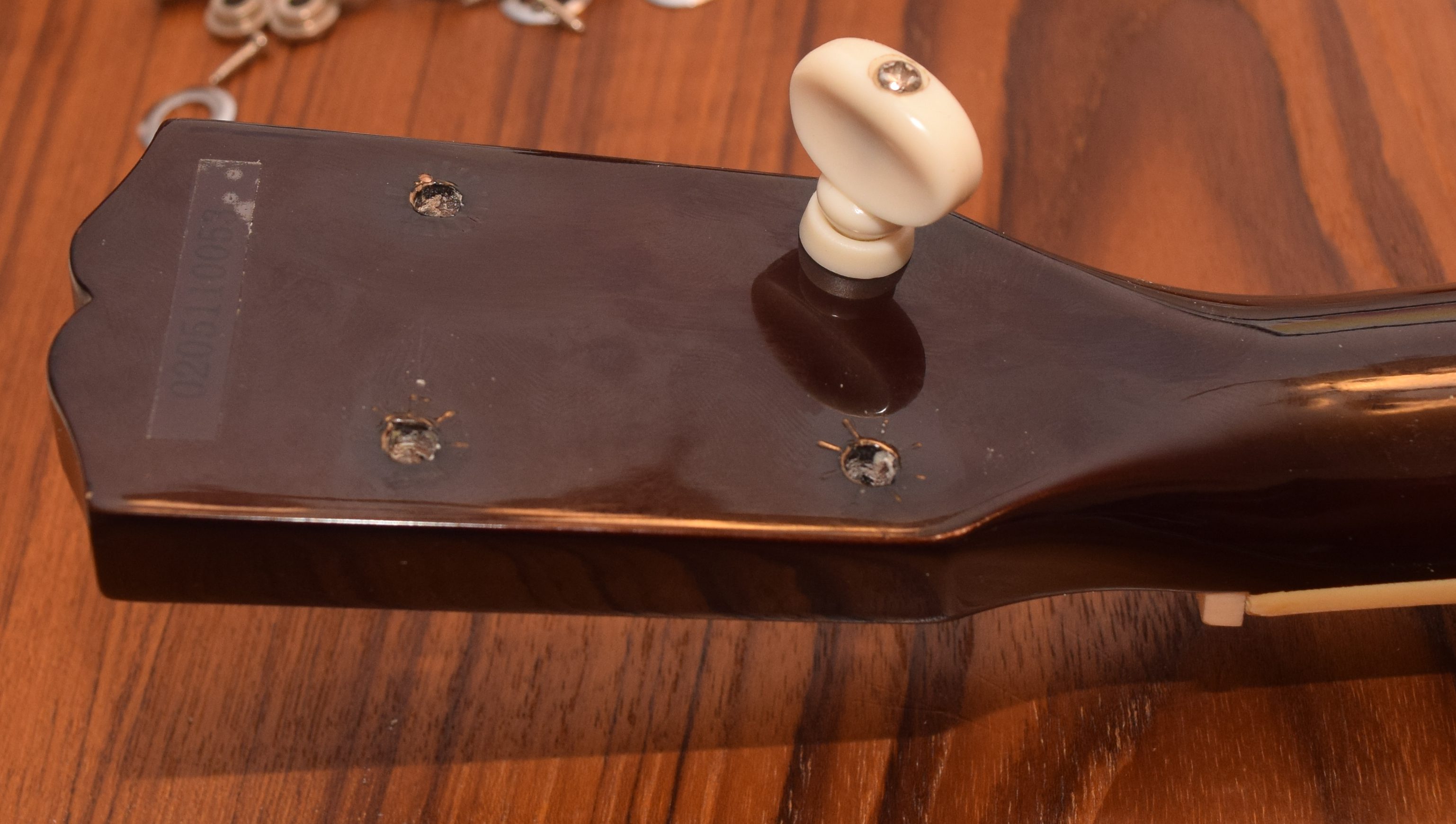
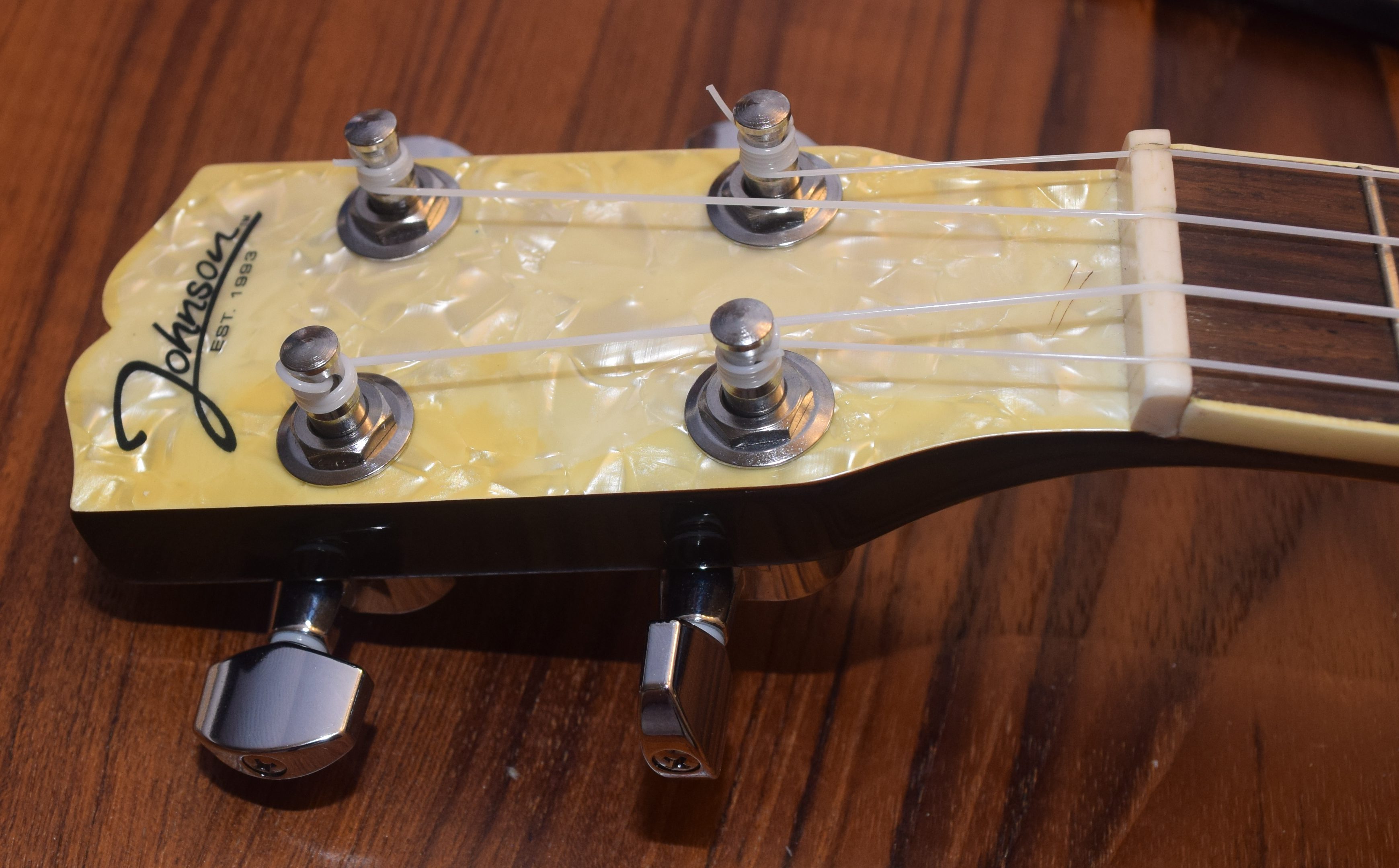
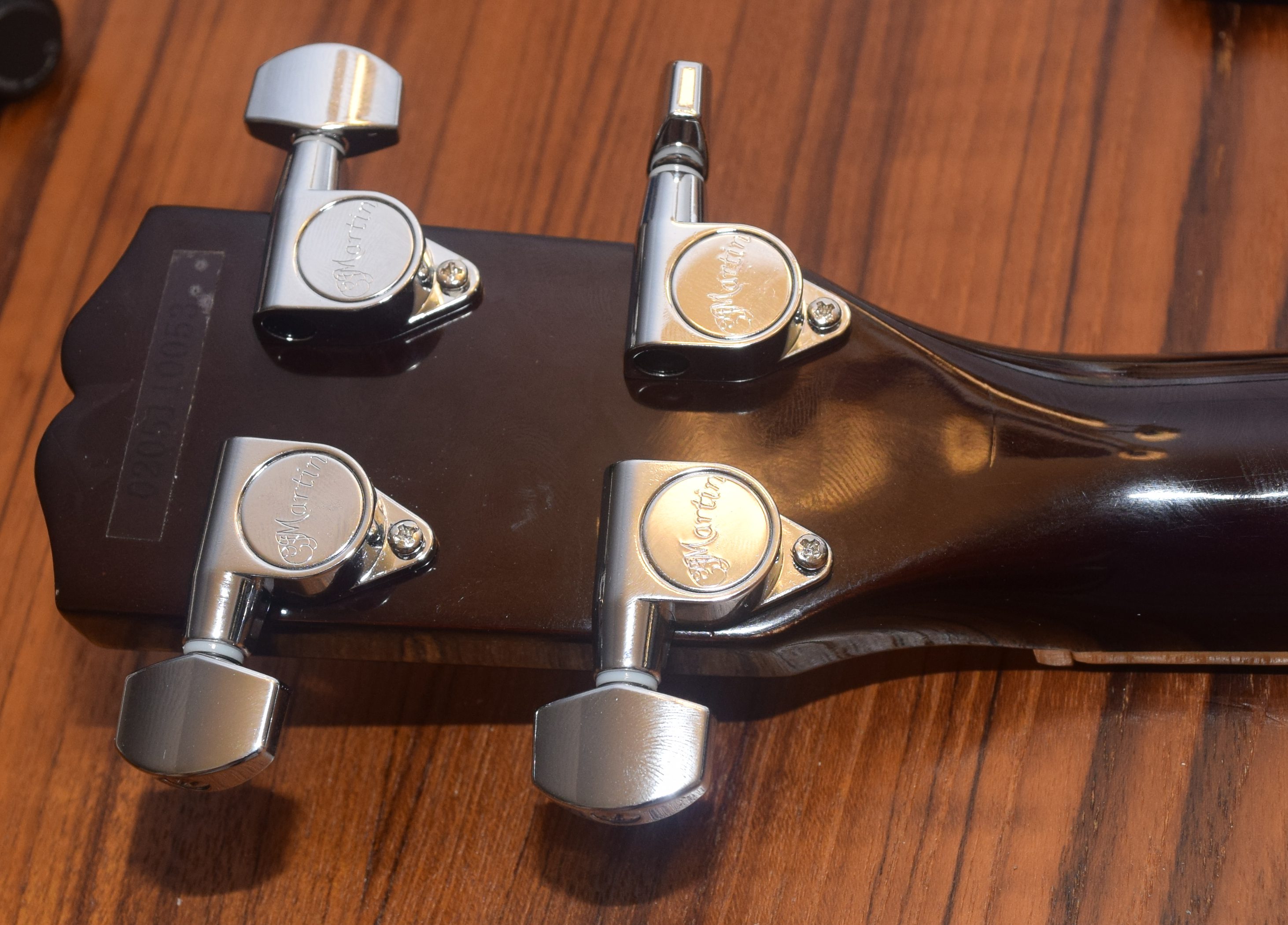
My resonator ukulele sounds really neat, but has horrible tuning pegs.  They are friction posts and get whacked out of tune every time I put them in the case.  After a lot of months of regular playing and re-tuning I decided to upgrade to geared tuners.  The old tuners are shown below and only required very small holes.

DSC_0368

DSC_0371

The holes on the top side are large enough for my new tuner to go in, but the bottom side is way too small.  The new tuner (below) has a large shoulder that must be accommodated.

DSC_0375

I carefully drilled out the backside and made sure not to break through to the front.  There was a little chip-out of the back paint.  Maybe not paint, I don’t know what it is.

DSC_0373

The chips and hole edges are easily covered by the tuner flange.  I didn’t have a drill bit small enough to pre-drill the screws included.  Instead I used an awl to push a good starting hole, and employed some screw wax to help them go in.  Everything went in smoothly with no damage to the screw heads.  After a few days the strings relaxed and everything stays nicely tuned.  Thinking about upgrading from friction to geared tuners?  Do it!

DSC_0377

DSC_0378

Bee Vacuum Box

It is time to kick up our bee rescues to another level.  We typically use a shop vac to suck up as many bees as we can.  Sometimes it works out well, sometimes we end up with a canister of pulverized bees.  I think the swirling action of most of those vacuums breaks the bees up eventually.  Enter, the bee vacuum box.

DSC_0366

DSC_0365

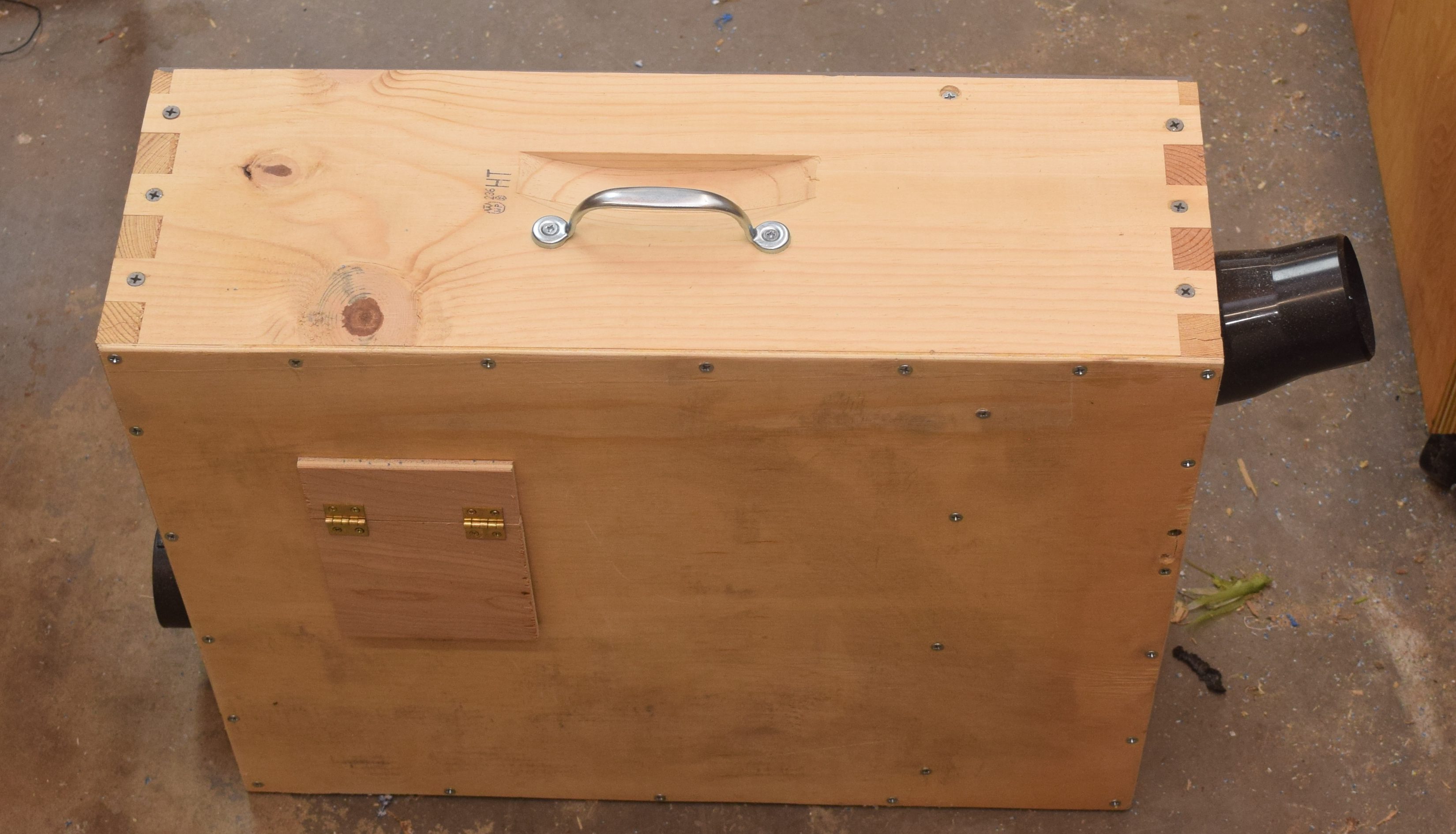
This tool goes in-between the vacuum and the hose sucking up the bees.  It catches them in a screened section that should hold them and prevent damage.


The Build

I started with an assembled medium super.  It is a good size to hold bees, and I built a lot of them a while back.  A thin scrap of plywood forms a sealed bottom of the box.  I made a small frame out of 1×2 and stapled on some 1/8th inch metal screening.  I used a lot of staples because I figured the force of thousands of bees pushing on the screen could be high.

I wanted to be able to see how many bees we had and how healthy they were.  A piece of clear acrylic sheeting across the top will be strong and allow viewing.

DSC_0341

I used a 2-1/2″ dust collection gate on the front entrance.  This should accept a standard shop vacuum hose, and can be shut once full to keep the bees from escaping.  I attached it with a lot of silicon caulking.  A standard port was screwed to the other end.  This side will go towards the vacuum.  It doesn’t need to be shut because the screen will keep the bees from getting out this way.

Once you have the bees captured you will need to let them out in their new hive.  I used more thin plywood to make a small trap door.  Tape will keep it from popping open in transport.  Once at the hive, you can just pull the tape off and let it open as you put the vacuum box down on top of the hive.  You could even completely seal the hive entrance with this method and leave the vacuum box on top for a day or two.  This will encourage them to stay and setup shop before opening the hive entrance.

All of this sounds great in theory, but has yet to be put to practice.  There is supposedly a tree that needs some bees removed from it, so we might be able to put this to the test soon.